
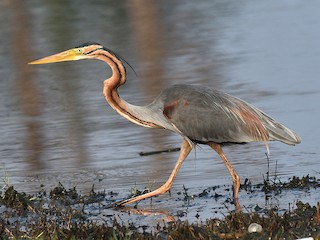
Where does the Purple Heron live?
Ardea purpurea
Spotted a bird? Identify it instantly with the Birdby app
Open the appThe Purple Heron lives in specific habitats and regions. Knowing where, and when, to look improves your chances of a successful sighting.
Biomes
Wetlands, marshes, swamps, reedbeds, lakes, slow-moving rivers, and coastal lagoons.
Geographic range
Widespread across Europe, Africa, and Asia. Breeding range extends from Western Europe and North Africa eastward through Central Asia to East Asia. Winters in tropical Africa and South Asia.
Preferred environments
Dense stands of emergent vegetation, particularly extensive reedbeds (Phragmites australis), papyrus swamps, and other tall aquatic plants. Prefers shallow water with abundant cover for hunting and nesting.
Elevation range
Typically found in lowlands, from sea level up to approximately 1,800 meters (6,000 ft), but usually below 500 meters.
Where to look
Extensive Reedbeds
The primary habitat. Look for large, undisturbed areas of Phragmites reeds along lakes, rivers, and marshes.
Swamps and Marshes
Any freshwater or brackish wetland with dense emergent vegetation provides suitable habitat.
Coastal Lagoons
In some parts of its range, it can be found in coastal brackish water bodies with ample vegetation.
Field tips
- Patience and Stealth. Purple Herons are very secretive. Find a good vantage point overlooking a reedbed and wait patiently. Use binoculars or a scope.
- Dawn and Dusk. They are often most active and visible during the early morning and late evening hours when hunting.
- Listen for Calls. Their harsh 'kraak' call can sometimes betray their presence even when hidden in dense vegetation.
- Look for Movement in Reeds. Scan the edges of reedbeds for subtle movements or glimpses of their dark plumage as they stalk prey.
- Breeding Colonies. During the breeding season, they may be more concentrated and slightly more visible around nesting sites, though still often well-hidden.
Migration
Most European and Asian populations are migratory, moving south to Africa and South Asia for the winter. African populations are largely resident or undertake local movements. Spring migration occurs from March to May, and autumn migration from August to October.
Explore the Purple Heron
Identify birds anywhere
Free on iOS, Android, and Web. Photo & sound identification, full species database, and your personal life list.