
Spotted a bird? Identify it instantly with the Birdby app
Open the appAbout
The Indian Pond Heron, also known as the Paddybird, is a small heron found in the Indian subcontinent and surrounding regions. It is a stocky species with a short neck, short thick bill, and a hunched posture. Its cryptic brown streaky plumage in non-breeding season makes it blend seamlessly with its surroundings, but it transforms dramatically into a striking white-winged bird with a chestnut back and purple-brown head and neck during the breeding season.
Size & lifespan
- Length
- 40-50 cm
- Wingspan
- 75-90 cm
- Weight
- 230-270 g
- Lifespan
- Approximately 5-8 years in the wild
- Diet
- Carnivore (primarily fish, amphibians, insects, crustaceans)
Physical characteristics
- Plumage
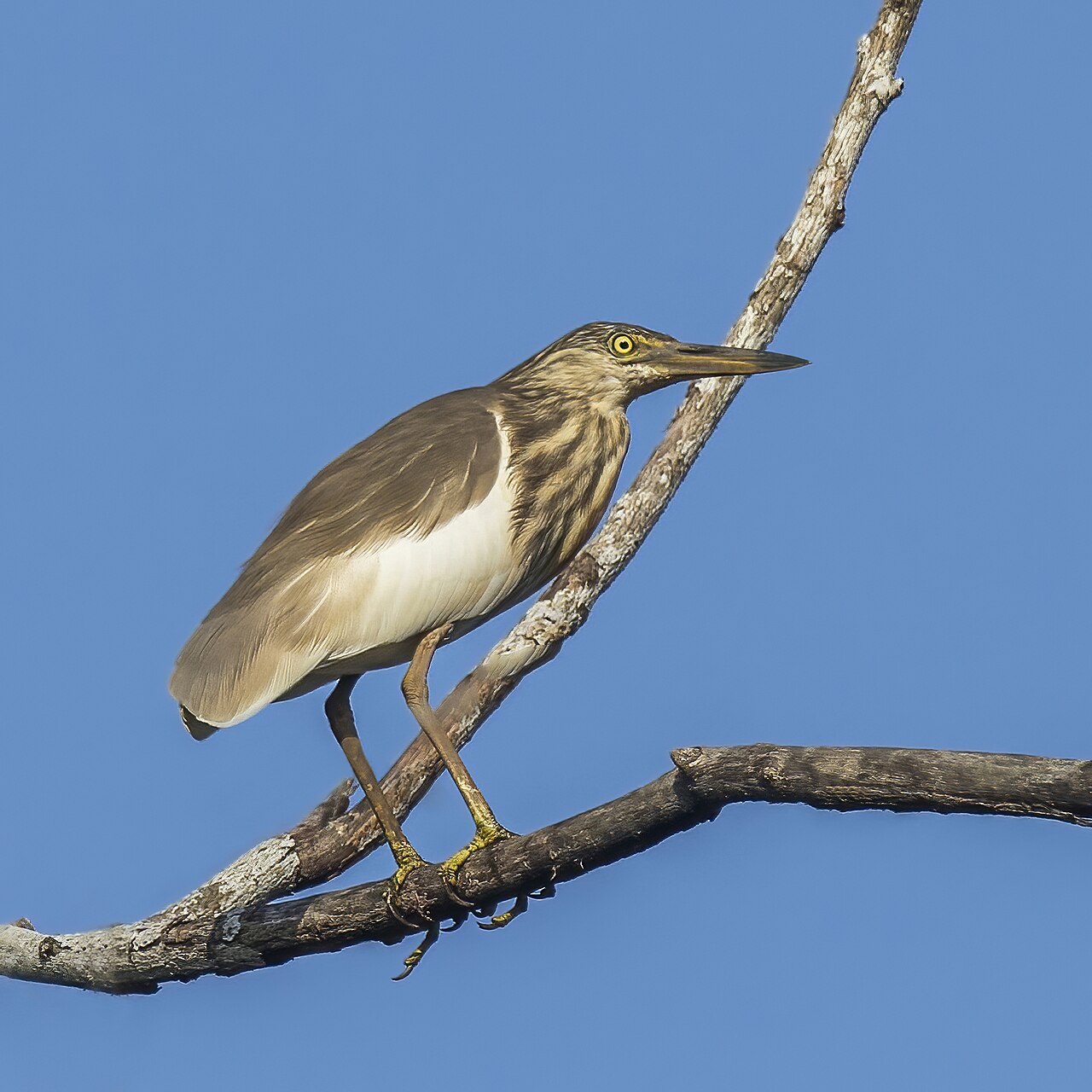
- Non-breeding plumage: Dull, streaky brown on the back, head, and neck; white underparts. Breeding plumage: Rich chestnut-brown back, deep purple-brown head and neck with elongated plumes, white wings (conspicuous in flight), and white belly. The breast plumes are buffy.
- Beak shape
- Short, thick, and pointed. Non-breeding: Yellowish-green with a dark tip. Breeding: Blue at the base, yellow in the middle, and black at the tip.
- Eye color
- Yellow
- Leg color
- Non-breeding: Dull greenish-yellow. Breeding: Bright yellow to reddish-yellow.
- Distinguishing features
- The most distinctive feature is the dramatic contrast between its drab, streaky brown appearance when perched and its brilliant white wings when in flight. The hunched posture is also characteristic.
- Juvenile appearance
- Juveniles resemble non-breeding adults but are duller, with more streaking on the breast and a less defined cap. Their bill is duller, and legs are greenish.
- Seasonal changes
- Undergoes a significant plumage change for the breeding season. The dull brown streaky plumage is replaced by rich chestnut-brown on the back, purple-brown on the head and neck with elongated plumes, and bright yellow legs and bill coloration.
- Sexual dimorphism
- Males and females are generally similar in plumage, though males may have slightly more developed breeding plumes.
How to identify
- 1
Plumage (Perched)
Look for a stocky, hunched heron with dull, streaky brown plumage on the back, head, and neck, and white underparts. It blends remarkably well with dry vegetation.
- 2
Plumage (In Flight)
The most striking identification feature: when it takes flight, the brilliant white wings contrast sharply with the brown body, making it unmistakable. This 'drab to dazzling' transformation is key.
- 3
Breeding Plumage
During the breeding season (monsoon), observe the rich chestnut-brown back, deep purple-brown head and neck with elongated plumes, and bright yellow legs and bill. This is a dramatic change from its non-breeding appearance.
- 4
Posture
Often seen standing motionless with a hunched posture, neck retracted, waiting patiently for prey.
- 5
Habitat
Typically found in shallow freshwater bodies, rice paddies, and marshes. If you see a small heron in such a habitat in the Indian subcontinent, it's likely an Indian Pond Heron.
Habitat & range
- Biomes
- Wetlands, freshwater marshes, rice paddies, ponds, lakes, rivers, canals, ditches, flooded fields, estuaries, and occasionally coastal areas.
- Geographic range
- Indian subcontinent, including India, Sri Lanka, Bangladesh, Pakistan, Nepal, Bhutan, Myanmar, and parts of Southeast Asia.
- Elevation range
- Primarily lowlands, up to approximately 1,500 meters.
- Preferred environments
- Shallow freshwater bodies with emergent vegetation, often close to human habitation. They prefer areas with muddy edges for foraging.
Behavior
- Activity time
- Diurnal, most active during early morning and late afternoon.
- Feeding habits
- A patient, solitary hunter. It typically stands motionless at the water's edge or in shallow water, waiting for prey to come within striking distance. It then lunges rapidly to catch fish, frogs, or insects. It may also walk slowly through shallow water, stirring up prey. Occasionally forages in open fields for insects.
- Social behavior
- Generally solitary when foraging, but often roosts communally in trees, sometimes with other heron species. Breeds in colonies (heronries).
- Flight pattern
- Slow, deliberate wing beats with the neck retracted into an 'S' shape, typical of herons. The bright white wings are very conspicuous against the brown body when in flight, making it easily identifiable.
- Migration pattern
- Mostly resident throughout its range, but some local movements occur, especially in response to rainfall and food availability. Northern populations may undertake short-distance migrations.
- Territoriality
- Defends a small foraging territory, especially during the breeding season, but is generally tolerant of other herons in communal roosts and breeding colonies.
Song & calls
- Song
- Generally silent outside the breeding season. No elaborate song.
- Call
- During the breeding season or when disturbed, it emits a harsh, croaking 'kwaak' or 'kraak' call. Also produces a low 'chup' or 'chok' call.
- When they vocalize
- Mainly vocal during the breeding season, especially around the nest, or when alarmed.
Breeding & reproduction
- Breeding season
- Typically May to September, coinciding with the monsoon season, but can vary regionally.
- Nesting habits
- Nests colonially in heronries, often alongside other waterbirds like Little Egrets and Cattle Egrets. The nest is a loose platform of twigs, typically placed in trees or bushes over or near water, 2-10 meters above the ground.
- Clutch size
- 3-5 eggs, occasionally 2-6.
- Egg description
- Pale greenish-blue, unmarked. Oval-shaped.
- Incubation period
- Approximately 18-24 days.
- Fledging period
- Chicks fledge (leave the nest) around 25-30 days after hatching, but remain dependent on parents for some time.
- Parental care
- Both parents participate in nest building, incubation, and feeding of the young.
Where to find
Rice Paddies
Abundant in active and fallow rice fields, especially during and after the monsoon.
Ponds and Lakes
Common around the edges of small to medium-sized ponds, lakes, and village tanks with emergent vegetation.
Marshes and Swamps
Found in various types of freshwater marshes and swampy areas.
Rivers and Canals
Along slow-moving rivers, irrigation canals, and drainage ditches.
Field tips
- Look for movement. They are often very still when foraging. Look for subtle movements of the head or a sudden lunge to catch prey.
- Observe flight. If you see a brown bird flush from the water's edge and reveal bright white wings, it's almost certainly an Indian Pond Heron. This is the easiest way to confirm identification.
- Check breeding colonies. During the breeding season, locate heronries (communal nesting sites) in trees near water. You'll see many individuals in their striking breeding plumage.
- Patience is key. Their cryptic plumage makes them hard to spot when perched. Scan the edges of water bodies carefully and patiently.
Similar species
Chinese Pond Heron
Ardeola bacchus
The Chinese Pond Heron has a greyish-black back and a darker, more rufous-chestnut head and neck in breeding plumage. Its bill is also typically darker at the tip. The Indian Pond Heron has a chestnut-brown back and a purple-brown head/neck.
Javan Pond Heron
Ardeola speciosa
The Javan Pond Heron has a golden-buff to rufous-buff head and neck, and a golden-buff back in breeding plumage, lacking the purple-brown and chestnut tones of the Indian Pond Heron. Its bill is also typically all yellow with a black tip in breeding plumage.
Squacco Heron
Ardeola ralloides
The Squacco Heron, found in Europe and Africa, has a paler, more yellowish-buff head and neck with fine streaking, and a pale buffy-brown back in breeding plumage. Its bill is also typically blue at the base with a black tip.
Quick facts
- Common Name:
- Indian Pond Heron
- Scientific Name:
- Ardeola grayii
- Family:
- Ardeidae
- Conservation Status:
- Least Concern
- Key ID Feature:
- White wings in flight, brown when perched
- Habitat:
- Shallow freshwater wetlands
- Diet:
- Fish, amphibians, insects
Fun facts
- The Indian Pond Heron is often called the 'Paddybird' due to its frequent presence in rice paddies.
- Its ability to blend into its surroundings when perched is a remarkable example of camouflage, making it almost invisible until it takes flight.
- Despite its drab appearance when still, its transformation in flight is one of the most dramatic in the bird world, often surprising first-time observers.
- They are opportunistic feeders and have been observed catching a wide variety of prey, adapting to what is available in their local environment.
Scientific classification
- Kingdom
- Animalia
- Phylum
- Chordata
- Class
- Aves
- Order
- Pelecaniformes
- Family
- Ardeidae
- Genus
- Ardeola
- Species
- Ardeola grayii
Explore the Indian Pond Heron
Identify birds anywhere
Free on iOS, Android, and Web. Photo & sound identification, full species database, and your personal life list.