
Spotted a bird? Identify it instantly with the Birdby app
Open the appAbout
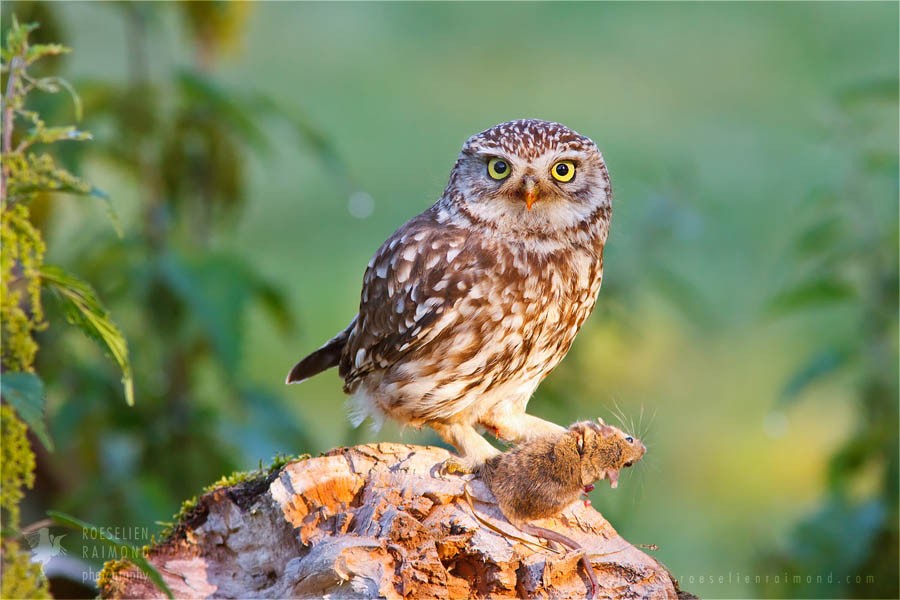
The Little Owl (Athene noctua), also known as the 'Kuvik' in some regions, is a small, compact owl with a distinctive flat-topped head and short tail. It is primarily crepuscular and nocturnal but is often seen hunting during the day, especially in open, cultivated landscapes. Known for its upright posture and 'frowning' expression, it is a widespread resident breeder across much of temperate Europe, Asia, and North Africa.
Size & lifespan
- Length
- 21-27 cm
- Wingspan
- 54-58 cm
- Weight
- 160-250 g (males), 170-280 g (females)
- Lifespan
- Up to 10-15 years in the wild, with records up to 18 years in captivity.
- Diet
- Carnivore (primarily insectivorous and rodentivorous)
Physical characteristics
- Plumage
- Upperparts are grey-brown, heavily streaked and spotted with white or pale buff. Underparts are whitish, broadly streaked with dark brown. The facial disc is not well-defined, and it lacks ear tufts. It has prominent white 'eyebrows' that give it a stern or frowning appearance.
- Beak shape
- Short, strongly hooked, and pale yellowish-horn to greenish-yellow.
- Eye color
- Bright yellow irises, giving it a piercing gaze.
- Leg color
- Feathered legs and feet, yellowish-grey claws.
- Distinguishing features
- Small size, flat-topped head, short tail, bright yellow eyes, prominent white 'eyebrows', heavily spotted and streaked plumage, and an upright stance. Often bobs its head when alert.
- Juvenile appearance
- Juveniles are similar to adults but generally have a duller, more uniform plumage with less distinct spotting and streaking. Their facial disc may appear less defined, and their 'eyebrows' less prominent.
- Seasonal changes
- No significant seasonal plumage changes. Plumage may appear slightly worn or faded towards the end of the breeding season before molting.
- Sexual dimorphism
- Females are typically slightly larger and heavier than males, but plumage differences are negligible, making visual sexing difficult in the field.
How to identify
- 1
Size and Shape
Look for a small, compact owl with a relatively flat head, short tail, and an upright posture. It often bobs its head when alert.
- 2
Plumage
Note the grey-brown upperparts heavily spotted and streaked with white/buff, and whitish underparts with broad dark streaks. The lack of ear tufts is also a key feature.
- 3
Facial Features
Observe the bright yellow eyes and the prominent white 'eyebrows' that give it a 'frowning' or stern expression. The facial disc is not strongly defined.
- 4
Behavior
Often seen perched conspicuously on posts, rocks, or buildings during the day. Its undulating flight pattern and habit of bobbing its head are good indicators.
- 5
Vocalization
Listen for its characteristic mournful 'goo-ek' or 'kiew' call, especially at dusk and dawn.
Habitat & range
- Biomes
- Temperate grasslands, agricultural lands, semi-deserts, open woodlands, rocky areas, and human-modified landscapes.
- Geographic range
- Widespread across Europe (from the Iberian Peninsula to Russia), North Africa (Morocco to Egypt), and Asia (Middle East, Central Asia, and parts of China and Korea). Introduced to New Zealand and the UK.
- Elevation range
- Typically found from sea level up to 2,000 meters, occasionally higher in some parts of its Asian range.
- Preferred environments
- Prefers open country with scattered trees, old buildings, ruins, stone walls, and rock crevices for nesting and roosting. Often found near human habitation, farms, orchards, and vineyards. Requires access to short grassland or cultivated fields for hunting.
Behavior
- Activity time
- Crepuscular and nocturnal, but frequently active and hunts during the day, particularly in overcast weather or when feeding young. Often seen perched conspicuously during daylight hours.
- Feeding habits
- Primarily hunts from a perch or by hovering. Diet consists mainly of large insects (beetles, grasshoppers, crickets), earthworms, and small mammals (voles, mice). Also takes small birds, amphibians, and reptiles. Often caches food.
- Social behavior
- Generally solitary or found in pairs during the breeding season. Highly territorial, especially around nesting sites.
- Flight pattern
- Undulating, rather direct flight with rapid wing beats, often close to the ground. Can hover briefly. When disturbed, it often flies a short distance and perches, bobbing its head.
- Migration pattern
- Mostly resident throughout its range. Northern populations may undertake short-distance dispersal movements, especially juveniles, but true long-distance migration is rare.
- Territoriality
- Highly territorial, especially during the breeding season. Pairs defend their nesting and hunting territories with vocalizations and occasional aggressive displays.
Song & calls
- Song
- The primary song is a distinctive, drawn-out, mournful 'goo-ek' or 'kiew' often repeated, sometimes with a slight tremolo. It can also produce a more rapid 'hoo-hoo-hoo' series.
- Call
- Various calls include a sharp 'kew-kew-kew' alarm call, a harsh 'chack-chack' when agitated, and a soft 'hoo' contact call. Juveniles emit a hissing begging call.
- When they vocalize
- Most vocal during the breeding season (late winter to early summer), particularly at dusk and dawn, but can be heard throughout the night and occasionally during the day.
Breeding & reproduction
- Breeding season
- Typically March to July, with peak egg-laying in April-May.
- Nesting habits
- Nests in cavities, often in old trees (especially fruit trees), rock crevices, abandoned buildings, ruins, stone walls, rabbit burrows, or artificial nest boxes. Does not build a nest, laying eggs directly on the substrate.
- Clutch size
- 3-5 eggs, occasionally 2-8.
- Egg description
- White, smooth, and glossy, typically oval to round. Average size is about 34 x 29 mm.
- Incubation period
- 28-29 days, primarily by the female.
- Fledging period
- Young fledge at around 30-35 days after hatching, but remain dependent on parents for several weeks.
- Parental care
- Female incubates and broods, while the male provides food. Both parents feed the young after hatching.
Where to find
Agricultural Areas
Look in open farmland, orchards, vineyards, and pastures with scattered trees or old buildings.
Old Buildings and Ruins
Check abandoned farmhouses, barns, churches, and ancient ruins, as these provide ideal nesting and roosting sites.
Rocky Outcrops and Quarries
In more natural settings, they can be found in areas with rock crevices and small caves.
Parks and Gardens
Occasionally found in suburban parks or large gardens, especially if they contain old trees or suitable structures.
Field tips
- Daytime Observation. Unlike many owls, Little Owls are often active during the day. Scan fence posts, telegraph poles, low branches, and prominent rocks for perched individuals.
- Listen for Calls. Their distinctive calls are often the first indication of their presence, especially at dusk and dawn. Learn to recognize the 'goo-ek' call.
- Look for Pellets. Check around potential roosting sites (e.g., under old trees, ledges in ruins) for owl pellets, which are regurgitated indigestible remains of prey.
- Use Binoculars. Their small size and cryptic plumage can make them hard to spot without optical aid, even when perched in the open.
Similar species
Tawny Owl
Strix aluco
Tawny Owls are significantly larger (37-43 cm), lack yellow eyes, have a more rounded head, and a more cryptic, bark-like plumage pattern. They are strictly nocturnal and typically inhabit denser woodlands.
Eurasian Pygmy Owl
Glaucidium passerinum
Eurasian Pygmy Owls are much smaller (16-18 cm), have a more compact body, and lack the prominent 'eyebrows' of the Little Owl. They have a more rapid, direct flight and often hunt during the day in coniferous forests.
Short-eared Owl
Asio flammeus
Short-eared Owls are larger (34-43 cm), have long wings, a buoyant, moth-like flight, and typically inhabit open grasslands and marshes. They have small ear tufts (often not visible) and a streaked breast, but lack the Little Owl's flat head and bright yellow eyes with prominent white brows.
Quick facts
- Diet:
- Insects, small mammals, small birds
- Habitat:
- Open country, farmland, ruins, rocky areas
- Activity:
- Crepuscular, nocturnal, often diurnal
- Status:
- Least Concern
- Distinguishing Feature:
- Flat head, yellow eyes, white 'eyebrows'
Fun facts
- The Little Owl is strongly associated with the Greek goddess Athena, symbolizing wisdom, and is often depicted on ancient Greek coins.
- Despite its small size, it is a fierce predator and will readily tackle prey larger than itself.
- Little Owls often cache surplus food in their nesting or roosting cavities, or in nearby crevices.
- They are known for their characteristic head-bobbing and bowing movements when alert or agitated.
- The species was introduced to Great Britain in the late 19th century and has since established a thriving population.
Scientific classification
- Kingdom
- Animalia
- Phylum
- Chordata
- Class
- Aves
- Order
- Strigiformes
- Family
- Strigidae
- Genus
- Athene
- Species
- Athene noctua
Explore the Little Owl
Identify birds anywhere
Free on iOS, Android, and Web. Photo & sound identification, full species database, and your personal life list.