
Spotted a bird? Identify it instantly with the Birdby app
Open the appAbout
The Cattle Egret is a cosmopolitan species of heron (family Ardeidae) found in the tropics, subtropics, and warm temperate zones. It is the only member of the genus Bubulcus. It is a small, stocky white heron, often seen foraging in dry, grassy fields alongside livestock, from which it gets its name. Its global expansion is one of the most spectacular avian colonizations in recent history.
Size & lifespan
- Length
- 46-56 cm (18-22 in)
- Wingspan
- 88-96 cm (35-38 in)
- Weight
- 270-510 g (9.5-18 oz)
- Lifespan
- Up to 15 years in the wild
- Diet
- Carnivore (primarily insectivore)
Physical characteristics
- Plumage
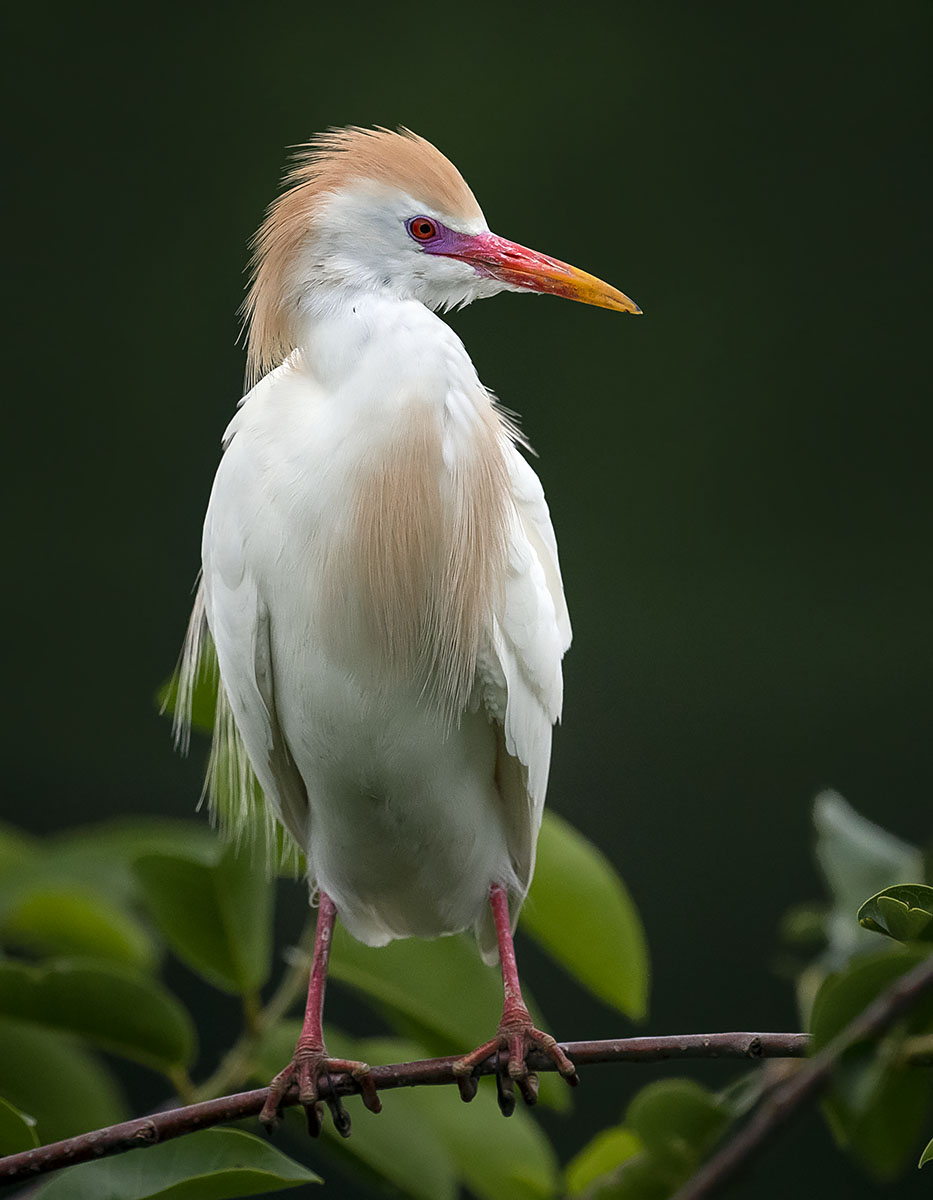
- Non-breeding adults are entirely white with a yellow bill and dusky yellowish-green legs. Breeding adults develop buff-orange plumes on the crown, nape, back, and breast. The extent and intensity of these plumes vary geographically and individually.
- Beak shape
- Relatively short, stout, and pointed bill. Yellow in non-breeding plumage, becoming orange-red during breeding.
- Eye color
- Yellow iris, becoming bright red or orange-red during breeding.
- Leg color
- Dusky yellowish-green to greenish-black in non-breeding adults, turning bright red or orange-red during breeding.
- Distinguishing features
- Stocky build, short neck (often held hunched), and a relatively short, thick bill. Its association with livestock is a key behavioral identifier. The buffy breeding plumes are distinctive.
- Juvenile appearance
- Juveniles are entirely white with a blackish bill and dull greenish-black legs. They lack any buffy plumes. Their bill gradually changes from blackish to yellow.
- Seasonal changes
- During the breeding season (typically spring and summer in temperate zones), adults develop distinctive buff-orange plumes on the crown, nape, back, and breast. The bill, legs, and irises also change color, becoming brighter orange-red or red. Outside the breeding season, they revert to plain white plumage with a yellow bill and dusky yellowish-green legs.
- Sexual dimorphism
- Males and females are generally similar in appearance, though males may be slightly larger and have more extensive or brighter breeding plumes. During courtship, males may display more intense bill and leg coloration.
How to identify
- 1
Size and Shape
Look for a relatively small, stocky white heron with a short neck (often hunched) and a somewhat stout bill. It appears more compact than other egrets.
- 2
Plumage (Non-breeding)
Entirely white body, yellow bill, and dusky yellowish-green legs. No fancy plumes.
- 3
Plumage (Breeding)
Distinctive buff-orange plumes on the crown, nape, back, and breast. The bill, legs, and eyes become brighter orange-red or red. This is the most definitive field mark during the breeding season.
- 4
Behavior
Often seen foraging in dry, grassy fields, pastures, or agricultural areas, frequently alongside grazing livestock (cattle, horses) or farm machinery. This behavior is unique among egrets.
- 5
Bill and Leg Color
Yellow bill and dusky yellowish-green legs in non-breeding adults. These colors change to orange-red/red during breeding, which is a key distinction from other white egrets.
Habitat & range
- Biomes
- Grasslands, savannas, agricultural fields, pastures, wetlands (edges), and open woodlands.
- Geographic range
- Nearly cosmopolitan. Native to Africa, Asia, and Europe. Colonized the Americas in the late 19th/early 20th century and Australia in the mid-20th century. Found across most tropical and subtropical regions globally, extending into warm temperate zones.
- Elevation range
- Primarily lowlands, from sea level up to approximately 2,000 meters (6,500 feet), though less common at higher altitudes.
- Preferred environments
- Open, grassy habitats, especially those with grazing livestock (cattle, horses, sheep) or agricultural machinery that disturb insects. Also found near ponds, marshes, and rice paddies, but generally prefers drier habitats than most other egrets.
Behavior
- Activity time
- Diurnal, actively foraging during daylight hours.
- Feeding habits
- Primarily insectivorous, feeding on a wide variety of insects, especially grasshoppers, crickets, flies, and beetles. Also consumes spiders, frogs, lizards, small snakes, and occasionally fish. It is famous for its commensal relationship with large grazing mammals, following them to catch insects flushed by their movement. It also forages behind agricultural machinery.
- Social behavior
- Highly social, especially outside the breeding season. Forages in loose flocks, often mixed with other wading birds. Roosts communally in large numbers, sometimes thousands, often with other heron species. Breeds colonially in mixed-species heronries.
- Flight pattern
- Direct and steady flight with relatively shallow wing beats. Neck is typically retracted in an 'S' shape, and legs trail behind the body, extending beyond the tail. Often flies in V-formations or lines when commuting to roosts.
- Migration pattern
- Many populations are migratory, particularly those in temperate regions, moving to warmer climates for winter. Tropical populations are often resident or undertake local dispersive movements. The species is known for its strong dispersal capabilities, which have facilitated its global expansion.
- Territoriality
- Generally not territorial in foraging areas, often feeding in close proximity to conspecifics and other species. However, pairs defend a small area around their nest within the breeding colony.
Song & calls
- Song
- Cattle Egrets do not have a complex song. Vocalizations are generally limited to harsh, croaking, or guttural calls, primarily given during breeding season or when disturbed.
- Call
- Common calls include a harsh, raspy 'rick-rack' or 'kwaark' given in colonies, during courtship, or when agitated. A softer 'r-r-r-r-r' or 'ch-ch-ch' may be heard during greeting displays. They are generally quiet outside the breeding season.
- When they vocalize
- Most vocal during the breeding season within colonies, particularly during pair formation, nest building, and when interacting with chicks. Less vocal when foraging or outside the breeding season.
Breeding & reproduction
- Breeding season
- Varies geographically, typically coinciding with the rainy season or periods of abundant insect prey. In North America, generally April to July. In tropical regions, it can be year-round or tied to specific rainfall patterns.
- Nesting habits
- Nests colonially, often in large, mixed-species heronries, typically in trees or shrubs over water or in dense vegetation. The nest is a flimsy platform of sticks, reeds, or other vegetation, built by both parents.
- Clutch size
- 2-6 eggs
- Egg description
- 2-6 (typically 3-5) pale blue or greenish-blue, unmarked eggs. Oval to sub-elliptical in shape.
- Incubation period
- 22-26 days, incubated by both parents.
- Fledging period
- Chicks fledge (leave the nest) at about 30-40 days, but remain dependent on parents for several weeks thereafter.
- Parental care
- Both parents participate in nest building, incubation, and feeding of the young. Chicks are altricial (helpless at hatching) and require extensive parental care.
Where to find
Pastures and Agricultural Fields
The most reliable places to find Cattle Egrets, especially where cattle or other livestock are grazing. They follow animals to catch flushed insects.
Wetland Edges and Marshes
While preferring drier habitats, they can also be found at the edges of wetlands, ponds, and rice paddies, particularly if there are open grassy areas nearby.
Roadsides
Often seen foraging in ditches and grassy verges along roads, especially in rural areas.
Roosts and Colonies
During non-breeding season, look for large communal roosts in trees, often near water. During breeding, locate mixed-species heronries in trees or dense shrubs.
Field tips
- Look for Livestock. If you see cattle or horses in a field, scan the ground around them for small white birds. Cattle Egrets are almost always associated with grazing animals.
- Observe Foraging Behavior. Watch for birds walking close to animals, darting to catch insects disturbed by their hooves. They also follow tractors and other farm equipment.
- Check for Breeding Plumage. During spring and summer, look for the distinctive buff-orange patches on the head, back, and breast, and the bright red/orange bill and legs, which make identification easier.
- Visit Communal Roosts. At dawn or dusk, observe large trees or stands of vegetation near water, where they gather in large numbers to roost, often with other heron species.
Similar species
Snowy Egret
Egretta thula
Snowy Egrets are more slender, have a black bill, black legs with bright yellow feet ('golden slippers'), and delicate lacy plumes on the head, neck, and back during breeding. They typically forage in water, not dry fields.
Great Egret
Ardea alba
Great Egrets are significantly larger, have a longer neck, a longer, dagger-like yellow bill (which turns black during breeding in some populations), and black legs and feet. They also forage primarily in water.
Little Egret
Egretta garzetta
Little Egrets are similar in size but have a black bill, black legs, and yellow feet. They also possess two long nuchal plumes during breeding. They are more aquatic in their foraging habits.
Quick facts
- Global Distribution:
- Cosmopolitan (Africa, Asia, Europe, Americas, Australia)
- Diet:
- Mainly insects (grasshoppers, crickets)
- Habitat:
- Open grasslands, pastures, agricultural fields
- Key Behavior:
- Forages with livestock
- Breeding Plumage:
- Buff-orange plumes, red bill/legs/eyes
Fun facts
- The Cattle Egret is one of the most successful avian colonizers in history, having spread naturally from its Old World origins to the Americas and Australia within the last century.
- Its scientific name, Bubulcus ibis, literally means 'ox heron' or 'cattle ibis', reflecting its close association with large grazing animals.
- Cattle Egrets have been observed riding on the backs of cattle, not just for a free ride, but also to gain a better vantage point for spotting insects.
- They are known to follow agricultural machinery, such as plows and mowers, to feed on insects and other small animals disturbed by the equipment.
- Despite being a heron, its diet is far less aquatic than most other heron species, focusing heavily on terrestrial insects.
Scientific classification
- Kingdom
- Animalia
- Phylum
- Chordata
- Class
- Aves
- Order
- Pelecaniformes
- Family
- Ardeidae
- Genus
- Bubulcus
- Species
- Bubulcus ibis
Explore the Cattle Egret
Identify birds anywhere
Free on iOS, Android, and Web. Photo & sound identification, full species database, and your personal life list.