
Spotted a bird? Identify it instantly with the Birdby app
Open the appAbout
The Red-shouldered Hawk is a medium-sized hawk of the genus Buteo, characterized by its distinctive reddish-brown barring on the underparts and rufous shoulders. It is a woodland raptor, often found near water, and is known for its loud, piercing calls.
Size & lifespan
- Length
- 38-58 cm (15-23 in)
- Wingspan
- 90-127 cm (35-50 in)
- Weight
- 475-950 g (1.0-2.1 lbs)
- Lifespan
- Up to 19 years in the wild, typically 10-12 years.
- Diet
- Carnivore, primarily preying on small mammals, amphibians, reptiles, and occasionally birds and large insects.
Physical characteristics
- Plumage
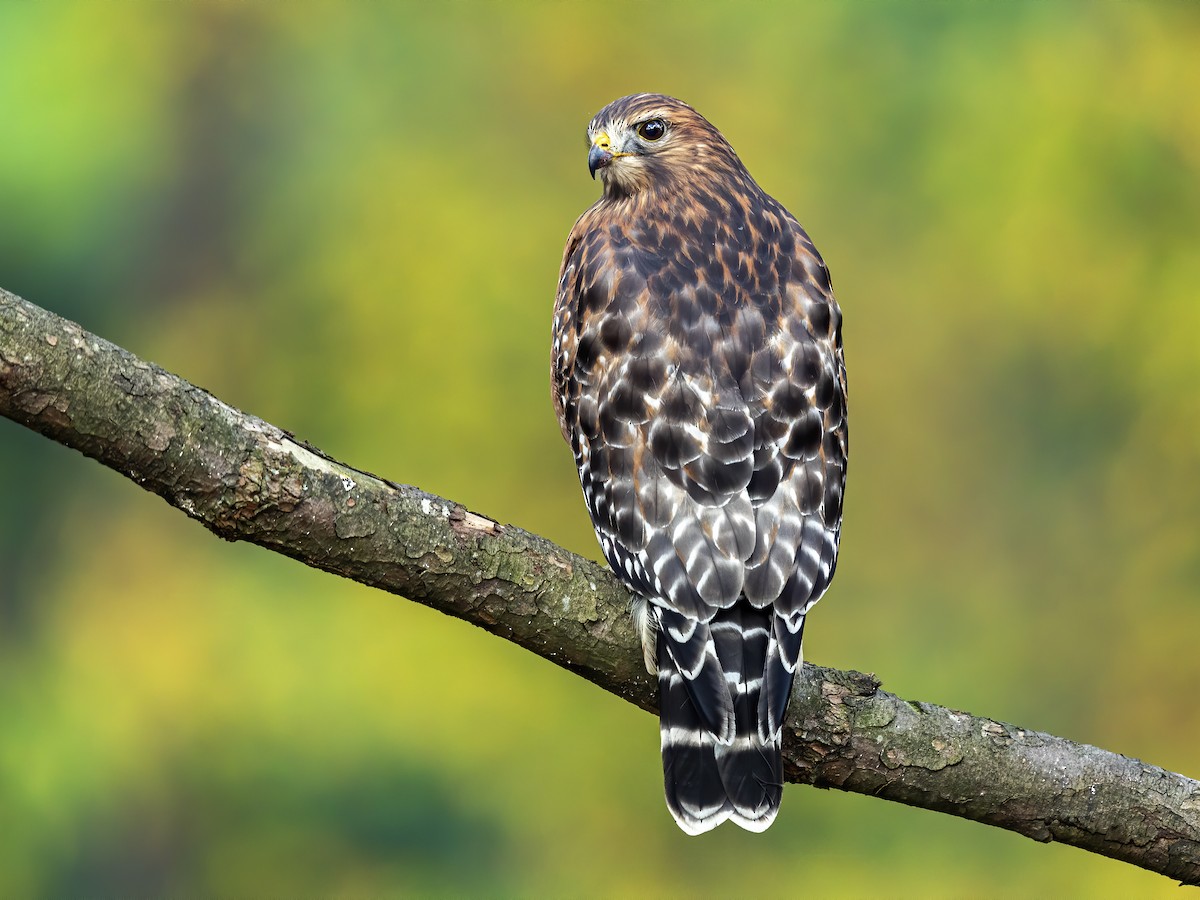
- Adults have reddish-brown barring on the underparts, rufous shoulders (visible when perched), and a black-and-white banded tail. The upperparts are dark brown with white mottling. Flight feathers are barred with black and white, creating a distinctive translucent crescent near the wingtips when viewed from below. Juveniles are streaked brown on the underparts, lack the rufous shoulders, and have a more narrowly banded tail.
- Beak shape
- Strong, hooked beak, dark gray to black with a yellow cere.
- Eye color
- Adults have dark brown eyes; juveniles have lighter, yellowish-brown eyes.
- Leg color
- Yellow
- Distinguishing features
- Rufous shoulders, reddish-brown barring on belly, black-and-white banded tail, and translucent crescents near wingtips in flight. Distinctive 'kee-aah' call.
- Juvenile appearance
- Juveniles have streaked brown underparts, a less distinctly banded tail (often with more narrow, irregular bands), and lack the prominent rufous shoulders of adults. Their eyes are also lighter.
- Seasonal changes
- No significant seasonal plumage changes; plumage remains consistent year-round after reaching adult coloration.
- Sexual dimorphism
- Females are typically 10-20% larger and heavier than males, but plumage is similar.
How to identify
- 1
Plumage (Adult)
Look for the reddish-brown barring on the breast and belly, and the distinctive rufous (reddish) patches on the shoulders when perched. The tail is black with several narrow white bands.
- 2
Plumage (Juvenile)
Juveniles have streaked brown underparts and a more narrowly banded tail. They lack the rufous shoulders and strong reddish barring of adults.
- 3
In Flight
Observe the translucent, crescent-shaped patches near the wingtips when soaring or gliding. The black-and-white banded tail is also prominent. Wings are broad and rounded.
- 4
Vocalization
Listen for its characteristic loud, piercing 'kee-aah' or 'kee-yer' calls, often repeated several times. This is one of the most reliable identification features.
- 5
Habitat
They prefer mature woodlands, especially near water. If you're in such an environment and hear the distinctive call, it's likely a Red-shouldered Hawk.
Habitat & range
- Biomes
- Deciduous and mixed deciduous-coniferous forests, riparian woodlands, swamps, and suburban areas with mature trees.
- Geographic range
- Eastern North America, from southern Canada south to Florida and the Gulf Coast, and along the Pacific coast in California and Baja California. Absent from the central Great Plains.
- Elevation range
- Typically found from sea level up to approximately 1,500 meters (5,000 feet), though occasionally higher in some western populations.
- Preferred environments
- Mature woodlands with an open understory, often near water sources such as rivers, streams, ponds, or swamps. They prefer areas with a mosaic of forest and open spaces for hunting.
Behavior
- Activity time
- Diurnal, active during daylight hours.
- Feeding habits
- Primarily a perch-and-pounce predator, hunting from a concealed perch and swooping down on prey. Also hunts while soaring or flying low through the forest. Diet includes small mammals (voles, mice, shrews), amphibians (frogs, salamanders), reptiles (snakes, lizards), large insects, and occasionally small birds.
- Social behavior
- Generally solitary outside of the breeding season. During breeding, pairs are monogamous and highly territorial, defending their nesting area from other raptors.
- Flight pattern
- Often soars on thermals with wings held in a slight dihedral. When flapping, the wingbeats are relatively shallow and quick. Known for its distinctive 'rowing' flight pattern when moving between perches. Translucent crescents near the wingtips are a key field mark in flight.
- Migration pattern
- Northern populations are migratory, moving south for the winter. Southern populations are largely resident year-round. Migrants typically move along coastlines and mountain ridges, though less concentrated than some other raptors.
- Territoriality
- Highly territorial, especially during the breeding season. Pairs will actively defend their nesting and foraging territories from other raptors and potential threats.
Song & calls
- Song
- Not a songbird; its vocalizations are calls.
- Call
- A distinctive, loud, and piercing series of 'kee-aah' or 'kee-yer' notes, often described as sounding like 'kill-dee-er, kill-dee-er, kill-dee-er'. This call is often mimicked by Blue Jays. Also has softer 'kew-kew-kew' calls.
- When they vocalize
- Most vocal during the breeding season, especially when establishing territories, during courtship, and when defending the nest. Also calls frequently when soaring or disturbed.
Breeding & reproduction
- Breeding season
- Typically March to July, with peak egg-laying in April.
- Nesting habits
- Nests are built high in the canopy of deciduous trees, often near the main trunk or in a major fork. Nests are bulky structures made of sticks, twigs, bark, and moss, lined with softer materials like lichens, leaves, and feathers. Both parents contribute to nest building.
- Clutch size
- 2-5 eggs
- Egg description
- 2-5 eggs, typically 3-4. Eggs are dull white or pale bluish-white, often sparsely marked with brown or purplish spots and blotches.
- Incubation period
- 28-33 days, primarily by the female, with the male providing food.
- Fledging period
- 39-45 days after hatching. Young remain dependent on parents for several weeks after fledging.
- Parental care
- Both parents participate in raising the young. The female primarily incubates and broods, while the male provides most of the food. After hatching, both parents hunt and feed the nestlings.
Where to find
Mature Deciduous Forests
Look in older forests with a mix of tree species, particularly those with tall trees for nesting and perching.
Riparian Zones
Areas along rivers, streams, and wetlands are prime habitats due to the availability of water and prey.
Swamps and Floodplains
These wet woodland environments provide abundant amphibians and reptiles, a key food source.
Suburban Woodlands
In some areas, they adapt to suburban environments with large, mature trees and nearby green spaces.
Field tips
- Listen for Calls. Their loud, distinctive calls are often the first indication of their presence. Learn to recognize the 'kee-aah' call.
- Scan Tree Canopies. They often perch high in trees, especially near the edges of clearings or along waterways, waiting for prey.
- Watch for Soaring. Look for them soaring overhead, particularly on warm days, using thermals. Pay attention to the translucent wing crescents.
- Check Near Water. Focus your search efforts in woodlands adjacent to water bodies, as these are preferred hunting grounds.
Similar species
Broad-winged Hawk
Buteo platypterus
Broad-winged Hawks are smaller and stockier, with a single broad white band on a dark tail (adults). Juveniles have streaked underparts but lack the rufous shoulders and translucent wing crescents of Red-shouldered Hawks. Their call is a high-pitched, whistled 'pee-teee'.
Red-tailed Hawk
Buteo jamaicensis
Red-tailed Hawks are larger and bulkier, with a diagnostic rufous tail (adults). They lack the reddish barring on the underparts and the translucent wing crescents. Their call is a harsh, descending 'kree-eee-ar'.
Cooper's Hawk
Accipiter cooperii
Cooper's Hawks are accipiters, with shorter, rounded wings and a longer tail. They have a different flight style (flap-flap-glide) and lack the broad wings and soaring behavior of Buteos. Adults have blue-gray upperparts and reddish barring on the underparts, but lack the rufous shoulders and distinct tail banding of Red-shouldered Hawks. Their head projects further forward in flight.
Quick facts
- Diet:
- Small mammals, amphibians, reptiles, insects
- Habitat:
- Mature woodlands, riparian forests, swamps
- Call:
- Loud, piercing 'kee-aah' or 'kee-yer'
- Distinguishing Mark:
- Rufous shoulders, reddish-barred underparts, translucent wing crescents
- Migration:
- Northern populations migratory, southern populations resident
Fun facts
- The Red-shouldered Hawk's call is frequently mimicked by Blue Jays, which can sometimes lead to misidentification.
- They are one of the few raptors that regularly prey on snakes and frogs, especially in wetland habitats.
- Despite their relatively small size for a Buteo, they are fierce defenders of their nests and will aggressively mob intruders, including humans.
- The western subspecies (B. l. elegans) found in California is often more brightly colored than its eastern counterparts.
Scientific classification
- Kingdom
- Animalia
- Phylum
- Chordata
- Class
- Aves
- Order
- Accipitriformes
- Family
- Accipitridae
- Genus
- Buteo
- Species
- Buteo lineatus
Explore the Red-shouldered Hawk
Identify birds anywhere
Free on iOS, Android, and Web. Photo & sound identification, full species database, and your personal life list.