
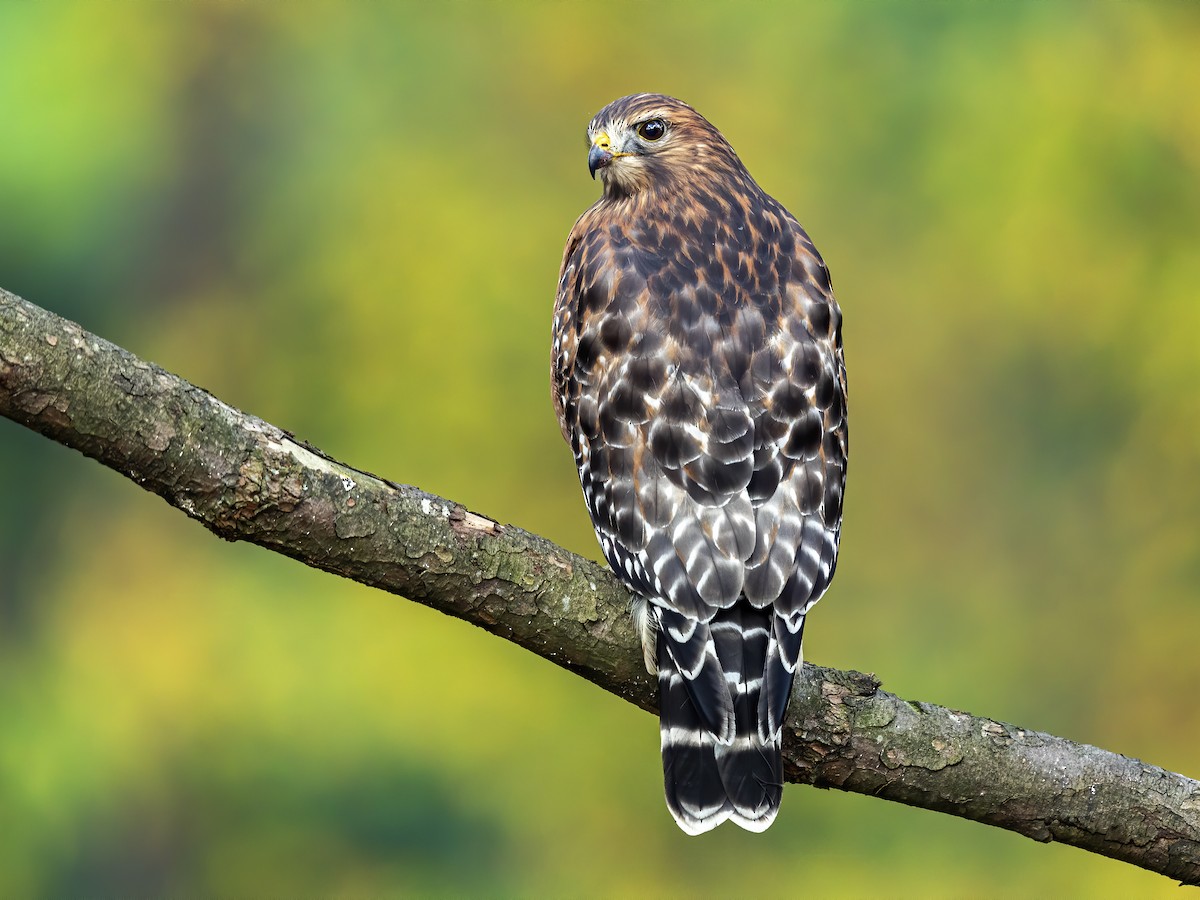
How to identify the Red-shouldered Hawk
Buteo lineatus
Spotted a bird? Identify it instantly with the Birdby app
Open the appTo correctly identify the Red-shouldered Hawk (Buteo lineatus), check each of these features. Birds can be tricky: habit, habitat, and call often confirm a sighting that a single photo cannot.
Size at a glance
- Length
- 38-58 cm (15-23 in)
- Wingspan
- 90-127 cm (35-50 in)
- Weight
- 475-950 g (1.0-2.1 lbs)
Physical features to check
- 1
Plumage
Overall feather coloration and pattern.
Adults have reddish-brown barring on the underparts, rufous shoulders (visible when perched), and a black-and-white banded tail. The upperparts are dark brown with white mottling. Flight feathers are barred with black and white, creating a distinctive translucent crescent near the wingtips when viewed from below. Juveniles are streaked brown on the underparts, lack the rufous shoulders, and have a more narrowly banded tail.
- 2
Beak shape
Shape and color of the bill: a key field mark.
Strong, hooked beak, dark gray to black with a yellow cere.
- 3
Eye color
Iris color and any distinctive eye markings.
Adults have dark brown eyes; juveniles have lighter, yellowish-brown eyes.
- 4
Leg color
Leg and foot color.
Yellow
- 5
Distinguishing features
Standout features that separate this species.
Rufous shoulders, reddish-brown barring on belly, black-and-white banded tail, and translucent crescents near wingtips in flight. Distinctive 'kee-aah' call.
- 6
Juvenile appearance
How young birds differ from adults.
Juveniles have streaked brown underparts, a less distinctly banded tail (often with more narrow, irregular bands), and lack the prominent rufous shoulders of adults. Their eyes are also lighter.
- 7
Seasonal changes
Plumage variation between breeding and non-breeding seasons.
No significant seasonal plumage changes; plumage remains consistent year-round after reaching adult coloration.
- 8
Sexual dimorphism
How males and females differ.
Females are typically 10-20% larger and heavier than males, but plumage is similar.
Key field marks
- Plumage (Adult). Look for the reddish-brown barring on the breast and belly, and the distinctive rufous (reddish) patches on the shoulders when perched. The tail is black with several narrow white bands.
- Plumage (Juvenile). Juveniles have streaked brown underparts and a more narrowly banded tail. They lack the rufous shoulders and strong reddish barring of adults.
- In Flight. Observe the translucent, crescent-shaped patches near the wingtips when soaring or gliding. The black-and-white banded tail is also prominent. Wings are broad and rounded.
- Vocalization. Listen for its characteristic loud, piercing 'kee-aah' or 'kee-yer' calls, often repeated several times. This is one of the most reliable identification features.
- Habitat. They prefer mature woodlands, especially near water. If you're in such an environment and hear the distinctive call, it's likely a Red-shouldered Hawk.
Explore the Red-shouldered Hawk
Identify birds anywhere
Free on iOS, Android, and Web. Photo & sound identification, full species database, and your personal life list.