
Spotted a bird? Identify it instantly with the Birdby app
Open the appAbout
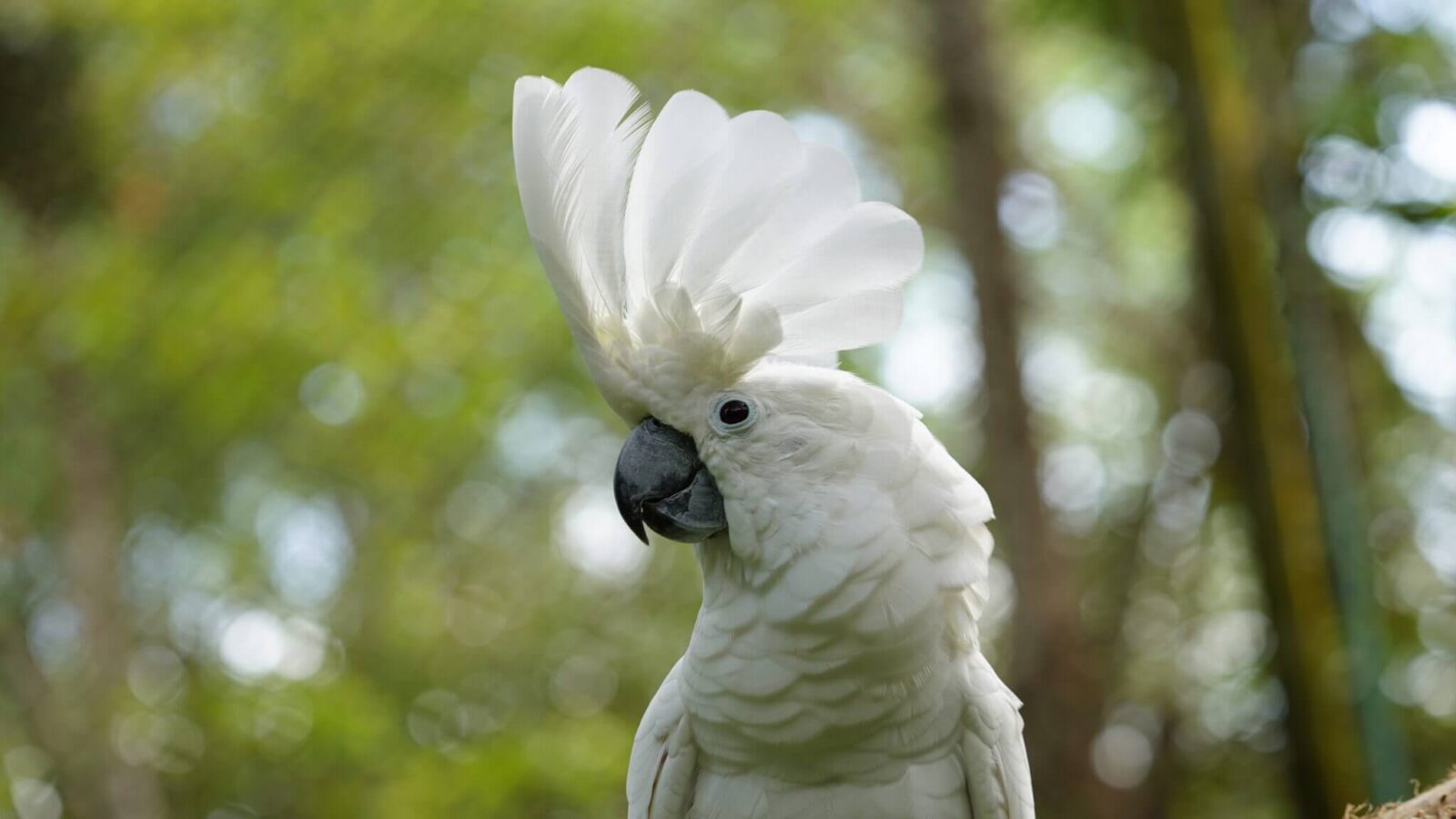
The Umbrella Cockatoo, also known as the White Cockatoo, is a medium-sized, all-white parrot endemic to the islands of Indonesia. Renowned for its large, expressive crest that it raises when excited or alarmed, it is a highly intelligent and social bird.
Size & lifespan
- Length
- 43-50 cm (17-20 in)
- Wingspan
- 80-90 cm (31-35 in)
- Weight
- 400-800 g (0.9-1.8 lbs)
- Lifespan
- 40-60 years in the wild, up to 80 years in captivity
- Diet
- Herbivore (primarily granivorous and frugivorous)
Physical characteristics
- Plumage
- Entirely white plumage, with a pale yellow wash on the underside of the wings and tail feathers, visible during flight or when the wings are spread. The most striking feature is the large, erectile crest of white feathers on its head.
- Beak shape
- Large, powerful, dark grey to black beak, strongly curved for cracking nuts and seeds.
- Eye color
- Males typically have dark brown to black eyes; females often have reddish-brown eyes.
- Leg color
- Dark grey to black
- Distinguishing features
- The prominent, broad, umbrella-like crest that can be raised and lowered. The pale yellow wash on the underwings and undertail is a key field mark.
- Juvenile appearance
- Juveniles resemble adults but may have slightly duller plumage and a less developed crest. Their eyes are typically dark brown, similar to adult males, making sexing by eye color unreliable until maturity.
- Seasonal changes
- No significant seasonal plumage changes. Plumage remains consistently white throughout the year.
- Sexual dimorphism
- Subtle sexual dimorphism exists primarily in eye color (males dark brown/black, females reddish-brown), though this can be difficult to discern in the field. Females may also be slightly smaller on average.
How to identify
- 1
Plumage Color
Look for an entirely white body plumage. Any strong pink or yellow coloration on the body or crest would indicate a different species.
- 2
Crest Shape and Color
Observe the large, broad, all-white crest. When raised, it forms a distinctive umbrella-like shape. This is a key identifier distinguishing it from other white cockatoos with colored crests.
- 3
Underwing/Undertail Wash
In flight or when wings are spread, look for a subtle, pale yellow wash on the underside of the wings and tail feathers. This is less prominent than in some other species but present.
- 4
Eye Color (Sexing)
If close enough, note the eye color. Males typically have dark brown/black eyes, while females often have reddish-brown eyes. This is a useful, though not always definitive, indicator of sex.
- 5
Vocalizations
Listen for their characteristic loud, piercing 'raah-ah' calls and various squawks and screeches. Their vocalizations are distinct from other cockatoo species.
Habitat & range
- Biomes
- Tropical and subtropical moist broadleaf forests, mangroves, and cultivated areas.
- Geographic range
- Endemic to the northern Moluccas (Maluku Utara) in Indonesia, specifically the islands of Halmahera, Bacan, Ternate, Tidore, Kasiruta, and Mandioli.
- Elevation range
- Primarily lowlands, from sea level up to approximately 900 meters (3,000 feet).
- Preferred environments
- Prefers primary and secondary lowland forests, forest edges, clearings, and sometimes agricultural lands where food is abundant. They are often found near rivers or other water sources.
Behavior
- Activity time
- Diurnal, most active during the early morning and late afternoon, foraging and vocalizing.
- Feeding habits
- Feeds on a variety of seeds, nuts, fruits, berries, flowers, and insects (larvae). They use their powerful beaks to crack open hard shells and extract food. They often forage in the canopy but will descend to the ground.
- Social behavior
- Highly social birds, typically found in pairs or small family groups. They can form larger flocks at communal roosting sites or abundant food sources. They are known for their intelligence and strong pair bonds.
- Flight pattern
- Strong, direct flight with relatively shallow wing beats. They are often seen flying in pairs or small groups, especially at dawn and dusk when moving to and from roosting sites.
- Migration pattern
- Resident; no significant migratory patterns. They may undertake local movements in search of food or suitable nesting sites.
- Territoriality
- Pairs defend their nesting territory during the breeding season. Outside of breeding, they are less territorial, especially when foraging in larger flocks.
Song & calls
- Song
- While not having a 'song' in the typical passerine sense, Umbrella Cockatoos produce a variety of loud, piercing, and often harsh calls. Their vocalizations are complex and serve various communication purposes.
- Call
- Common calls include a loud, disyllabic 'raah-ah' or 'kree-ah' that can carry over long distances. They also emit squawks, screeches, whistles, and softer chattering sounds. Alarm calls are particularly harsh and piercing. They are known for their ability to mimic sounds and human speech in captivity.
- When they vocalize
- Most vocal at dawn and dusk, during flight, when alarmed, or when communicating with flock members. They can be quite noisy, especially when disturbed or excited.
Breeding & reproduction
- Breeding season
- Typically May to September, though can vary depending on local conditions and food availability.
- Nesting habits
- Nests are constructed in tree hollows, often high up in large, mature trees. Both parents participate in preparing the nest cavity.
- Clutch size
- 1-3 eggs, most commonly 2.
- Egg description
- Typically 2-3 white, oval eggs.
- Incubation period
- Approximately 28-30 days, incubated by both parents.
- Fledging period
- Chicks fledge (leave the nest) around 10-11 weeks after hatching. They remain dependent on their parents for several weeks to months after fledging.
- Parental care
- Both parents share incubation duties and care for the chicks, feeding them regurgitated food until they are independent.
Where to find
Lowland Forests
Primary and secondary lowland tropical forests on the islands of Halmahera, Bacan, Ternate, Tidore, Kasiruta, and Mandioli in Indonesia.
Forest Edges and Clearings
Often found at the edges of forests or in clearings, especially near agricultural areas where food sources might be more accessible.
Mangrove Swamps
Can occasionally be found in mangrove habitats, particularly where they border other forest types.
Field tips
- Listen for Calls. Their loud, distinctive calls are often heard before the birds are seen. Listen for their piercing 'raah-ah' calls, especially at dawn and dusk.
- Look for Flocks. While often seen in pairs, they can gather in larger flocks at communal roosting sites or abundant food sources. Scan the canopy for groups of white birds.
- Observe Roosting Sites. They often use the same large trees for roosting. Observing these sites at sunrise or sunset can provide good viewing opportunities as they leave or return.
- Check Fruit Trees. Focus on areas with fruiting trees or cultivated fields, as these are preferred foraging locations.
Similar species
Moluccan Cockatoo
Cacatua moluccensis
The Moluccan Cockatoo has a distinct salmon-pink wash on its white plumage, especially on the crest, underwings, and undertail, which is absent in the Umbrella Cockatoo. Its crest is also more rounded and less 'umbrella-like' when fully erect.
Sulphur-crested Cockatoo
Cacatua galerita
The Sulphur-crested Cockatoo has a prominent yellow crest, yellow ear patches, and a yellow wash on its underwings and undertail, contrasting with the Umbrella Cockatoo's all-white crest and pale yellow underwing/undertail wash.
Goffin's Cockatoo
Cacatua goffiniana
Goffin's Cockatoo is significantly smaller than the Umbrella Cockatoo (around 31 cm vs. 43-50 cm) and has a much smaller, less prominent crest. It also has a pinkish-orange patch between its eyes and beak.
Quick facts
- Conservation Status:
- Endangered (IUCN Red List)
- Native Range:
- Northern Moluccas, Indonesia
- Diet:
- Seeds, nuts, fruits, berries, flowers, insects
- Distinguishing Feature:
- Large, all-white, umbrella-like crest
- Social Behavior:
- Highly social, often in pairs or small flocks
Fun facts
- The Umbrella Cockatoo is one of the largest white cockatoo species.
- Their powerful beaks are strong enough to crack open very hard nuts, but also to cause significant damage to property or fingers.
- In captivity, Umbrella Cockatoos are known for their affectionate nature and ability to mimic human speech and sounds, making them popular but demanding pets.
- The raising and lowering of their crest is a key form of communication, indicating excitement, alarm, or curiosity.
- They are sometimes referred to as 'White Cockatoos' due to their pristine white plumage.
Scientific classification
- Kingdom
- Animalia
- Phylum
- Chordata
- Class
- Aves
- Order
- Psittaciformes
- Family
- Cacatuidae
- Genus
- Cacatua
- Species
- Cacatua alba
Explore the Umbrella Cockatoo
Identify birds anywhere
Free on iOS, Android, and Web. Photo & sound identification, full species database, and your personal life list.