
Spotted a bird? Identify it instantly with the Birdby app
Open the appAbout
The Sulphur-crested Cockatoo is a large, conspicuous white parrot native to Australia and New Guinea. Renowned for its striking yellow crest, intelligence, and loud vocalizations, it is a highly adaptable species often found in both natural and urban environments. They are long-lived birds, forming strong social bonds and exhibiting complex behaviors.
Size & lifespan
- Length
- 45-55 cm
- Wingspan
- 90-110 cm
- Weight
- 700-1200 g
- Lifespan
- 40-60 years (up to 80 years in captivity)
- Diet
- Herbivore (primarily granivorous and frugivorous)
Physical characteristics
- Plumage
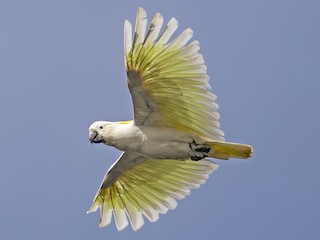
- Predominantly white plumage with a distinctive forward-curving, erectile sulphur-yellow crest. The underside of the wings and tail feathers show a pale yellow wash, most noticeable in flight. The feathers around the ear coverts can also have a faint yellow tinge.
- Beak shape
- Large, powerful, dark grey to black beak, strongly hooked, adapted for cracking hard nuts and seeds.
- Eye color
- Males typically have dark brown to black irises, while females often have reddish-brown irises. Juveniles have dark irises.
- Leg color
- Dark grey to black
- Distinguishing features
- The prominent, erectile sulphur-yellow crest is the most defining feature. When relaxed, the crest lies flat, but when alarmed, excited, or displaying, it is raised prominently. The large size and all-white body with yellow underwings are also key identifiers.
- Juvenile appearance
- Juveniles resemble adults but may have a slightly duller yellow crest and often have darker irises, similar to adult males, making sexing by eye color unreliable until maturity (around 2-3 years). Their calls may also be less developed.
- Seasonal changes
- No significant seasonal plumage changes. Plumage remains consistent year-round.
- Sexual dimorphism
- Subtle sexual dimorphism exists primarily in eye color: males typically have dark brown/black irises, and females have reddish-brown irises. This difference is not always easy to discern in the field, especially in poor light or at a distance. Males may also be slightly larger on average, but this is not a reliable field mark.
How to identify
- 1
Size and Overall Color
Look for a large, entirely white parrot. Its substantial size (45-55 cm) makes it stand out among most other white cockatoos.
- 2
Crest
The most definitive feature is the prominent, forward-curving, sulphur-yellow crest. Observe if it is raised (indicating excitement, alarm, or display) or laid flat.
- 3
Underwing/Undertail Color
In flight, look for the distinct pale yellow wash on the underside of the wings and tail feathers. This is a key differentiator from other white cockatoos.
- 4
Vocalizations
Listen for its extremely loud, harsh, screeching 'kaa-ark' calls. These are unmistakable and often heard before the bird is seen.
- 5
Eye Color (for sexing)
If close enough, observe eye color: dark brown/black for males, reddish-brown for females. This is a subtle but reliable indicator in adults.
Habitat & range
- Biomes
- Tropical and subtropical rainforests, woodlands, open forests, riparian zones, agricultural lands, suburban parks, and urban gardens.
- Geographic range
- Eastern and northern Australia, Tasmania, New Guinea, and some Indonesian islands (e.g., Aru Islands). Introduced populations exist in various parts of the world, including New Zealand and Singapore.
- Elevation range
- Sea level up to approximately 1500 meters.
- Preferred environments
- Highly adaptable, they prefer areas with a mix of tall trees for roosting and nesting, and open areas for foraging. They thrive in human-modified landscapes, often becoming common in cities and towns where food and water are readily available.
Behavior
- Activity time
- Diurnal, most active during early morning and late afternoon, foraging and socializing. They roost communally in large trees during the night.
- Feeding habits
- Primarily herbivorous, feeding on seeds, nuts, fruits, berries, flowers, leaf buds, and roots. They are opportunistic and will also consume insects and their larvae, especially during breeding season. They often forage on the ground or in trees, using their powerful beaks to crack open tough shells and husks. They can be destructive to crops.
- Social behavior
- Highly social birds, typically found in pairs or small family groups, but often congregate in large, noisy flocks (sometimes hundreds) at communal roosting sites or abundant food sources. They exhibit complex social interactions, including allopreening and cooperative foraging. They are known for their intelligence and problem-solving abilities.
- Flight pattern
- Strong, direct flight with relatively slow, deep wing beats. They often glide on stiff wings. In flight, the yellow wash on the underwings and undertail is conspicuous. They are often seen flying in noisy flocks.
- Migration pattern
- Resident throughout their range, though local movements may occur in response to food availability or water sources. They do not undertake long-distance migrations.
- Territoriality
- While not strictly territorial over large areas, breeding pairs will defend their nest hollow and immediate surroundings. Flocks generally share foraging and roosting sites.
Song & calls
- Song
- Sulphur-crested Cockatoos do not have a melodic 'song' in the traditional sense. Their vocalizations are primarily loud, harsh, and often piercing calls.
- Call
- Their most characteristic call is a very loud, raucous, screeching 'kaa-ark' or 'scree-aah' that can carry over long distances. They also produce a variety of other squawks, whistles, and growls, often in rapid succession, especially when excited or alarmed. Flocks are incredibly noisy, particularly at dawn and dusk when moving to and from roosting sites.
- When they vocalize
- Most vocal at dawn and dusk, and throughout the day when foraging, interacting socially, or when alarmed. They are generally quieter when resting or incubating eggs.
Breeding & reproduction
- Breeding season
- Typically August to January in the southern parts of their range, and May to September in the northern parts, varying with rainfall and food availability.
- Nesting habits
- They are hollow-nesting birds, utilizing large tree hollows, often in tall eucalypts, typically near water. Both parents prepare the nest by lining the hollow with wood chips and bark. Nests are usually high above the ground.
- Clutch size
- 2-3 eggs
- Egg description
- 2-3 (occasionally 1 or 4) elliptical, dull white eggs.
- Incubation period
- Approximately 27-30 days, shared by both parents.
- Fledging period
- Chicks fledge around 9-10 weeks after hatching. They remain dependent on their parents for several weeks to months after fledging, learning foraging skills.
- Parental care
- Both parents share incubation duties and care for the young. They feed the chicks regurgitated food and continue to feed them for an extended period after they leave the nest.
Where to find
Urban Parks and Gardens
Common in cities and towns across eastern Australia, often found feeding on lawns, in trees, or around picnic areas.
Woodlands and Forests
Look in open eucalypt woodlands, riparian forests, and rainforest edges, especially near water sources.
Agricultural Areas
Often seen in farmlands, particularly where grain crops or fruit orchards are present, as they can be significant pests.
Communal Roosts
At dawn and dusk, observe large, tall trees (often dead eucalypts) where hundreds may gather to roost, creating a spectacular and noisy display.
Field tips
- Listen First. Their loud, raucous calls are often the first indication of their presence. Follow the sound to locate them.
- Look Up. They spend a lot of time in trees, either feeding, roosting, or nesting. Scan tree canopies, especially large eucalypts.
- Observe Flocks. They are highly social. If you see one, there are likely more nearby. Look for large groups, especially around food sources or water.
- Watch for Crest Movement. The crest is a good indicator of their mood. A raised crest can mean excitement, alarm, or curiosity, making them easier to spot.
- Be Patient. While often conspicuous, they can blend into the white bark of some eucalypts. Patience and careful scanning will help.
Similar species
Major Mitchell's Cockatoo
Lophochroa leadbeateri
Major Mitchell's Cockatoo has a distinctive pinkish-white plumage, a much more elaborate red and yellow banded crest, and a smaller, more delicate appearance. Its range is also more arid and inland compared to the Sulphur-crested Cockatoo.
Little Corella
Cacatua sanguinea
Little Corellas are significantly smaller (35-40 cm), have a shorter, less prominent white crest, and a pale blue eye-ring. They lack the yellow wash on the underwings and tail. Their calls are also distinct, being higher-pitched and more chattering.
Long-billed Corella
Cacatua tenuirostris
Long-billed Corellas are similar in size to Little Corellas but possess a much longer upper mandible, a pinkish-orange band across the breast, and a pinkish flush on the face. Their crest is also short and white, not yellow.
Quick facts
- Crest Color:
- Sulphur-yellow
- Primary Diet:
- Seeds, nuts, fruits
- Social Structure:
- Highly social, often in large flocks
- Vocalization:
- Loud, harsh screeches
- Nesting:
- Tree hollows
Fun facts
- Sulphur-crested Cockatoos are known for their intelligence and ability to mimic human speech and sounds, making them popular pets, though their loud calls and destructive chewing habits can be challenging.
- They have been observed using tools in the wild, such as using small sticks to scratch themselves or to extract food from crevices.
- These cockatoos can live for an exceptionally long time, with some individuals in captivity reaching over 80 years of age, making them one of the longest-lived bird species.
- In urban areas, they have learned to open garbage bins and even unscrew lightbulbs, demonstrating remarkable adaptability and problem-solving skills.
- Their powerful beaks are strong enough to crack open very hard nuts and seeds, but also to cause significant damage to wooden structures, electrical wiring, and crops.
Scientific classification
- Kingdom
- Animalia
- Phylum
- Chordata
- Class
- Aves
- Order
- Psittaciformes
- Family
- Cacatuidae
- Genus
- Cacatua
- Species
- Cacatua galerita
Explore the Sulphur-crested Cockatoo
Identify birds anywhere
Free on iOS, Android, and Web. Photo & sound identification, full species database, and your personal life list.