
Spotted a bird? Identify it instantly with the Birdby app
Open the appAbout
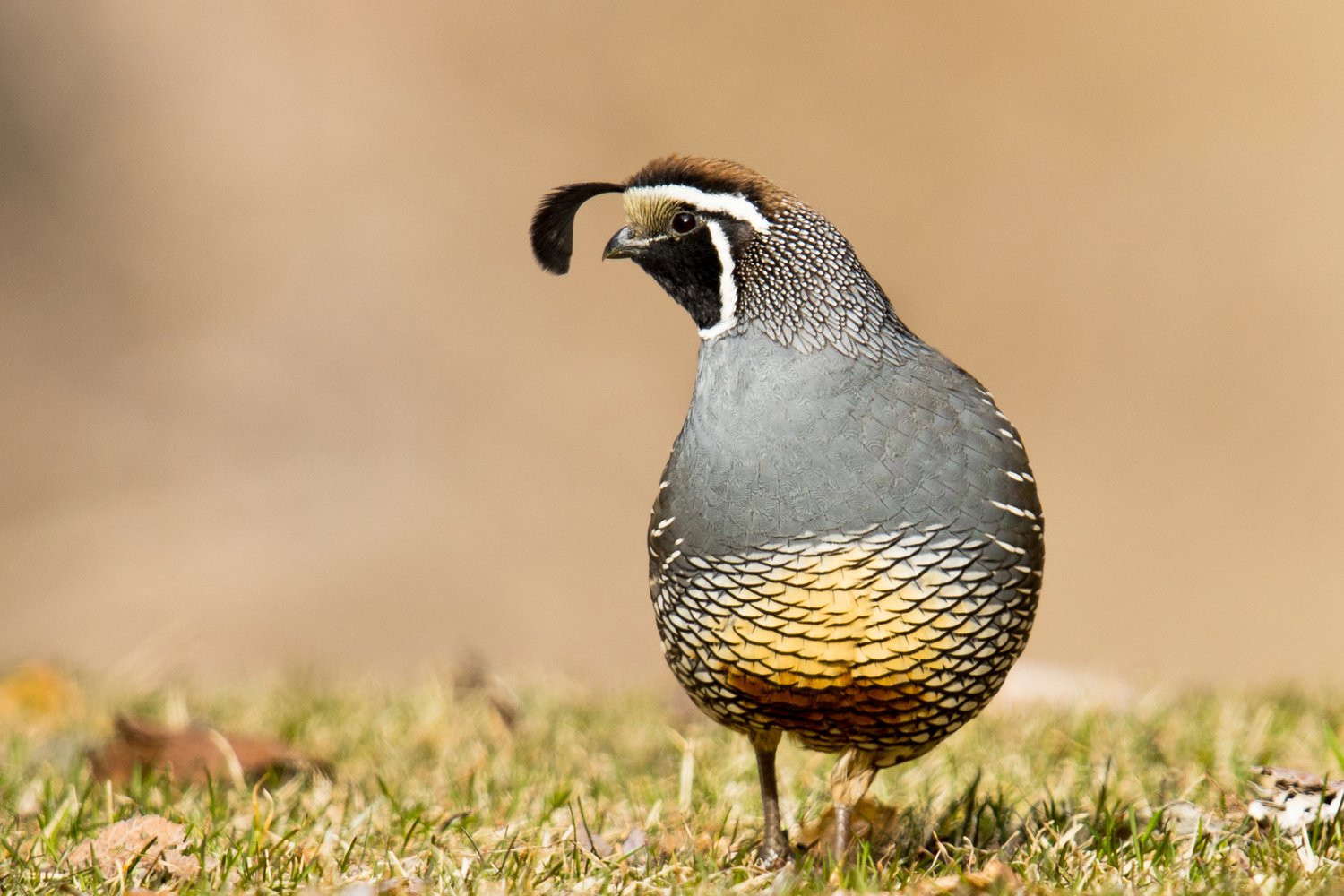
The California Quail is a small, plump ground-dwelling bird native to California and other parts of the western United States. It is easily recognized by its distinctive forward-curving plume (topknot) and its characteristic 'chi-ca-go' call. They are highly social birds, often seen in coveys, especially outside the breeding season.
Size & lifespan
- Length
- 23-28 cm (9-11 in)
- Wingspan
- 32-36 cm (12.6-14.2 in)
- Weight
- 150-200 g (5.3-7.1 oz)
- Lifespan
- 2-7 years in the wild, up to 10 years in captivity
- Diet
- Herbivore (primarily seeds, leaves, berries, and some insects)
Physical characteristics
- Plumage
- Males have a striking black face framed by a white stripe, a dark brown cap, and a prominent black, forward-curving plume. Their back is olive-brown, and their flanks are streaked with chestnut and white. The belly is scaled with white and chestnut. Females are duller overall, lacking the strong facial pattern, with a smaller, straighter plume and more muted brown and gray tones. Juveniles resemble females but are even duller and have a very small, undeveloped plume.
- Beak shape
- Short, stout, and conical, adapted for pecking seeds and foraging. Color is dark gray to black.
- Eye color
- Dark brown
- Leg color
- Grayish-brown
- Distinguishing features
- The most distinctive feature is the black, teardrop-shaped, forward-curving plume on the head, present in both sexes but larger and more prominent in males. Males also have a bold black and white facial pattern.
- Juvenile appearance
- Young birds are mottled brown and gray, resembling adult females but with a much smaller, often barely visible, straight plume. Their plumage is generally less defined and duller.
- Seasonal changes
- No significant seasonal plumage changes. Plumage remains consistent year-round, though wear and tear can make colors appear slightly duller before molting.
- Sexual dimorphism
- Pronounced. Males have a bold black and white facial pattern, a dark brown cap, and a larger, more curved black plume. Females are duller, with a smaller, straighter plume, and lack the distinct facial markings, appearing more uniformly brownish-gray.
How to identify
- 1
Head Plume
Look for the distinctive black, forward-curving plume on the head. It's larger and more prominent in males.
- 2
Male Facial Pattern
Males have a bold black face outlined by a crisp white stripe, and a dark brown cap. This is a key identifier.
- 3
Flank Pattern
Observe the flanks: California Quail have chestnut streaks on a white background, giving a scaled appearance.
- 4
Call
Listen for the characteristic 'chi-ca-go' or 'chi-ca-go-go' call, which is very distinctive and often heard before the bird is seen.
- 5
Behavior
They are often seen in coveys, foraging on the ground near dense cover, and will run rather than fly when disturbed.
Habitat & range
- Biomes
- Chaparral, oak woodlands, grasslands, agricultural areas, suburban gardens, riparian zones.
- Geographic range
- Native to California, Oregon, Washington, Nevada, and parts of Idaho, Utah, Arizona, and Baja California (Mexico). Introduced populations exist in British Columbia, Hawaii, New Zealand, and Chile.
- Elevation range
- Sea level up to 2,000 meters (6,500 feet), occasionally higher.
- Preferred environments
- Prefers areas with dense shrub cover for protection and roosting, interspersed with open ground for foraging. Often found near water sources and in areas with a mix of brushy cover and grassy clearings.
Behavior
- Activity time
- Diurnal, most active during early morning and late afternoon, often resting in shaded cover during the hottest parts of the day.
- Feeding habits
- Primarily ground foragers, scratching and pecking for seeds, leaves, flowers, and berries. They will also consume insects, especially during the breeding season when protein is needed for chick development. They often feed in open areas but stay close to cover for quick escape.
- Social behavior
- Highly social, forming coveys (flocks) of 10-100+ individuals outside the breeding season. Coveys provide safety in numbers. During breeding, pairs become more territorial but may still forage near other pairs.
- Flight pattern
- Short, explosive bursts of flight with rapid wingbeats, typically low to the ground. They prefer to run or walk to escape danger, flying only when necessary. They can glide for short distances.
- Migration pattern
- Non-migratory; they are resident birds throughout their range, though some local movements may occur in response to food availability or severe weather.
- Territoriality
- During the breeding season, males establish and defend small territories around nesting sites, primarily through vocalizations and aggressive displays towards other males. Coveys are not territorial outside of breeding.
Song & calls
- Song
- The most iconic call is a three-note 'chi-ca-go' or 'chi-ca-go-go' song, often given by males to announce their presence and attract mates. It can also serve as a contact call within a covey.
- Call
- A variety of calls including a sharp 'whit!' alarm call when startled, a soft 'cluck' or 'pip' contact call within the covey, and a 'squawk' when flushed. Chicks emit soft peeping sounds.
- When they vocalize
- Most vocal during the breeding season (spring and early summer) when males are establishing territories and attracting mates. Contact calls are heard year-round within coveys.
Breeding & reproduction
- Breeding season
- Typically March to August, peaking in April-June, depending on location and rainfall.
- Nesting habits
- Nests are shallow depressions on the ground, often concealed under dense shrubs, grass clumps, or at the base of trees. Lined with grass, leaves, and feathers. Both parents participate in nest selection and construction.
- Clutch size
- 10-16 eggs, though clutches of up to 20 have been recorded. They may lay a second clutch if the first fails or if conditions are favorable.
- Egg description
- Creamy white to pale buff, often speckled with fine brown or reddish-brown spots. Oval-shaped.
- Incubation period
- 21-23 days, primarily by the female, though the male may assist.
- Fledging period
- Precocial chicks leave the nest within hours of hatching and are able to feed themselves. They can make short flights within 10-14 days and are largely independent by 4-5 weeks.
- Parental care
- Both parents care for the young. The female primarily incubates, while the male guards the nest and helps brood and protect the chicks after hatching. Coveys often form with multiple families joining together.
Where to find
Chaparral and Shrublands
Look in dense, brushy areas with good cover, especially near water sources.
Oak Woodlands
Often found at the edges of oak woodlands, where there's a mix of trees and undergrowth.
Suburban Gardens and Parks
Common in well-vegetated suburban areas, especially those with native plants and good ground cover.
Agricultural Edges
Can be found along the borders of farms and orchards, where there's cover and food.
Field tips
- Listen for their call. Their distinctive 'chi-ca-go' call is often the first indication of their presence. Learn to recognize it.
- Look near cover. California Quail rarely venture far from dense shrubs or brush, which they use for escape and roosting. Scan the edges of these areas.
- Observe at dawn and dusk. They are most active during the early morning and late afternoon when foraging. This is the best time to spot them.
- Watch for movement on the ground. They are ground-dwelling birds and often move in groups. Look for subtle movements in the undergrowth.
- Be patient and quiet. Quail can be shy. Move slowly and quietly, and use binoculars to scan potential habitats.
Similar species
Gambel's Quail
Callipepla gambelii
Gambel's Quail has a black patch on its belly (absent in California Quail) and a chestnut cap (California Quail has a dark brown cap). The white facial stripe of the male Gambel's Quail is less extensive, and its flanks are streaked with white on a chestnut background, rather than chestnut on a white background as in California Quail.
Scaled Quail
Callipepla squamata
Scaled Quail has a white, cottony crest (not a black plume) and a distinctive 'scaled' appearance on its breast and back. Its overall coloration is grayer than the California Quail.
Mountain Quail
Oreortyx pictus
Mountain Quail are larger, have a long, straight, brown head plume, and a distinctive chestnut throat bordered by white. They also have bold white and chestnut barring on their flanks.
Quick facts
- State Bird:
- California
- Social Structure:
- Coveys (flocks) outside breeding season
- Flight:
- Short, explosive bursts
- Diet:
- Seeds, leaves, berries, insects
- Nesting:
- Ground nest, well-concealed
Fun facts
- The California Quail is the official state bird of California.
- Their distinctive forward-curving plume is made of six feathers, not just one.
- Coveys often form a tight circle at night, facing outwards, to conserve heat and watch for predators.
- Chicks are precocial, meaning they are born with open eyes, covered in down, and can walk and feed themselves almost immediately after hatching.
- They are known to dust-bathe regularly to maintain feather health and remove parasites.
Scientific classification
- Kingdom
- Animalia
- Phylum
- Chordata
- Class
- Aves
- Order
- Galliformes
- Family
- Odontophoridae
- Genus
- Callipepla
- Species
- Callipepla californica
Explore the California Quail
Identify birds anywhere
Free on iOS, Android, and Web. Photo & sound identification, full species database, and your personal life list.