
Spotted a bird? Identify it instantly with the Birdby app
Open the appAbout
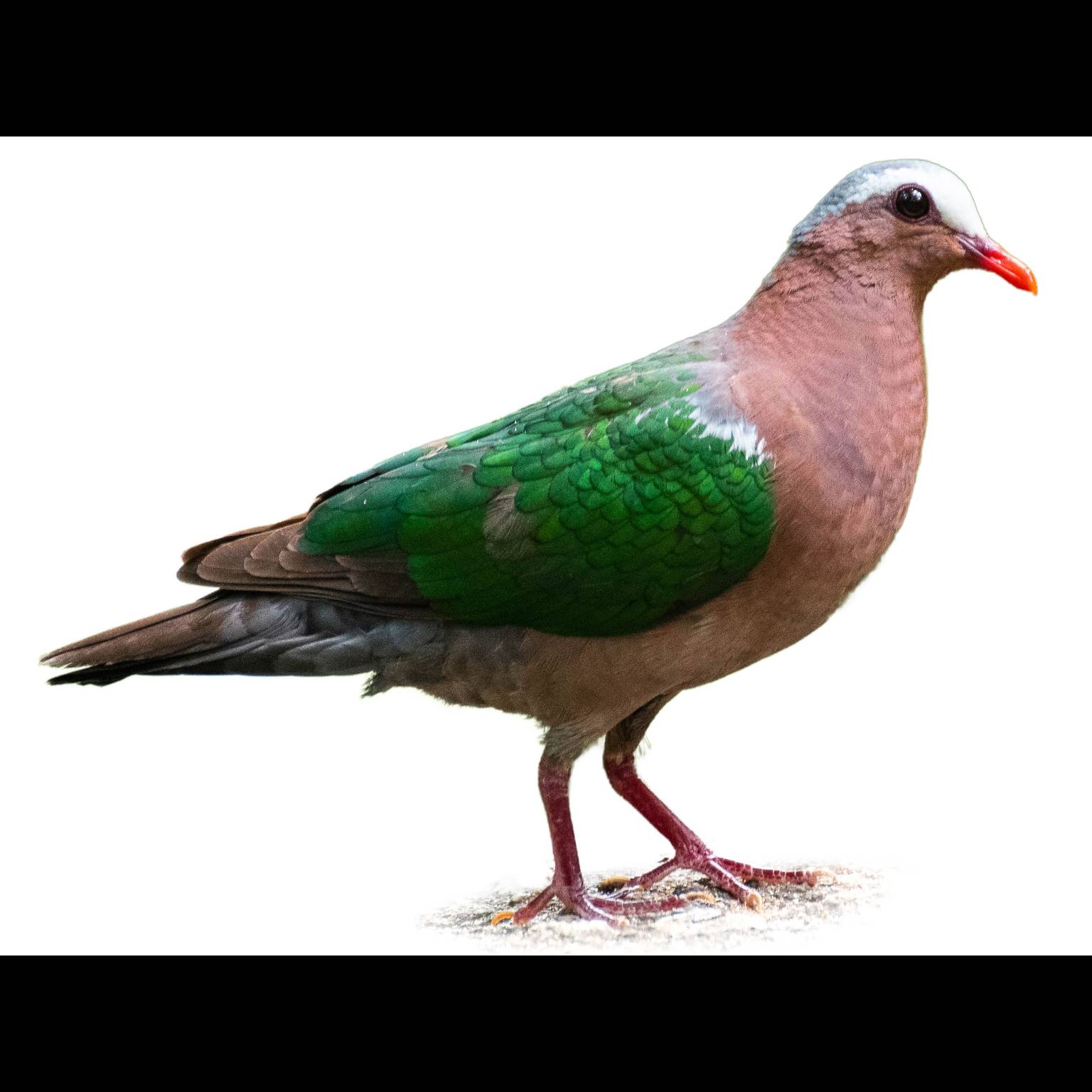
The Emerald Dove, also known as the Common Emerald Dove or Green-winged Pigeon, is a widespread resident breeding bird in the tropical and subtropical parts of the Indian Subcontinent and Southeast Asia. It is a small, stocky pigeon typically found in dense forests and woodlands, often foraging on the ground for fallen fruits and seeds. Its striking iridescent green back and wings make it easily recognizable.
Size & lifespan
- Length
- 23-27 cm
- Wingspan
- 45-48 cm
- Weight
- 110-180 g
- Lifespan
- Approximately 5-10 years in the wild
- Diet
- Frugivore/Granivore
Physical characteristics
- Plumage
- Adult males have a brilliant iridescent emerald green back and wings, contrasting with a purplish-brown head and underparts. They possess a white patch on the forehead and a white stripe over the eye, with a grey crown. Two black and white bars are visible on the lower back. The underparts are a rich vinous-chestnut. Adult females are generally duller, with a more brownish head and breast, and a less prominent white forehead patch. Juveniles are duller still, with brownish-green plumage and faint barring on the underparts.
- Beak shape
- Relatively small and slender, reddish-orange at the base fading to yellow or horn-colored at the tip.
- Eye color
- Dark brown, surrounded by a narrow red orbital ring.
- Leg color
- Reddish-pink to purplish-red.
- Distinguishing features
- The iridescent emerald green back and wings are the most distinctive feature. The white forehead and supercilium (eyebrow stripe) in males, and the two black and white bars on the lower back are also key identification marks.
- Juvenile appearance
- Juveniles are duller than adults, with brownish-green plumage and often faint, dusky barring on the breast and flanks. The iridescent green is less pronounced, and the white facial markings are absent or very indistinct.
- Seasonal changes
- No significant seasonal plumage changes are observed in Emerald Doves.
- Sexual dimorphism
- Males are more brightly colored with a more prominent white forehead and supercilium, and a grey crown. Females are duller overall, with a brownish head and breast, and a less distinct white forehead patch. The grey crown is often absent or less defined in females.
How to identify
- 1
Iridescent Green Back and Wings
The most striking and definitive feature. Look for the brilliant, shimmering emerald green plumage covering the entire back and wings. This is visible even in low light.
- 2
White Forehead and Supercilium (Males)
Adult males have a distinct white patch on the forehead and a prominent white stripe extending from above the eye towards the nape. This is a key differentiator from females and juveniles.
- 3
Two Black and White Bars on Lower Back
Observe the lower back, just above the tail. There are two distinct black and white bars that are often visible, especially when the bird is perched or in flight.
- 4
Vinous-Chestnut Underparts
The breast and underparts are a rich purplish-brown or vinous-chestnut, contrasting with the green upperparts.
- 5
Ground Foraging Behavior
Emerald Doves are typically seen foraging on the forest floor, scratching through leaf litter. Their secretive nature means they are often heard before they are seen.
- 6
Soft Cooing Call
Listen for their characteristic soft, mournful 'hoo-hoo-hoo' cooing call, which can be a good indicator of their presence in dense vegetation.
Habitat & range
- Biomes
- Tropical and subtropical moist broadleaf forests, lowland rainforests, secondary forests, dense woodlands, plantations, and gardens.
- Geographic range
- Widespread across the Indian Subcontinent (India, Sri Lanka, Bangladesh, Nepal, Bhutan), Southeast Asia (Myanmar, Thailand, Laos, Cambodia, Vietnam, Malaysia, Singapore, Indonesia, Philippines), and parts of northern Australia and the Pacific Islands.
- Elevation range
- Sea level up to 1600 meters, occasionally higher.
- Preferred environments
- Dense undergrowth, forest edges, areas with good ground cover, often near water sources. They prefer areas with a good supply of fallen fruits and seeds.
Behavior
- Activity time
- Diurnal, most active during the early morning and late afternoon.
- Feeding habits
- Primarily ground feeders, foraging for fallen fruits, berries, seeds, and occasionally small invertebrates. They are often seen scratching through leaf litter. They typically feed alone or in pairs.
- Social behavior
- Generally solitary or found in pairs. They are not typically seen in large flocks, though small groups may gather at abundant food sources or waterholes.
- Flight pattern
- Fast and direct flight, often low through the undergrowth. They can be quite agile in dense vegetation. When flushed, they fly off with a characteristic whirring sound.
- Migration pattern
- Resident throughout its range, with no significant migratory movements. Local movements may occur in response to food availability.
- Territoriality
- Pairs maintain a breeding territory, which they defend from other doves. They can be quite secretive and shy.
Song & calls
- Song
- The song is a soft, low, mournful cooing, often described as a series of 'hoo-hoo-hoo' notes, sometimes accelerating into a 'coo-coo-coo-coo-coo'. It can be quite monotonous and repetitive.
- Call
- Alarm call is a sharp 'whup' or 'whirr' as it takes flight. Other calls include soft grunts and murmurs.
- When they vocalize
- Most vocal during the breeding season, typically in the early morning and late afternoon.
Breeding & reproduction
- Breeding season
- Varies geographically, but generally throughout the year in tropical regions, with peaks during the dry season or after monsoons. In India, it's typically March-May and August-October.
- Nesting habits
- Nests are typically flimsy platforms of twigs, placed low in a bush, small tree, or on a fern frond, usually 1-5 meters above the ground. Both parents participate in nest construction.
- Clutch size
- 1-2 eggs, most commonly 2.
- Egg description
- Usually two eggs, creamy white or buff-colored, elliptical in shape.
- Incubation period
- Approximately 14-16 days.
- Fledging period
- Chicks fledge around 12-14 days after hatching.
- Parental care
- Both parents share incubation duties and care for the young, feeding them 'crop milk' initially, then regurgitated seeds and fruits.
Where to find
Dense Forests and Woodlands
Look in the undergrowth of tropical and subtropical forests, especially areas with good tree cover and leaf litter.
Forest Edges and Plantations
They can also be found at the edges of forests, in coffee or rubber plantations, and even large, well-vegetated gardens.
Near Water Sources
Often found near streams, rivers, or other water bodies within their preferred habitats.
Field tips
- Listen for Calls. Their soft cooing call is often the first indication of their presence. Learn to recognize it to locate them in dense foliage.
- Scan the Forest Floor. Since they are ground feeders, spend time scanning the leaf litter on the forest floor. They can be quite camouflaged despite their bright colors.
- Be Patient and Quiet. Emerald Doves are shy and secretive. Move slowly and quietly, and be prepared to wait patiently for them to emerge or become visible.
- Look in Early Morning/Late Afternoon. They are most active during these cooler parts of the day, increasing your chances of spotting them.
Similar species
Nicobar Pigeon
Caloenas nicobarica
While also iridescent, the Nicobar Pigeon is much larger, has a dark grey head, a long hackle-like neck plumage, and a short white tail. It is found on smaller islands and is not typically found in the same mainland forest habitats as the Emerald Dove.
Common Bronzewing
Phaps chalcoptera
Found in Australia, the Common Bronzewing has iridescent bronze-green patches on its wings, but its overall plumage is brownish-grey, lacking the extensive emerald green back and wings of the Emerald Dove. It also has a prominent white forehead and a reddish eye-ring.
Brush Bronzewing
Phaps elegans
Also Australian, the Brush Bronzewing is smaller and darker than the Common Bronzewing, with less prominent iridescent wing patches and a more rufous underparts. It lacks the extensive emerald green of the Emerald Dove.
Quick facts
- Primary Color:
- Iridescent Emerald Green
- Habitat Preference:
- Dense Forests, Ground Forager
- Diet:
- Fallen Fruits and Seeds
- Social Structure:
- Solitary or Pairs
- Conservation Status:
- Least Concern
Fun facts
- The Emerald Dove is the state bird of the Indian state of Tamil Nadu.
- Despite their vibrant green plumage, they are surprisingly well-camouflaged on the forest floor amidst dappled sunlight and green foliage.
- They are one of the few pigeon species that primarily forage on the ground, using their beaks to sift through leaf litter.
- Their scientific name 'Chalcophaps' comes from Greek 'chalkos' (bronze) and 'phaps' (pigeon), referring to the metallic sheen on their wings.
Scientific classification
- Kingdom
- Animalia
- Phylum
- Chordata
- Class
- Aves
- Order
- Columbiformes
- Family
- Columbidae
- Genus
- Chalcophaps
- Species
- Chalcophaps indica
Explore the Emerald Dove
Identify birds anywhere
Free on iOS, Android, and Web. Photo & sound identification, full species database, and your personal life list.