
How to identify the Emerald Dove
Chalcophaps indica
Spotted a bird? Identify it instantly with the Birdby app
Open the appTo correctly identify the Emerald Dove (Chalcophaps indica), check each of these features. Birds can be tricky: habit, habitat, and call often confirm a sighting that a single photo cannot.
Size at a glance
- Length
- 23-27 cm
- Wingspan
- 45-48 cm
- Weight
- 110-180 g
Physical features to check
- 1
Plumage
Overall feather coloration and pattern.
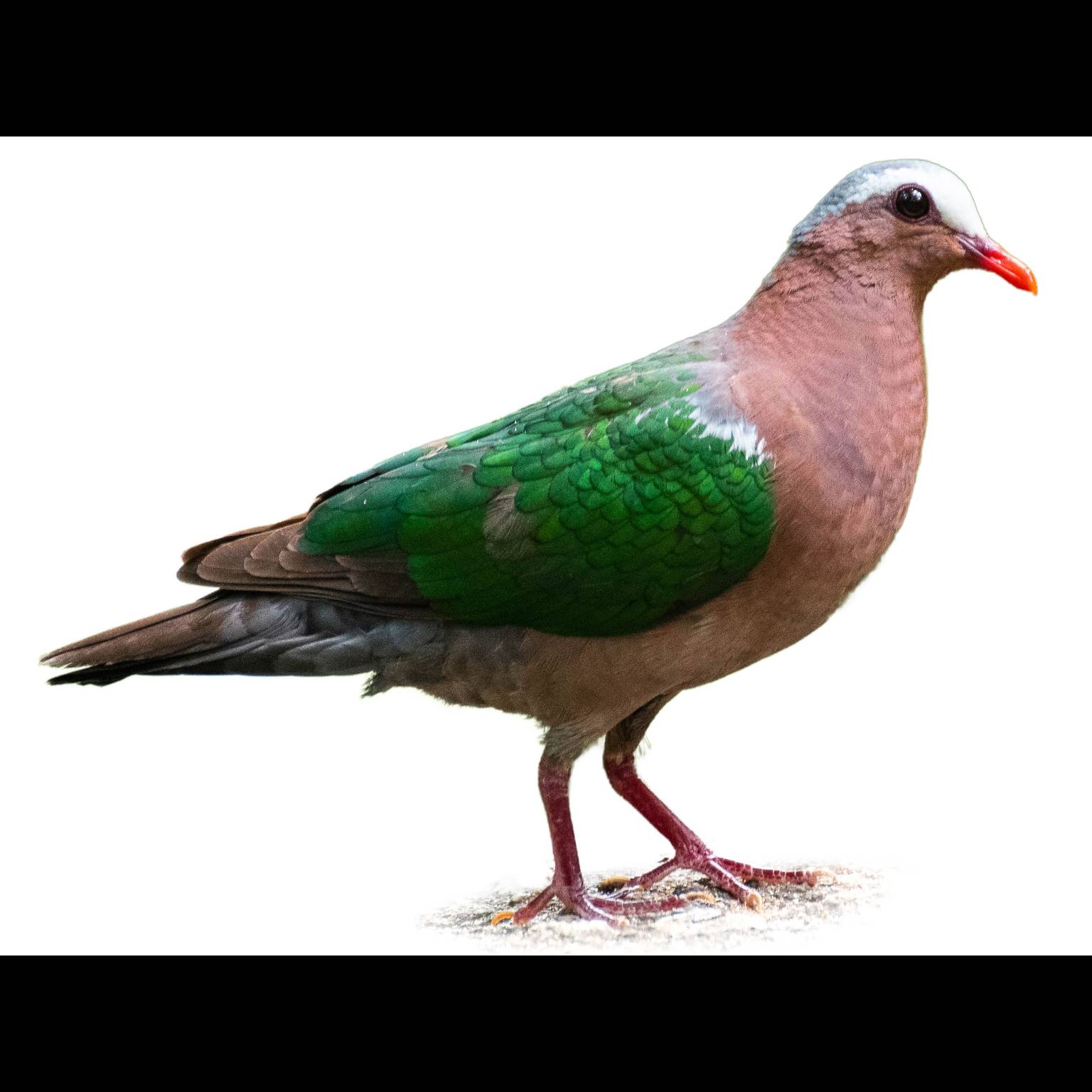
Adult males have a brilliant iridescent emerald green back and wings, contrasting with a purplish-brown head and underparts. They possess a white patch on the forehead and a white stripe over the eye, with a grey crown. Two black and white bars are visible on the lower back. The underparts are a rich vinous-chestnut. Adult females are generally duller, with a more brownish head and breast, and a less prominent white forehead patch. Juveniles are duller still, with brownish-green plumage and faint barring on the underparts.
- 2
Beak shape
Shape and color of the bill: a key field mark.
Relatively small and slender, reddish-orange at the base fading to yellow or horn-colored at the tip.
- 3
Eye color
Iris color and any distinctive eye markings.
Dark brown, surrounded by a narrow red orbital ring.
- 4
Leg color
Leg and foot color.
Reddish-pink to purplish-red.
- 5
Distinguishing features
Standout features that separate this species.
The iridescent emerald green back and wings are the most distinctive feature. The white forehead and supercilium (eyebrow stripe) in males, and the two black and white bars on the lower back are also key identification marks.
- 6
Juvenile appearance
How young birds differ from adults.
Juveniles are duller than adults, with brownish-green plumage and often faint, dusky barring on the breast and flanks. The iridescent green is less pronounced, and the white facial markings are absent or very indistinct.
- 7
Seasonal changes
Plumage variation between breeding and non-breeding seasons.
No significant seasonal plumage changes are observed in Emerald Doves.
- 8
Sexual dimorphism
How males and females differ.
Males are more brightly colored with a more prominent white forehead and supercilium, and a grey crown. Females are duller overall, with a brownish head and breast, and a less distinct white forehead patch. The grey crown is often absent or less defined in females.
Key field marks
- Iridescent Green Back and Wings. The most striking and definitive feature. Look for the brilliant, shimmering emerald green plumage covering the entire back and wings. This is visible even in low light.
- White Forehead and Supercilium (Males). Adult males have a distinct white patch on the forehead and a prominent white stripe extending from above the eye towards the nape. This is a key differentiator from females and juveniles.
- Two Black and White Bars on Lower Back. Observe the lower back, just above the tail. There are two distinct black and white bars that are often visible, especially when the bird is perched or in flight.
- Vinous-Chestnut Underparts. The breast and underparts are a rich purplish-brown or vinous-chestnut, contrasting with the green upperparts.
- Ground Foraging Behavior. Emerald Doves are typically seen foraging on the forest floor, scratching through leaf litter. Their secretive nature means they are often heard before they are seen.
- Soft Cooing Call. Listen for their characteristic soft, mournful 'hoo-hoo-hoo' cooing call, which can be a good indicator of their presence in dense vegetation.
Explore the Emerald Dove
Identify birds anywhere
Free on iOS, Android, and Web. Photo & sound identification, full species database, and your personal life list.