
Spotted a bird? Identify it instantly with the Birdby app
Open the appAbout
The Killdeer is a medium-sized plover, widely distributed across the Americas. It is easily recognized by its distinctive double breast bands and loud, piercing calls. Unlike many shorebirds, Killdeer are often found far from water, inhabiting open fields, lawns, and agricultural areas. They are known for their 'broken-wing' display, a distraction technique used to lure predators away from their nests or young.
Size & lifespan
- Length
- 23-28 cm (9-11 in)
- Wingspan
- 46-48 cm (18-19 in)
- Weight
- 75-120 g (2.6-4.2 oz)
- Lifespan
- Typically 3-5 years in the wild, with records up to 10 years.
- Diet
- Insectivore, primarily feeding on a wide variety of invertebrates.
Physical characteristics
- Plumage
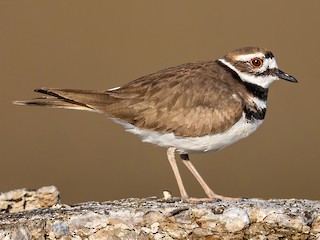
- Adults have a brown back and crown, white underparts, and two prominent black bands across the white breast. The rump is rufous-orange, visible in flight. They have a white forehead and a black stripe extending from the beak through the eye. The wings are long and pointed, with a conspicuous white wing stripe visible in flight.
- Beak shape
- Short, straight, and black.
- Eye color
- Dark brown, surrounded by a thin red orbital ring (more prominent in breeding season).
- Leg color
- Pinkish-gray to flesh-colored.
- Distinguishing features
- The two black breast bands are the most definitive field mark. The rufous-orange rump is also a key identifier, especially in flight. Their large, dark eyes give them a gentle expression.
- Juvenile appearance
- Juveniles resemble adults but have a scaly appearance on their back feathers due to buffy feather edges. Their breast bands may be slightly narrower and less sharply defined, and the rufous-orange on the rump may be duller.
- Seasonal changes
- There are no significant seasonal plumage changes. Breeding and non-breeding plumages are essentially identical.
- Sexual dimorphism
- Males and females are outwardly similar in plumage and size. There are no reliable visual differences for sexing in the field.
How to identify
- 1
Double Breast Bands
Look for the two distinct black bands across the white breast. This is the most reliable field mark.
- 2
Rufous Rump
Observe the bird in flight; the bright rufous-orange rump is a striking and unique feature.
- 3
Vocalization
Listen for the loud, piercing 'kill-deer' call, which is often given repeatedly, especially when disturbed.
- 4
Behavior
Watch for its characteristic 'run-stop-peck' foraging style and the dramatic 'broken-wing' display if you approach a nest or young.
- 5
Habitat
Unlike many shorebirds, Killdeer are frequently found in open, dry, upland habitats far from large bodies of water.
Habitat & range
- Biomes
- Grasslands, agricultural fields, open woodlands, urban and suburban areas, wetlands (less frequently).
- Geographic range
- Breeds across most of North America, from Alaska and Canada south through the United States and Mexico, and into parts of Central and South America. Winters from the southern United States south to northern South America.
- Elevation range
- Sea level up to approximately 3,000 meters (10,000 feet) in some mountainous regions.
- Preferred environments
- Open, short-grass habitats with sparse vegetation, including pastures, golf courses, athletic fields, cultivated fields, gravel roads, parking lots, and shorelines of ponds and rivers. They prefer areas with bare ground or very short grass for foraging and nesting.
Behavior
- Activity time
- Diurnal, actively foraging during the day. They can also be active at night, especially during migration or when foraging under artificial lights.
- Feeding habits
- Forages by running a few steps, stopping abruptly, and then pecking at the ground to catch prey. They primarily eat insects (beetles, grasshoppers, crickets, flies, caterpillars) and other invertebrates (earthworms, snails, crayfish). They may also consume some seeds. They often forage in open areas, sometimes near livestock.
- Social behavior
- Typically seen singly or in pairs during the breeding season. Outside of breeding, they may gather in small flocks, especially during migration or in wintering grounds. They are generally tolerant of other species.
- Flight pattern
- Strong, direct flight with rapid wingbeats. When flushed, they often fly erratically, calling loudly, and may perform aerial displays. The white wing stripe and rufous rump are prominent in flight.
- Migration pattern
- Northern populations are migratory, moving south for the winter. Southern populations are largely resident. Migration occurs primarily at night. They are among the earliest spring migrants and late fall migrants.
- Territoriality
- Highly territorial during the breeding season, defending their nesting area with vocalizations and aggressive displays. They are well-known for their 'broken-wing' display to distract predators from their nest or young.
Song & calls
- Song
- The Killdeer does not have a complex song. Its vocalizations are primarily calls.
- Call
- The most characteristic call is a loud, piercing, two-note 'kill-deer' or 'kill-deeah', often repeated. They also have a rapid, trilling 'dee-dee-dee' call, especially when agitated or in flight. Alarm calls are sharp and insistent.
- When they vocalize
- Vocalizes frequently throughout the day, especially when disturbed, in flight, or during territorial disputes. Calls are particularly common during the breeding season and when performing distraction displays.
Breeding & reproduction
- Breeding season
- Varies geographically, typically from March to July in North America, with some southern populations starting earlier.
- Nesting habits
- Nests are scrapes on the ground, often in open areas with sparse vegetation, gravel, or bare soil. They are typically unlined or sparsely lined with small pebbles, shell fragments, or bits of vegetation. Nests are often placed in unexpected locations like driveways, gravel roads, or cultivated fields. Both parents participate in nest site selection and construction.
- Clutch size
- Usually 4 eggs, rarely 3 or 5.
- Egg description
- Typically 4 eggs, pear-shaped, buffy or creamy-white with heavy dark brown, black, or purplish spots and blotches, providing excellent camouflage against the ground. Eggs measure approximately 3.8 x 2.8 cm (1.5 x 1.1 in).
- Incubation period
- 24-28 days, incubated by both parents.
- Fledging period
- Precocial young leave the nest shortly after hatching (within hours) and are able to feed themselves. They fledge (become capable of sustained flight) at about 25-31 days old.
- Parental care
- Both parents share incubation duties and care for the precocial young. Parents lead the chicks to foraging areas and protect them from predators, often employing the 'broken-wing' display.
Where to find
Agricultural Fields
Look in freshly plowed or harvested fields, pastures, and cultivated lands.
Lawns and Golf Courses
Often found on short-grass lawns, parks, athletic fields, and golf courses, especially those with bare patches or gravel.
Gravel Areas
Check gravel roads, parking lots, and construction sites, as these mimic their preferred nesting substrates.
Shorelines
While less common than other plovers, they can sometimes be found along the edges of ponds, rivers, and mudflats.
Field tips
- Listen for Calls. Their distinctive 'kill-deer' call is often heard before the bird is seen, especially when they are flushed or agitated.
- Scan Open Areas. Killdeer prefer open, short-grass or bare ground. Scan these areas carefully, as their plumage provides excellent camouflage.
- Observe Behavior. Watch for their characteristic 'run-stop-peck' foraging. If you see a bird performing a 'broken-wing' display, you are likely near a nest or chicks, and it's best to slowly back away.
- Check Unexpected Places. Don't limit your search to traditional birding spots; Killdeer are often found in highly human-modified environments.
Similar species
Semipalmated Plover
Charadrius semipalmatus
The Semipalmated Plover is smaller and has only one black breast band, not two. It also lacks the rufous rump of the Killdeer. Typically found closer to water.
Piping Plover
Charadrius melodus
The Piping Plover is smaller and much paler, with a single, often incomplete, breast band. It also lacks the rufous rump and is typically found on sandy beaches.
Wilson's Plover
Charadrius wilsonia
Wilson's Plover has a much thicker, heavier bill and a single, broad breast band. It is typically found on coastal beaches and mudflats.
Quick facts
- Distinctive Mark:
- Two black breast bands
- Call:
- Loud 'kill-deer' call
- Habitat Preference:
- Open, dry, short-grass areas
- Nesting:
- Ground scrape, often in exposed locations
- Defense Mechanism:
- Broken-wing display
Fun facts
- The Killdeer's common name is an onomatopoeia, directly reflecting its distinctive call.
- They are one of the few shorebird species that thrive in human-altered landscapes, often nesting in surprising places like gravel driveways or rooftops.
- The 'broken-wing' display is a highly effective anti-predator strategy, drawing attention away from their vulnerable eggs or chicks.
- Killdeer chicks are precocial, meaning they are born with open eyes, covered in down, and are able to walk and feed themselves within hours of hatching.
- They sometimes 'foot-tremble' or 'foot-patter' on the ground, a behavior thought to disturb invertebrates and bring them to the surface for capture.
Scientific classification
- Kingdom
- Animalia
- Phylum
- Chordata
- Class
- Aves
- Order
- Charadriiformes
- Family
- Charadriidae
- Genus
- Charadrius
- Species
- Charadrius vociferus
Explore the Killdeer
Identify birds anywhere
Free on iOS, Android, and Web. Photo & sound identification, full species database, and your personal life list.