
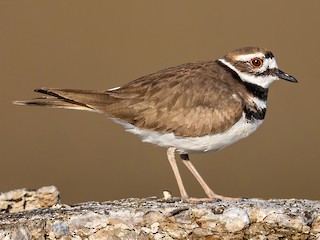
Where does the Killdeer live?
Charadrius vociferus
Spotted a bird? Identify it instantly with the Birdby app
Open the appThe Killdeer lives in specific habitats and regions. Knowing where, and when, to look improves your chances of a successful sighting.
Biomes
Grasslands, agricultural fields, open woodlands, urban and suburban areas, wetlands (less frequently).
Geographic range
Breeds across most of North America, from Alaska and Canada south through the United States and Mexico, and into parts of Central and South America. Winters from the southern United States south to northern South America.
Preferred environments
Open, short-grass habitats with sparse vegetation, including pastures, golf courses, athletic fields, cultivated fields, gravel roads, parking lots, and shorelines of ponds and rivers. They prefer areas with bare ground or very short grass for foraging and nesting.
Elevation range
Sea level up to approximately 3,000 meters (10,000 feet) in some mountainous regions.
Where to look
Agricultural Fields
Look in freshly plowed or harvested fields, pastures, and cultivated lands.
Lawns and Golf Courses
Often found on short-grass lawns, parks, athletic fields, and golf courses, especially those with bare patches or gravel.
Gravel Areas
Check gravel roads, parking lots, and construction sites, as these mimic their preferred nesting substrates.
Shorelines
While less common than other plovers, they can sometimes be found along the edges of ponds, rivers, and mudflats.
Field tips
- Listen for Calls. Their distinctive 'kill-deer' call is often heard before the bird is seen, especially when they are flushed or agitated.
- Scan Open Areas. Killdeer prefer open, short-grass or bare ground. Scan these areas carefully, as their plumage provides excellent camouflage.
- Observe Behavior. Watch for their characteristic 'run-stop-peck' foraging. If you see a bird performing a 'broken-wing' display, you are likely near a nest or chicks, and it's best to slowly back away.
- Check Unexpected Places. Don't limit your search to traditional birding spots; Killdeer are often found in highly human-modified environments.
Migration
Northern populations are migratory, moving south for the winter. Southern populations are largely resident. Migration occurs primarily at night. They are among the earliest spring migrants and late fall migrants.
Explore the Killdeer
Identify birds anywhere
Free on iOS, Android, and Web. Photo & sound identification, full species database, and your personal life list.