
Spotted a bird? Identify it instantly with the Birdby app
Open the appAbout
The Gouldian Finch, also known as the Lady Gouldian Finch or Rainbow Finch, is a vibrantly colored passerine bird endemic to Australia. Renowned for its striking plumage, it is one of the most visually spectacular finches in the world. It is a small, seed-eating bird that typically inhabits tropical savannas and woodlands.
Size & lifespan
- Length
- 13-15 cm (5.1-5.9 in)
- Wingspan
- Approximately 18-20 cm (7.1-7.9 in)
- Weight
- 12-17 g (0.42-0.60 oz)
- Lifespan
- 5-7 years in the wild, up to 8-10 years in captivity
- Diet
- Granivore (primarily seeds, especially grass seeds), occasionally insects during breeding season
Physical characteristics
- Plumage
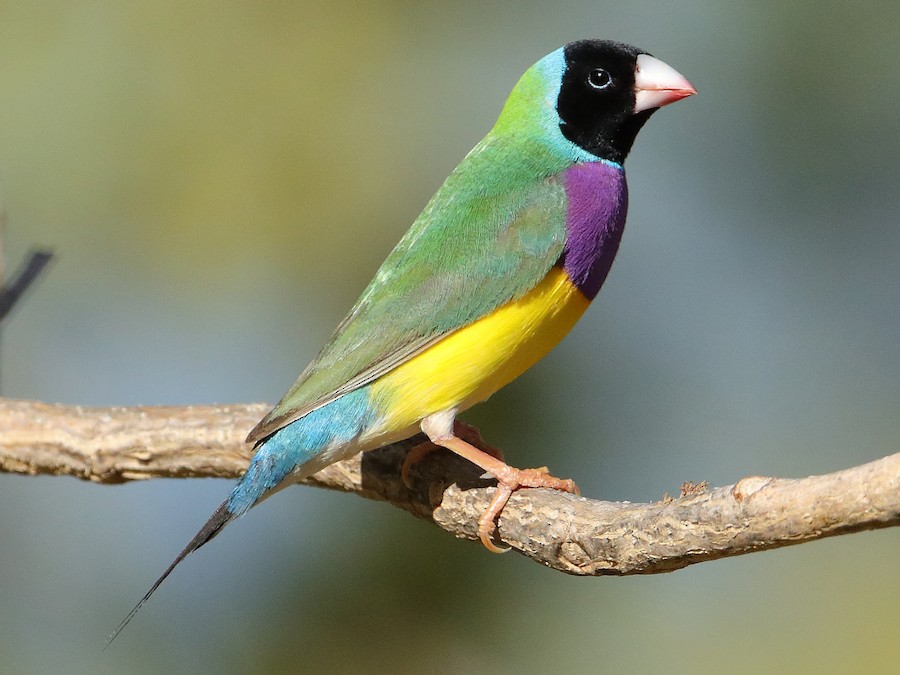
- Adults exhibit a dazzling array of colors. The back and wings are bright green, the breast is purple, and the belly is yellow. The rump is bright blue. There are three main head color morphs: red-headed (most common), black-headed, and yellow-headed (rarest). A narrow turquoise band separates the head color from the green nape. The tail is black with elongated central feathers.
- Beak shape
- Conical and strong, adapted for cracking seeds. The beak is pale horn-colored with a red tip in red-headed birds, or yellowish with a red tip in black-headed and yellow-headed birds. The upper mandible has a red tip, and the lower mandible is pale.
- Eye color
- Dark brown
- Leg color
- Pinkish-orange to pale pink
- Distinguishing features
- The combination of a brightly colored head (red, black, or yellow), turquoise collar, green back, purple breast, and yellow belly is unique. The elongated central tail feathers are also distinctive.
- Juvenile appearance
- Juveniles are dull olive-green to grey on the head, back, and wings, with a pale greyish-brown belly. The beak is dark grey to black with a pale yellow tip and prominent pale, phosphorescent blue nodules at the gape (corners of the mouth), which serve as targets for feeding parents. They lack the vibrant adult coloration and develop it gradually over several months, typically after their first molt at around 3-4 months of age.
- Seasonal changes
- No significant seasonal plumage changes. The vibrant coloration is maintained year-round, though intensity may vary slightly with feather wear or during molting periods.
- Sexual dimorphism
- Males are generally brighter and more intensely colored than females, particularly the purple on the breast and the yellow on the belly. The male's head color is also typically more vivid. Females often have a paler purple breast and a less extensive yellow belly. The elongated central tail feathers are longer in males.
How to identify
- 1
Head Color
Look for the distinct head colors: red, black, or yellow. This is the most immediate identifier.
- 2
Body Plumage
Observe the combination of bright green back, purple breast, and yellow belly. No other Australian finch has this specific color pattern.
- 3
Turquoise Collar
Note the narrow, bright turquoise band separating the head color from the green nape. This is a key field mark.
- 4
Tail Feathers
Identify the elongated central tail feathers, especially prominent in males.
- 5
Juvenile Appearance
For juveniles, look for the dull olive-green/grey plumage and the distinctive pale blue phosphorescent nodules at the gape.
Habitat & range
- Biomes
- Tropical savannas, open woodlands, and grasslands
- Geographic range
- Northern Australia, specifically across the Kimberley region of Western Australia, the Top End of the Northern Territory, and parts of Queensland. Its distribution is patchy and often associated with specific grass species.
- Elevation range
- Typically found in lowlands, from sea level up to a few hundred meters.
- Preferred environments
- Prefers areas with tall grasses (especially Sorghum species) for food, scattered trees (e.g., Eucalyptus, Terminalia) for roosting and nesting, and proximity to permanent water sources. They favor areas with a mosaic of burnt and unburnt grasslands.
Behavior
- Activity time
- Diurnal, most active during the cooler parts of the day, particularly early morning and late afternoon.
- Feeding habits
- Primarily ground feeders, foraging for ripe or semi-ripe grass seeds. They will also pluck seeds directly from grass heads. During the breeding season, they supplement their diet with insects, particularly termites, to provide protein for their young. They drink frequently, especially in the morning and late afternoon.
- Social behavior
- Highly social birds, typically found in small flocks outside the breeding season, which can merge into larger flocks of several hundred individuals at communal roosts or watering holes. During the breeding season, they form monogamous pairs.
- Flight pattern
- Fast, undulating flight over short distances. When moving between feeding and watering sites, they fly in cohesive flocks.
- Migration pattern
- Partially migratory or nomadic, undertaking local movements in response to rainfall and food availability. They move from inland breeding grounds to coastal areas during the dry season, seeking permanent water and food sources.
- Territoriality
- Generally not highly territorial outside the immediate vicinity of the nest during breeding. Flocks share feeding and watering sites peacefully.
Song & calls
- Song
- The song is a soft, high-pitched, reedy trill or whistle, often described as a 'tseet' or 'ssitt' sound, sometimes extended into a short, warbling phrase. It is not particularly loud or complex.
- Call
- Common calls include soft, high-pitched 'sit' or 'psit' contact calls, often given while foraging or in flight. Alarm calls are sharper and more insistent.
- When they vocalize
- Vocalize throughout the day, especially when foraging, flying, or interacting within the flock. Males sing to attract mates during the breeding season.
Breeding & reproduction
- Breeding season
- Typically during the wet season in northern Australia, from December to April, coinciding with the abundance of grass seeds and insects.
- Nesting habits
- Nests are usually built in tree hollows, often in Eucalyptus or Terminalia trees, or sometimes in abandoned termite mounds. Both parents participate in nest construction, using grass stems and fine rootlets to line the cavity.
- Clutch size
- 4-8 eggs, typically 5-6.
- Egg description
- Small, oval, pure white, and unspotted.
- Incubation period
- 14-16 days, incubated by both parents.
- Fledging period
- Approximately 19-23 days after hatching. Juveniles remain dependent on parents for a short period after fledging.
- Parental care
- Both parents share incubation duties and feed the nestlings. They continue to feed the fledglings for several weeks after they leave the nest.
Where to find
Tropical Savannas
Areas with a mix of tall grasses, scattered trees, and shrubs in northern Australia.
Waterholes and Rivers
They frequently visit permanent water sources, especially during the dry season, making these excellent places to spot them.
Eucalyptus Woodlands
Look in woodlands adjacent to grasslands, as they use trees for roosting and nesting.
Field tips
- Timing. Best seen during the early morning or late afternoon when they are most active, particularly at watering holes.
- Patience. They can be shy. Remain still and observe quietly. Look for movement in tall grasses or around water sources.
- Listen for Calls. Their soft 'sit' calls can help locate flocks, especially when they are foraging in dense vegetation.
- Binoculars. Essential for appreciating their intricate plumage details and for observing them from a distance without disturbance.
Similar species
Long-tailed Finch
Poephila acuticauda
The Long-tailed Finch has a grey head, brown back, and a black bib, lacking the vibrant multi-colored plumage of the Gouldian Finch. While it also has elongated central tail feathers, its overall coloration is much more subdued.
Masked Finch
Poephila personata
The Masked Finch has a distinctive black mask around its eyes and beak, a pale brown body, and a white belly. It lacks the bright head colors and extensive purple and yellow of the Gouldian Finch.
Quick facts
- Head Morphs:
- Red, Black, Yellow
- Diet:
- Grass seeds, some insects
- Habitat:
- Northern Australian savannas
- Sociality:
- Highly social, forms flocks
- Conservation Status:
- Near Threatened
Fun facts
- The Gouldian Finch was named after Elizabeth Gould, the wife of British ornithologist John Gould, who first described the species.
- The three head color morphs (red, black, yellow) are genetically determined, with red being dominant over black, and yellow being a rare recessive mutation.
- Juvenile Gouldian Finches have phosphorescent blue nodules at the corners of their mouths (gape), which are thought to help parents locate their mouths in dark tree hollows for feeding.
- Despite their vibrant colors, they are surprisingly well-camouflaged in their natural habitat of tall grasses and eucalyptus foliage.
- They are highly sought after in the pet trade due to their beauty, which has contributed to pressure on wild populations.
Scientific classification
- Kingdom
- Animalia
- Phylum
- Chordata
- Class
- Aves
- Order
- Passeriformes
- Family
- Estrildidae
- Genus
- Chloebia
- Species
- Chloebia gouldiae
Explore the Gouldian Finch
Identify birds anywhere
Free on iOS, Android, and Web. Photo & sound identification, full species database, and your personal life list.