
How to identify the Gouldian Finch
Chloebia gouldiae
Spotted a bird? Identify it instantly with the Birdby app
Open the appTo correctly identify the Gouldian Finch (Chloebia gouldiae), check each of these features. Birds can be tricky: habit, habitat, and call often confirm a sighting that a single photo cannot.
Size at a glance
- Length
- 13-15 cm (5.1-5.9 in)
- Wingspan
- Approximately 18-20 cm (7.1-7.9 in)
- Weight
- 12-17 g (0.42-0.60 oz)
Physical features to check
- 1
Plumage
Overall feather coloration and pattern.
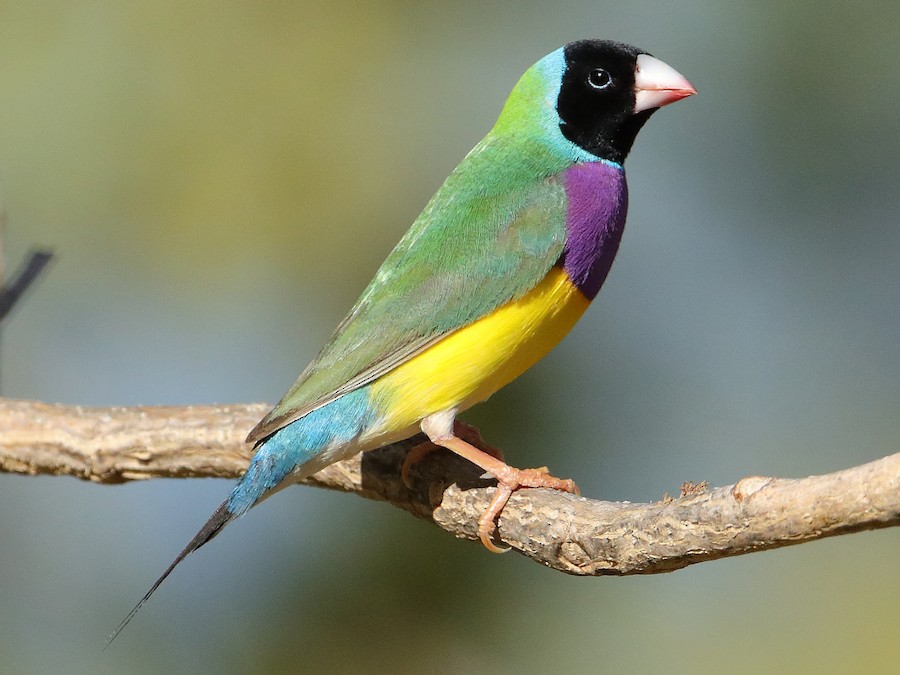
Adults exhibit a dazzling array of colors. The back and wings are bright green, the breast is purple, and the belly is yellow. The rump is bright blue. There are three main head color morphs: red-headed (most common), black-headed, and yellow-headed (rarest). A narrow turquoise band separates the head color from the green nape. The tail is black with elongated central feathers.
- 2
Beak shape
Shape and color of the bill: a key field mark.
Conical and strong, adapted for cracking seeds. The beak is pale horn-colored with a red tip in red-headed birds, or yellowish with a red tip in black-headed and yellow-headed birds. The upper mandible has a red tip, and the lower mandible is pale.
- 3
Eye color
Iris color and any distinctive eye markings.
Dark brown
- 4
Leg color
Leg and foot color.
Pinkish-orange to pale pink
- 5
Distinguishing features
Standout features that separate this species.
The combination of a brightly colored head (red, black, or yellow), turquoise collar, green back, purple breast, and yellow belly is unique. The elongated central tail feathers are also distinctive.
- 6
Juvenile appearance
How young birds differ from adults.
Juveniles are dull olive-green to grey on the head, back, and wings, with a pale greyish-brown belly. The beak is dark grey to black with a pale yellow tip and prominent pale, phosphorescent blue nodules at the gape (corners of the mouth), which serve as targets for feeding parents. They lack the vibrant adult coloration and develop it gradually over several months, typically after their first molt at around 3-4 months of age.
- 7
Seasonal changes
Plumage variation between breeding and non-breeding seasons.
No significant seasonal plumage changes. The vibrant coloration is maintained year-round, though intensity may vary slightly with feather wear or during molting periods.
- 8
Sexual dimorphism
How males and females differ.
Males are generally brighter and more intensely colored than females, particularly the purple on the breast and the yellow on the belly. The male's head color is also typically more vivid. Females often have a paler purple breast and a less extensive yellow belly. The elongated central tail feathers are longer in males.
Key field marks
- Head Color. Look for the distinct head colors: red, black, or yellow. This is the most immediate identifier.
- Body Plumage. Observe the combination of bright green back, purple breast, and yellow belly. No other Australian finch has this specific color pattern.
- Turquoise Collar. Note the narrow, bright turquoise band separating the head color from the green nape. This is a key field mark.
- Tail Feathers. Identify the elongated central tail feathers, especially prominent in males.
- Juvenile Appearance. For juveniles, look for the dull olive-green/grey plumage and the distinctive pale blue phosphorescent nodules at the gape.
Explore the Gouldian Finch
Identify birds anywhere
Free on iOS, Android, and Web. Photo & sound identification, full species database, and your personal life list.