
Spotted a bird? Identify it instantly with the Birdby app
Open the appAbout
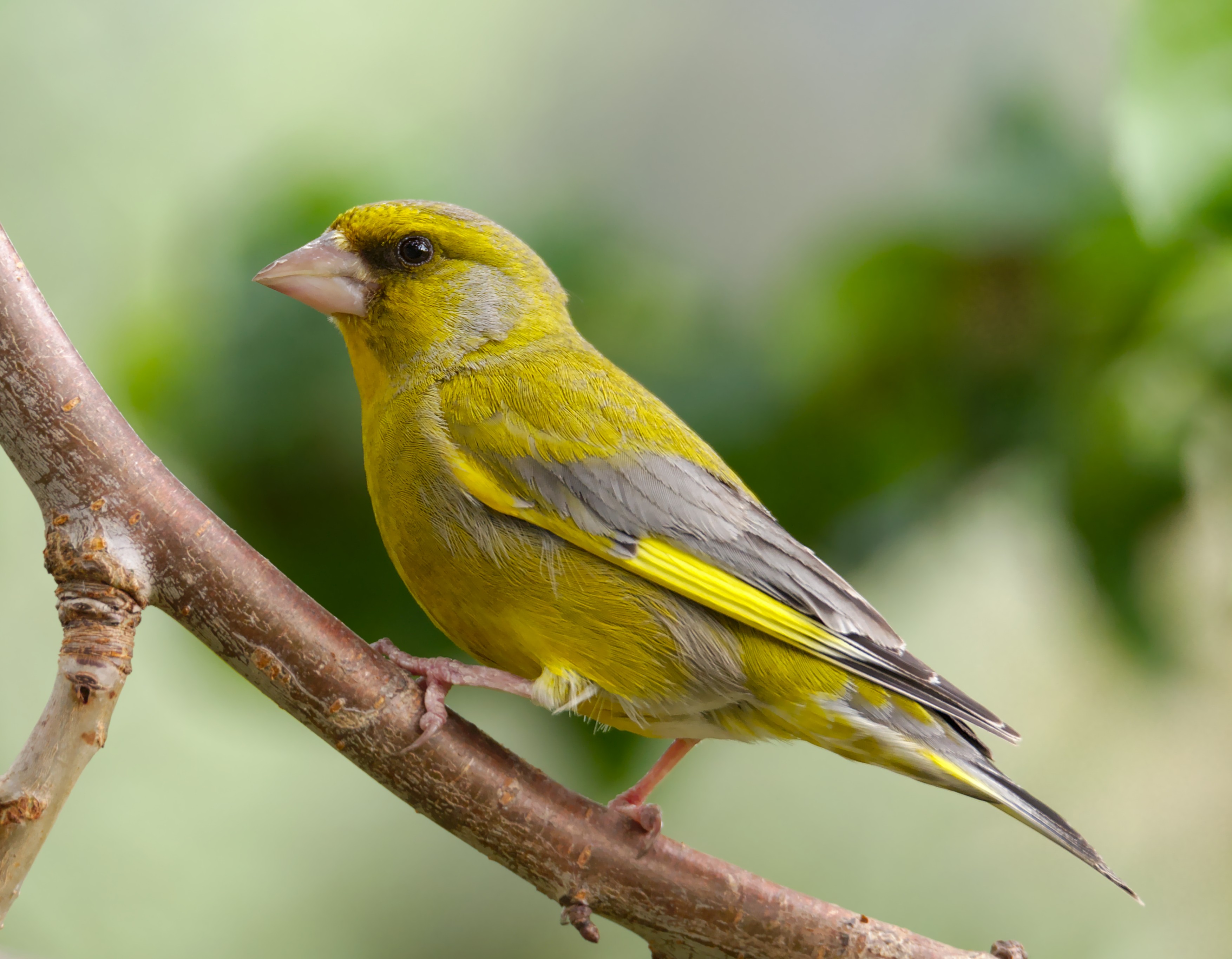
The European Greenfinch is a common and widespread passerine bird in the finch family Fringillidae. It is known for its distinctive olive-green plumage, particularly in males, and its robust, conical bill adapted for seed eating. Often found in gardens, parks, and woodland edges, it is a familiar sight and sound across much of Europe, North Africa, and Southwest Asia.
Size & lifespan
- Length
- 14-16 cm
- Wingspan
- 25-28 cm
- Weight
- 17-34 g
- Lifespan
- 2-5 years (up to 9 years recorded)
- Diet
- Granivore (primarily seeds, some insects)
Physical characteristics
- Plumage
- Males are predominantly olive-green with bright yellow patches on the primaries and tail sides, and a yellowish-green rump. The underparts are paler, more yellowish. Females are duller, with more greyish-green plumage and less prominent yellow wing and tail patches. Juveniles are streaky brown with faint yellow wing patches.
- Beak shape
- Conical, stout, and pale pinkish-horn colored, well-suited for cracking seeds.
- Eye color
- Dark brown
- Leg color
- Pinkish-brown
- Distinguishing features
- Robust build, olive-green plumage (especially males), bright yellow flashes in wings and tail, stout conical bill, undulating flight.
- Juvenile appearance
- Juveniles are heavily streaked brown on the head, back, and underparts, lacking the uniform green of adults. They have faint yellowish wing patches, but these are less defined than in adults.
- Seasonal changes
- Plumage remains largely consistent throughout the year, though colors may appear slightly duller due to feather wear before the annual molt (typically late summer/early autumn).
- Sexual dimorphism
- Pronounced. Males are brighter and more intensely colored with vivid yellow on wings and tail. Females are duller, more greyish-green, and streaky, with less extensive yellow markings.
How to identify
- 1
Plumage Coloration
Look for the overall olive-green body, especially in males. Females are duller, more greyish-green. Juveniles are streaky brown.
- 2
Yellow Wing and Tail Patches
Observe the bright yellow flashes on the primary feathers and the sides of the tail, particularly noticeable in flight or when perched with wings slightly open. These are most prominent in males.
- 3
Bill Shape
Note the stout, conical, pale pinkish-horn bill, indicative of a seed-eating finch.
- 4
Flight Pattern
Watch for its characteristic undulating, 'bouncy' flight.
- 5
Vocalizations
Listen for the distinctive trilling 'dzzzzzzzzzz' song and the nasal 'tweeet' call.
- 6
Habitat
Often found in gardens, parks, and areas with dense shrubs and trees, especially near bird feeders.
Habitat & range
- Biomes
- Temperate forests, woodlands, shrublands, urban and suburban areas.
- Geographic range
- Widespread across Europe, North Africa, and Southwest Asia. Introduced to parts of Australia and New Zealand.
- Elevation range
- Sea level up to approximately 1,500 meters, occasionally higher in some regions.
- Preferred environments
- Gardens, parks, orchards, hedgerows, woodland edges, cultivated land with scattered trees, and coniferous plantations. They thrive in areas with a mix of dense cover for nesting and open areas for foraging.
Behavior
- Activity time
- Diurnal.
- Feeding habits
- Primarily feeds on seeds, especially from trees like elm, beech, and hawthorn, as well as various weeds and cultivated plants. They are frequent visitors to bird feeders, particularly for sunflower seeds. Occasionally consumes insects, especially when feeding young. Forages on the ground or in vegetation.
- Social behavior
- Gregarious outside the breeding season, forming flocks, sometimes mixed with other finches. During breeding, they are territorial but may nest in loose colonies.
- Flight pattern
- Strong, undulating flight, often described as 'bouncy' or 'dipping'.
- Migration pattern
- Mostly resident in much of its range, but northern and eastern populations may undertake short-distance migratory movements to milder areas in winter. Some irruptive movements can occur in harsh winters.
- Territoriality
- Males establish and defend small breeding territories, primarily through song and display flights. Outside the breeding season, they are not territorial.
Song & calls
- Song
- A distinctive, trilling 'dzzzzzzzzzz' or 'tsooeet' often interspersed with a rapid 'chichichichit' and a drawn-out 'sweeeeee'. Often delivered from a prominent perch or during a slow, butterfly-like display flight.
- Call
- Common calls include a sharp 'chip-chip-chip' or 'chup', and a characteristic nasal 'tweeet' or 'tsooeet' often given in flight.
- When they vocalize
- Most vocal during the breeding season (spring and early summer), but calls can be heard year-round, especially when foraging in flocks.
Breeding & reproduction
- Breeding season
- April to August, typically two broods, sometimes three.
- Nesting habits
- Nests are typically built in dense shrubs, hedges, or small trees, often 1-3 meters above the ground. The nest is a neat, cup-shaped structure made of twigs, moss, roots, and grass, lined with finer materials like hair, wool, and feathers.
- Clutch size
- 3-6 eggs (average 4-5)
- Egg description
- 3-6 eggs, typically pale bluish-white or greenish-white, sparsely spotted and streaked with reddish-brown or purplish-grey, mainly at the broad end.
- Incubation period
- 12-14 days, primarily by the female.
- Fledging period
- 13-16 days after hatching.
- Parental care
- Female incubates, male feeds the female during incubation. Both parents feed the nestlings, primarily with regurgitated seeds and some insects.
Where to find
Gardens and Parks
Common visitors to garden bird feeders, especially for sunflower seeds. Look in hedges and dense shrubs.
Woodland Edges and Hedgerows
Frequents the transitional zones between open fields and woodlands, and dense hedgerows.
Orchards and Cultivated Land
Can be found in areas with fruit trees and agricultural land, particularly where there are scattered trees or bushes.
Field tips
- Listen for their song and calls. Their distinctive trilling song and nasal 'tweeet' call are often the first indication of their presence, even before you see them.
- Check bird feeders. They are regular and often dominant visitors to feeders, especially those offering sunflower seeds or nyjer seed.
- Look in dense vegetation. They prefer to nest and roost in dense shrubs and hedges, so scan these areas carefully.
- Observe flight. Their undulating flight pattern is quite characteristic and can help distinguish them from other finches.
Similar species
Common Chaffinch
Fringilla coelebs
Chaffinches are generally smaller, have a more upright posture, and lack the strong olive-green and prominent yellow wing/tail flashes of the Greenfinch. Males have a blue-grey cap and reddish-brown underparts. Their calls and songs are also distinctly different.
Serin
Serinus serinus
Serins are much smaller and more compact, with a shorter tail. Males are brighter yellow overall, especially on the head and breast, and have more streaking on the flanks. Their bill is smaller and more pointed. Serins have a distinctive 'trilling' song.
Yellowhammer
Emberiza citrinella
Yellowhammers are larger, with a longer tail and a more upright stance. Males have a bright yellow head and underparts with chestnut streaking on the back. They are buntings, not finches, and their bill shape is slightly different. Their song is a distinctive 'a little bit of bread and no cheese'.
Quick facts
- Family:
- Fringillidae (Finches)
- Diet:
- Seeds (granivorous)
- Habitat:
- Gardens, parks, woodlands, hedgerows
- Conservation Status:
- Least Concern
- Distinguishing Feature:
- Olive-green plumage, yellow wing/tail flashes, stout bill
Fun facts
- The European Greenfinch was once classified in the genus Carduelis, but genetic studies led to its reclassification into the genus Chloris.
- They are known to be quite aggressive at bird feeders, often dominating smaller species.
- The species suffered a significant population decline in the UK and parts of Europe due to an outbreak of the parasite Trichomonas gallinae, which causes avian trichomonosis. While populations are recovering in some areas, it remains a concern.
- Their stout bill is perfectly adapted for cracking open tough seeds, allowing them to exploit a food source inaccessible to many other small birds.
Scientific classification
- Kingdom
- Animalia
- Phylum
- Chordata
- Class
- Aves
- Order
- Passeriformes
- Family
- Fringillidae
- Genus
- Chloris
- Species
- Chloris chloris
Explore the European Greenfinch
Identify birds anywhere
Free on iOS, Android, and Web. Photo & sound identification, full species database, and your personal life list.