
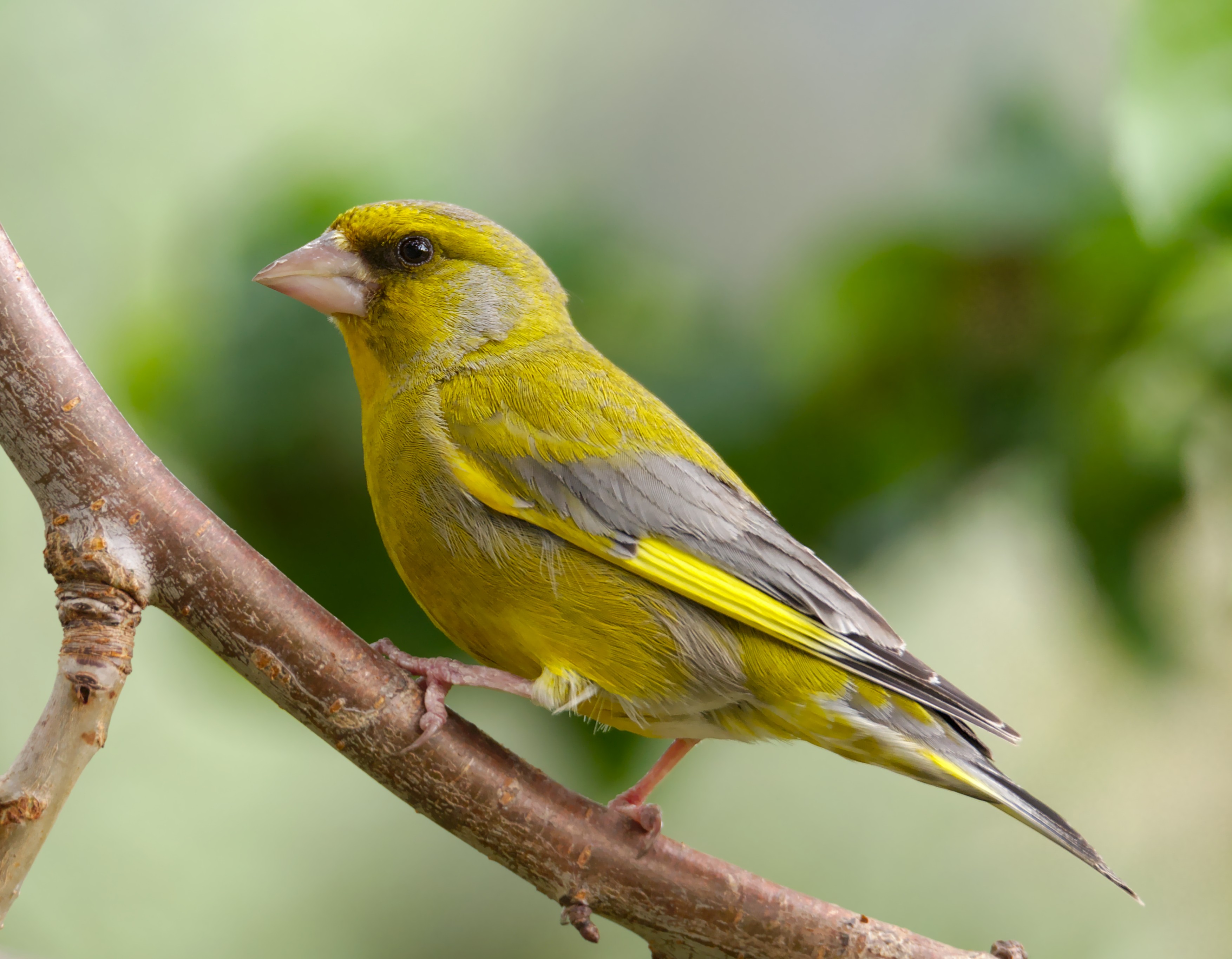
How to identify the European Greenfinch
Chloris chloris
Spotted a bird? Identify it instantly with the Birdby app
Open the appTo correctly identify the European Greenfinch (Chloris chloris), check each of these features. Birds can be tricky: habit, habitat, and call often confirm a sighting that a single photo cannot.
Size at a glance
- Length
- 14-16 cm
- Wingspan
- 25-28 cm
- Weight
- 17-34 g
Physical features to check
- 1
Plumage
Overall feather coloration and pattern.
Males are predominantly olive-green with bright yellow patches on the primaries and tail sides, and a yellowish-green rump. The underparts are paler, more yellowish. Females are duller, with more greyish-green plumage and less prominent yellow wing and tail patches. Juveniles are streaky brown with faint yellow wing patches.
- 2
Beak shape
Shape and color of the bill: a key field mark.
Conical, stout, and pale pinkish-horn colored, well-suited for cracking seeds.
- 3
Eye color
Iris color and any distinctive eye markings.
Dark brown
- 4
Leg color
Leg and foot color.
Pinkish-brown
- 5
Distinguishing features
Standout features that separate this species.
Robust build, olive-green plumage (especially males), bright yellow flashes in wings and tail, stout conical bill, undulating flight.
- 6
Juvenile appearance
How young birds differ from adults.
Juveniles are heavily streaked brown on the head, back, and underparts, lacking the uniform green of adults. They have faint yellowish wing patches, but these are less defined than in adults.
- 7
Seasonal changes
Plumage variation between breeding and non-breeding seasons.
Plumage remains largely consistent throughout the year, though colors may appear slightly duller due to feather wear before the annual molt (typically late summer/early autumn).
- 8
Sexual dimorphism
How males and females differ.
Pronounced. Males are brighter and more intensely colored with vivid yellow on wings and tail. Females are duller, more greyish-green, and streaky, with less extensive yellow markings.
Key field marks
- Plumage Coloration. Look for the overall olive-green body, especially in males. Females are duller, more greyish-green. Juveniles are streaky brown.
- Yellow Wing and Tail Patches. Observe the bright yellow flashes on the primary feathers and the sides of the tail, particularly noticeable in flight or when perched with wings slightly open. These are most prominent in males.
- Bill Shape. Note the stout, conical, pale pinkish-horn bill, indicative of a seed-eating finch.
- Flight Pattern. Watch for its characteristic undulating, 'bouncy' flight.
- Vocalizations. Listen for the distinctive trilling 'dzzzzzzzzzz' song and the nasal 'tweeet' call.
- Habitat. Often found in gardens, parks, and areas with dense shrubs and trees, especially near bird feeders.
Explore the European Greenfinch
Identify birds anywhere
Free on iOS, Android, and Web. Photo & sound identification, full species database, and your personal life list.