
Spotted a bird? Identify it instantly with the Birdby app
Open the appAbout
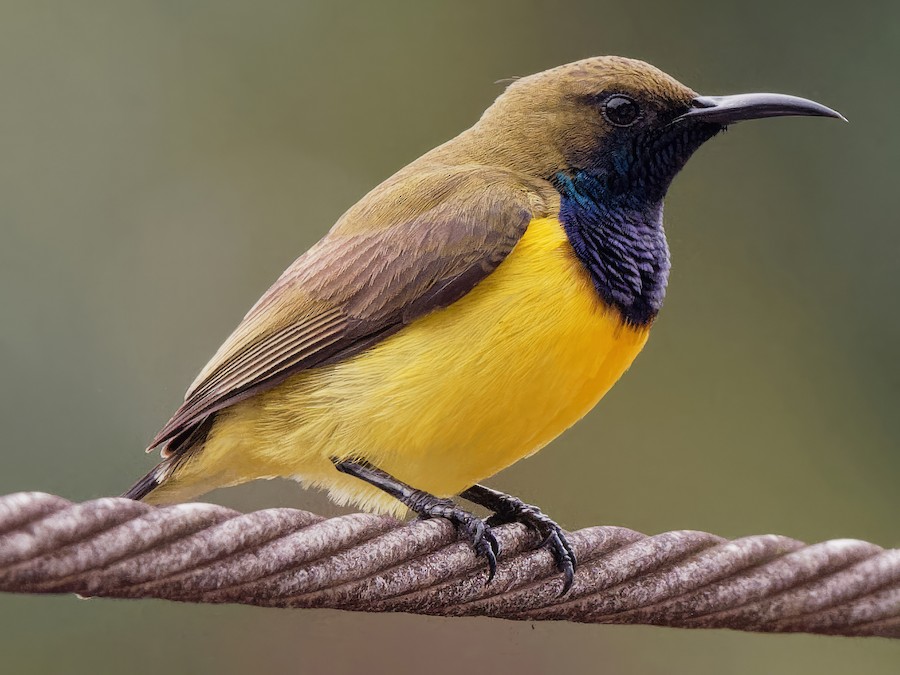
The Olive-backed Sunbird, also known as the Yellow-bellied Sunbird, is a small passerine bird of the sunbird family Nectariniidae. It is widely distributed across Southeast Asia and northeastern Australia, known for its vibrant iridescent plumage in males and its active, nectar-feeding behavior. These birds are common residents in a variety of habitats, often found in gardens and urban areas.
Size & lifespan
- Length
- 10-12 cm
- Wingspan
- 13-15 cm
- Weight
- 6-11 g
- Lifespan
- 3-5 years in the wild
- Diet
- Nectarivore (primarily nectar, supplemented with small insects and spiders)
Physical characteristics
- Plumage
- Males have a metallic, iridescent blue-black throat and upper breast, contrasting with a bright yellow belly and olive-green back. The rump is also olive-green. Females lack the iridescent throat, having a duller olive-green head and upperparts, and a bright yellow underparts. Both sexes have a slender, decurved black bill and dark legs.
- Beak shape
- Long, slender, and decurved (downward-curved) black bill, adapted for probing into flowers.
- Eye color
- Dark brown
- Leg color
- Dark grey to black
- Distinguishing features
- The combination of a metallic blue-black throat/upper breast (male) or plain olive-green head (female) with a bright yellow belly and olive-green back is distinctive. Their small size and rapid, darting flight are also key features.
- Juvenile appearance
- Juveniles resemble adult females, but are generally duller, with a paler yellow belly and sometimes a faint streaking on the breast. Young males gradually acquire the iridescent throat patch as they mature.
- Seasonal changes
- No significant seasonal plumage changes. Plumage remains consistent throughout the year, though wear and tear can make colors appear slightly duller over time.
- Sexual dimorphism
- Pronounced. Males are much more brightly colored with iridescent blue-black on the throat and upper breast, while females are duller, lacking the iridescent patch and having an olive-green head.
How to identify
- 1
Size and Shape
Small, slender bird with a long, thin, decurved bill. Often appears active and restless.
- 2
Male Plumage
Look for the striking metallic blue-black throat and upper breast, contrasting sharply with the bright yellow belly and olive-green back. The iridescent patch can appear black in poor light.
- 3
Female Plumage
Identify by the plain olive-green head and upperparts, and bright yellow underparts. Lacks any iridescent patches.
- 4
Behavior
Observe its feeding habits: hovering or perching at flowers to sip nectar. Its rapid, darting flight is also characteristic.
- 5
Vocalizations
Listen for its high-pitched, rapid, and often repetitive 'chew-chew-chew' song or sharp 'chip' calls.
Habitat & range
- Biomes
- Tropical and subtropical moist broadleaf forests, mangroves, shrublands, gardens, and urban areas.
- Geographic range
- Southeast Asia, including India (northeastern), Bangladesh, Myanmar, Thailand, Laos, Cambodia, Vietnam, Malaysia, Singapore, Indonesia, Philippines, Papua New Guinea, and northeastern Australia.
- Elevation range
- Sea level up to 1,800 meters, occasionally higher.
- Preferred environments
- Highly adaptable, preferring areas with abundant flowering plants, including coastal scrub, forest edges, plantations, parks, and residential gardens. They are often found in disturbed habitats.
Behavior
- Activity time
- Diurnal, most active during daylight hours, particularly in the morning and late afternoon.
- Feeding habits
- Primarily feeds on nectar, using its long, brush-tipped tongue to extract nectar from a wide variety of flowers. Also consumes small insects and spiders, especially when feeding young, which are caught on the wing or gleaned from foliage. They often hover briefly in front of flowers or perch while feeding.
- Social behavior
- Typically seen singly or in pairs, especially during the breeding season. Outside of breeding, they may form small, loose foraging groups. They are generally quite tame and accustomed to human presence in urban environments.
- Flight pattern
- Fast, direct, and often darting or hovering, especially when feeding at flowers. Their small size and rapid wingbeats give them a 'bee-like' flight.
- Migration pattern
- Resident throughout its range, with no significant migratory movements. Local movements may occur in response to flowering seasons or food availability.
- Territoriality
- Males can be territorial, especially during the breeding season, defending prime feeding areas and nesting sites from rivals. They will chase away other sunbirds and even larger birds.
Song & calls
- Song
- A rapid, high-pitched, and often repetitive series of 'chew-chew-chew' or 'swee-swee-swee' notes, sometimes interspersed with trills and whistles. It can be quite energetic and varied.
- Call
- Common calls include a sharp 'chip' or 'zit' note, often given while foraging or in flight. Alarm calls are typically more insistent and rapid 'chit-chit-chit'.
- When they vocalize
- Most vocal during the breeding season, but calls can be heard year-round, especially when foraging or interacting with other birds.
Breeding & reproduction
- Breeding season
- Varies geographically, often coinciding with the availability of flowering plants. In many parts of its range, it can breed year-round, with peaks during the dry season or after monsoons.
- Nesting habits
- The female builds a distinctive pear-shaped or purse-shaped nest, suspended from a branch or leaf, often in a sheltered location like a porch or under a roof eave. The nest is constructed from fine grass, plant fibers, spider webs, and often decorated with bits of leaves, bark, or even rubbish, with a small side entrance.
- Clutch size
- 2-3 eggs
- Egg description
- Typically 2-3 eggs, oval-shaped, whitish or pale greenish-blue, often speckled or mottled with brown or grey, particularly at the broader end.
- Incubation period
- 13-14 days, primarily by the female.
- Fledging period
- 13-16 days after hatching. Both parents feed the nestlings.
- Parental care
- Both parents participate in feeding the young, though the female does most of the incubation and initial brooding. Males are active in defending the nest and bringing food.
Where to find
Gardens and Parks
Common in urban and suburban gardens, parks, and cultivated areas with flowering plants.
Forest Edges and Open Woodlands
Found along the edges of forests, in secondary growth, and open woodlands.
Mangroves and Coastal Areas
Present in coastal scrub and mangrove forests, especially where flowering plants are abundant.
Field tips
- Look for flowering plants. Focus your search on areas with a variety of blooming flowers, as nectar is their primary food source. Hibiscus, bougainvillea, and banana flowers are often favored.
- Listen for calls. Their high-pitched calls and songs are often the first indication of their presence, even before you see them.
- Observe active feeding. They are very active feeders. Watch for small birds darting between flowers or hovering briefly to feed.
- Check under eaves and sheltered spots. During breeding season, look for their distinctive hanging nests in sheltered locations around human habitation.
Similar species
Brown-throated Sunbird
Anthreptes malacensis
The Brown-throated Sunbird is larger, has a thicker bill, and lacks the iridescent blue-black throat of the male Olive-backed Sunbird. Its throat is dull brown, and its underparts are a duller yellow. Females are also duller overall.
Copper-throated Sunbird
Leptocoma calcostetha
Males have a metallic copper-red throat and breast, which is distinctly different from the blue-black of the Olive-backed Sunbird. Females are also generally darker and less yellow on the underparts.
Purple-throated Sunbird
Leptocoma sperata
Males have a metallic purple throat and breast, contrasting with a red band across the upper breast, and a yellow belly. The iridescent color is purple, not blue-black. Females are also different, often with a yellowish wash on the throat.
Quick facts
- Diet:
- Nectar and small insects
- Nest Type:
- Pear-shaped hanging nest
- Male Plumage:
- Iridescent blue-black throat, yellow belly, olive back
- Female Plumage:
- Olive-green upperparts, yellow belly
- Conservation Status:
- Least Concern
Fun facts
- The Olive-backed Sunbird is one of the most common and widespread sunbird species in Southeast Asia and Australia.
- Despite their small size, they are quite aggressive and territorial, especially males defending their feeding patches.
- Their long, decurved bill and brush-tipped tongue are perfectly adapted for extracting nectar from deep flowers, similar to hummingbirds in the Americas.
- They are often seen 'robbing' nectar by piercing the base of flowers that are too deep for their bills, rather than entering through the opening.
Scientific classification
- Kingdom
- Animalia
- Phylum
- Chordata
- Class
- Aves
- Order
- Passeriformes
- Family
- Nectariniidae
- Genus
- Cinnyris
- Species
- Cinnyris jugularis
Explore the Olive-backed Sunbird
Identify birds anywhere
Free on iOS, Android, and Web. Photo & sound identification, full species database, and your personal life list.