
How to identify the Olive-backed Sunbird
Cinnyris jugularis
Spotted a bird? Identify it instantly with the Birdby app
Open the appTo correctly identify the Olive-backed Sunbird (Cinnyris jugularis), check each of these features. Birds can be tricky: habit, habitat, and call often confirm a sighting that a single photo cannot.
Size at a glance
- Length
- 10-12 cm
- Wingspan
- 13-15 cm
- Weight
- 6-11 g
Physical features to check
- 1
Plumage
Overall feather coloration and pattern.
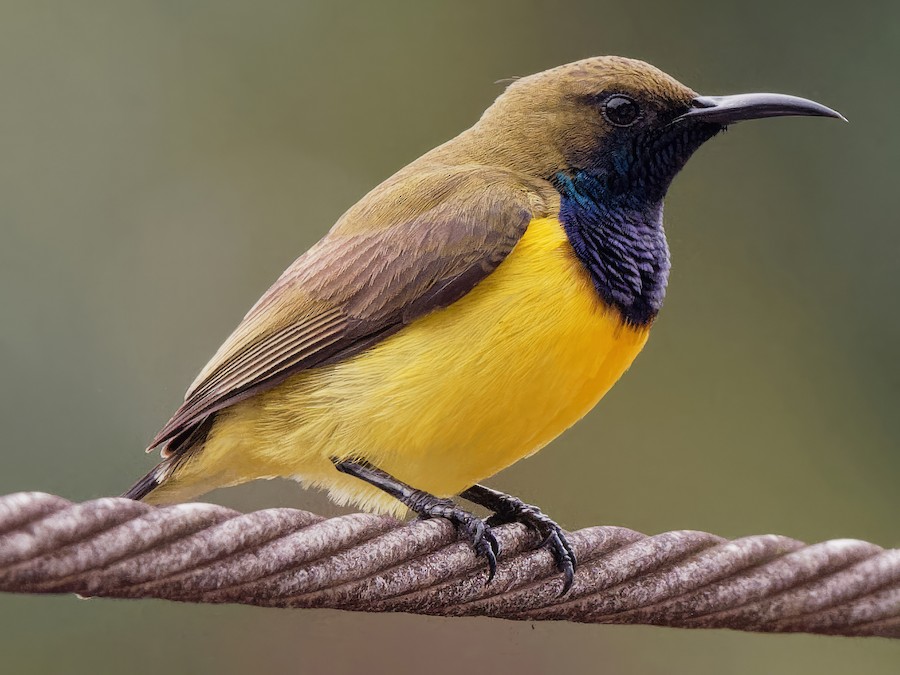
Males have a metallic, iridescent blue-black throat and upper breast, contrasting with a bright yellow belly and olive-green back. The rump is also olive-green. Females lack the iridescent throat, having a duller olive-green head and upperparts, and a bright yellow underparts. Both sexes have a slender, decurved black bill and dark legs.
- 2
Beak shape
Shape and color of the bill: a key field mark.
Long, slender, and decurved (downward-curved) black bill, adapted for probing into flowers.
- 3
Eye color
Iris color and any distinctive eye markings.
Dark brown
- 4
Leg color
Leg and foot color.
Dark grey to black
- 5
Distinguishing features
Standout features that separate this species.
The combination of a metallic blue-black throat/upper breast (male) or plain olive-green head (female) with a bright yellow belly and olive-green back is distinctive. Their small size and rapid, darting flight are also key features.
- 6
Juvenile appearance
How young birds differ from adults.
Juveniles resemble adult females, but are generally duller, with a paler yellow belly and sometimes a faint streaking on the breast. Young males gradually acquire the iridescent throat patch as they mature.
- 7
Seasonal changes
Plumage variation between breeding and non-breeding seasons.
No significant seasonal plumage changes. Plumage remains consistent throughout the year, though wear and tear can make colors appear slightly duller over time.
- 8
Sexual dimorphism
How males and females differ.
Pronounced. Males are much more brightly colored with iridescent blue-black on the throat and upper breast, while females are duller, lacking the iridescent patch and having an olive-green head.
Key field marks
- Size and Shape. Small, slender bird with a long, thin, decurved bill. Often appears active and restless.
- Male Plumage. Look for the striking metallic blue-black throat and upper breast, contrasting sharply with the bright yellow belly and olive-green back. The iridescent patch can appear black in poor light.
- Female Plumage. Identify by the plain olive-green head and upperparts, and bright yellow underparts. Lacks any iridescent patches.
- Behavior. Observe its feeding habits: hovering or perching at flowers to sip nectar. Its rapid, darting flight is also characteristic.
- Vocalizations. Listen for its high-pitched, rapid, and often repetitive 'chew-chew-chew' song or sharp 'chip' calls.
Explore the Olive-backed Sunbird
Identify birds anywhere
Free on iOS, Android, and Web. Photo & sound identification, full species database, and your personal life list.