
Spotted a bird? Identify it instantly with the Birdby app
Open the appAbout
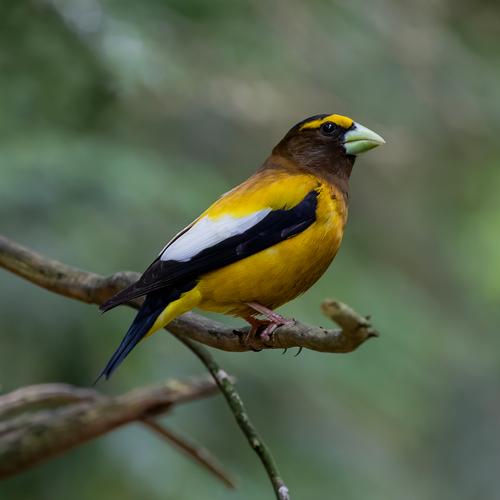
The Evening Grosbeak is a large, stocky finch known for its striking plumage, particularly in males, and its massive, conical bill. They are often found in coniferous and mixed forests across North America, frequently visiting bird feeders, especially during winter irruptions.
Size & lifespan
- Length
- 18-22 cm (7.1-8.7 in)
- Wingspan
- 30-36 cm (11.8-14.2 in)
- Weight
- 50-70 g (1.8-2.5 oz)
- Lifespan
- Typically 3-7 years in the wild, with records up to 13 years.
- Diet
- Omnivore (primarily granivorous and insectivorous)
Physical characteristics
- Plumage
- Males are brightly colored with a bright yellow body, dark head with a prominent yellow eyebrow, and large white patches on the black wings. Females and juveniles are duller, mostly grayish-brown with yellowish tinges, especially on the flanks and nape, and smaller white wing patches.
- Beak shape
- Very large, conical, and pale yellowish-green to ivory-colored bill, particularly noticeable in males. The bill can appear darker in winter.
- Eye color
- Dark brown.
- Leg color
- Pinkish-brown to dark brown.
- Distinguishing features
- Massive, pale bill; short, notched tail; and distinctive white wing patches (more extensive in males).
- Juvenile appearance
- Similar to females but often with more streaking on the underparts and a duller overall appearance. The bill is initially smaller and darker.
- Seasonal changes
- Little to no significant seasonal plumage change, though bill color can vary slightly with season (paler in breeding season, sometimes darker in winter).
- Sexual dimorphism
- Pronounced. Males are much more brightly colored with vivid yellow and black, while females are predominantly grayish-brown with less extensive yellow and white markings.
How to identify
- 1
Size and Shape
Look for a large, stocky finch with a short tail and a very large, conical bill.
- 2
Male Plumage
Bright yellow body, black wings with large white patches, dark head with a yellow eyebrow. Unmistakable.
- 3
Female/Juvenile Plumage
Grayish-brown overall with yellowish tinges, especially on the flanks and nape. Look for smaller but still noticeable white wing patches and the characteristic large, pale bill.
- 4
Bill
The massive, pale yellowish-green to ivory bill is a key identifier for all ages and sexes.
- 5
Calls
Listen for the sharp, metallic 'peck' or 'cleep' call, often given in flight or while feeding in flocks.
Habitat & range
- Biomes
- Coniferous forests, mixed forests, deciduous forests, suburban areas with mature trees.
- Geographic range
- North America, from central Canada south through the western mountains of the United States and into Mexico. Irruptive movements can bring them further east and south during winter.
- Elevation range
- Sea level to over 3,000 meters (10,000 feet), typically breeding at higher elevations in the western mountains.
- Preferred environments
- Mature forests, especially those with spruce, fir, pine, and aspen. They are also attracted to orchards, parks, and backyard feeders, particularly during non-breeding seasons.
Behavior
- Activity time
- Diurnal.
- Feeding habits
- Primarily feeds on seeds, especially those of conifers (spruce, fir, pine) and deciduous trees (maple, ash, cherry). They also consume berries, small fruits, and a significant number of insects, particularly spruce budworms during outbreaks. They use their powerful bills to crack open tough seeds. Often forages in flocks.
- Social behavior
- Highly social, especially outside the breeding season. They form large, noisy flocks that can number in the hundreds, particularly at feeders or during migration. During breeding, they are more solitary but may nest in loose colonies.
- Flight pattern
- Strong, undulating flight, typical of finches. They often fly in compact flocks.
- Migration pattern
- Partial migrant. Northern populations are migratory, moving south for winter. Western populations are often resident or undertake altitudinal migrations. Known for irruptive movements, where large numbers move far outside their typical winter range in response to food shortages.
- Territoriality
- Males defend a small territory around the nest during the breeding season, but feeding areas are often shared.
Song & calls
- Song
- The song is a series of short, high-pitched, somewhat squeaky whistles and trills, often described as 'cleer-cleer-cleer' or 'pew-pew-pew'. It is not particularly musical or complex.
- Call
- The most common call is a sharp, metallic 'peck' or 'cleep', often given in flight or while foraging. They also have a softer 'tsew' call.
- When they vocalize
- Most vocal during the breeding season and when foraging in flocks. Calls are heard year-round.
Breeding & reproduction
- Breeding season
- Late April to August, with peak activity in May and June.
- Nesting habits
- Nests are typically built in coniferous or deciduous trees, often high up (6-20 meters or 20-65 feet) on a horizontal branch, well concealed by foliage. The nest is a bulky, open cup made of twigs, rootlets, bark strips, and moss, lined with finer materials like grass, hair, and lichens.
- Clutch size
- 2-4 eggs, typically 3.
- Egg description
- 2-4 eggs, pale blue or greenish-blue, heavily marked with brown, purple, or gray spots and blotches, especially at the larger end.
- Incubation period
- 11-14 days, primarily by the female.
- Fledging period
- 13-14 days after hatching.
- Parental care
- Female incubates and broods, while the male brings food to the female and later to the nestlings. Both parents feed the young after they fledge.
Where to find
Coniferous and Mixed Forests
Especially in the western mountains and boreal forests of North America. Look for areas with spruce, fir, and pine.
Bird Feeders
They are frequent visitors to feeders, particularly those offering black oil sunflower seeds, especially during winter and irruptive years.
Parks and Suburban Areas
Mature trees in parks and backyards can attract them, especially if feeders are present.
Field tips
- Listen for calls. Their distinctive 'cleep' call is often heard before the birds are seen, especially when they are flying overhead in flocks.
- Check feeders. If you live within their range, keeping a feeder stocked with black oil sunflower seeds can attract them, particularly in winter.
- Look for flocks. Evening Grosbeaks are highly social and are almost always found in flocks, sometimes quite large ones. Scan tree tops and feeders for groups of birds.
- Observe feeding behavior. Watch them crack open seeds with their powerful bills; this behavior is characteristic.
Similar species
Pine Grosbeak
Pinicola enucleator
Pine Grosbeaks are larger, have a smaller, more rounded bill, and lack the prominent white wing patches of the Evening Grosbeak. Males are rosy-red, and females are grayish with yellow or orange on the head and rump, lacking the bright yellow body of male Evening Grosbeaks.
Yellow-billed Grosbeak
Eophona migratoria
Found in Asia, not North America. While also having a large yellow bill, its plumage is distinct, with a black head and gray body.
Quick facts
- Conservation Status:
- Vulnerable (IUCN Red List)
- Diet:
- Seeds, insects, berries
- Habitat:
- Coniferous and mixed forests
- Migration:
- Partial migrant, irruptive
- Bill:
- Massive, pale, conical
Fun facts
- The Evening Grosbeak's population has experienced significant declines in recent decades, particularly in the eastern part of its range, leading to its 'Vulnerable' conservation status. Reasons are thought to include habitat loss, pesticide use affecting insect prey (like spruce budworm), and climate change.
- Their name 'Evening Grosbeak' is a bit of a misnomer; they are active during the day, not just in the evening. The name likely comes from early observations of them feeding late in the day.
- They are highly nomadic and irruptive, meaning their winter distribution can vary dramatically from year to year depending on food availability. This makes them exciting and unpredictable visitors to bird feeders.
- Their powerful bills are capable of cracking open very hard seeds, including those of cherry pits and sunflower seeds, which few other birds can manage.
- During outbreaks of spruce budworm, Evening Grosbeaks can switch their diet almost entirely to these caterpillars, playing a significant role in controlling pest populations.
Scientific classification
- Kingdom
- Animalia
- Phylum
- Chordata
- Class
- Aves
- Order
- Passeriformes
- Family
- Fringillidae
- Genus
- Coccothraustes
- Species
- Coccothraustes vespertinus
Explore the Evening Grosbeak
Identify birds anywhere
Free on iOS, Android, and Web. Photo & sound identification, full species database, and your personal life list.