
Spotted a bird? Identify it instantly with the Birdby app
Open the appAbout
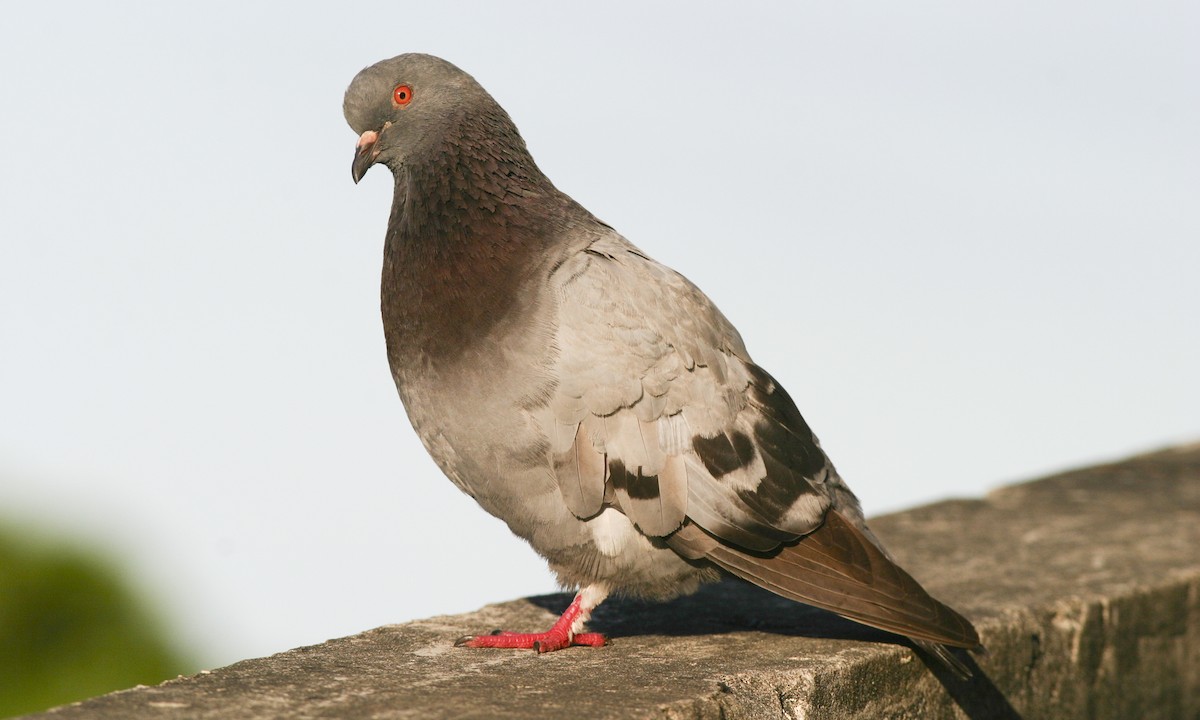
The Feral Pigeon, or Rock Dove (Columba livia domestica), is a domesticated descendant of the wild Rock Dove (Columba livia) that has returned to the wild. It is one of the most common and widespread birds globally, particularly in urban environments. Known for its adaptability and intelligence, it thrives in close proximity to humans.
Size & lifespan
- Length
- 30-35 cm (12-14 in)
- Wingspan
- 60-70 cm (24-28 in)
- Weight
- 230-380 g (8.1-13.4 oz)
- Lifespan
- 3-5 years in urban environments, up to 15 years in captivity or less harsh conditions
- Diet
- Omnivore, primarily granivorous (seeds, grains), but highly opportunistic, consuming human food scraps, insects, and invertebrates.
Physical characteristics
- Plumage
- Highly variable due to domestication and interbreeding. The ancestral wild type is slate-grey with iridescent green and purple sheens on the neck and breast, two prominent black wing bars, and a white rump. Feral populations exhibit a wide range of colors including solid black, white, brown, pied (mixed colors), and various shades of grey, often with reduced or absent wing bars. The primary flight feathers are typically darker.
- Beak shape
- Slender, dark grey to black, with a prominent white cere (fleshy patch) at the base of the upper mandible.
- Eye color
- Typically orange-red, sometimes yellow or dark brown, with a pale orbital ring.
- Leg color
- Reddish-pink to dark red, scaly.
- Distinguishing features
- Variable plumage, characteristic head-bobbing walk, stout body, relatively small head, and short legs. The white cere at the base of the beak is a consistent feature.
- Juvenile appearance
- Juveniles resemble adults but have duller plumage, less iridescence on the neck, and a greyish cere that gradually whitens with age. Their eyes may also appear duller.
- Seasonal changes
- No significant seasonal plumage changes. Plumage variations are primarily genetic and age-related.
- Sexual dimorphism
- Minimal. Males tend to be slightly larger and have more pronounced iridescence on the neck, and may display more vigorous courtship bowing. However, these differences are often subtle and not reliable for field identification.
How to identify
- 1
Plumage Variability
Look for the wide range of colors and patterns, from classic grey with two black wing bars to solid black, white, brown, or pied. The ancestral grey form with a white rump is a good indicator, but many variations exist.
- 2
Head and Beak
Note the relatively small head, the slender dark beak, and especially the prominent white, fleshy cere at the base of the upper mandible.
- 3
Walk and Behavior
Observe its characteristic head-bobbing walk while foraging on the ground. Its comfort and presence in urban environments are strong indicators.
- 4
Flight
Watch for its strong, direct flight with rapid wing beats. Often seen flying in flocks.
- 5
Vocalization
Listen for the soft, guttural 'coo-COO-coo-coo' call, especially during courtship or when interacting with others.
Habitat & range
- Biomes
- Urban, suburban, agricultural, coastal cliffs (ancestral habitat).
- Geographic range
- Cosmopolitan, found on every continent except Antarctica. Originally native to Europe, North Africa, and Asia, but introduced globally.
- Elevation range
- Sea level up to high altitudes in mountainous regions, particularly where human settlements exist.
- Preferred environments
- Cities, towns, villages, farms, industrial areas, bridges, buildings, cliffs, and other structures that provide ledges for roosting and nesting, and access to food and water.
Behavior
- Activity time
- Diurnal. Most active during daylight hours, foraging and interacting. Roosts communally at night on ledges or sheltered structures.
- Feeding habits
- Forages primarily on the ground, walking and pecking. Highly opportunistic, consuming seeds, grains, berries, insects, snails, and human food waste (bread, popcorn, etc.). Will also visit bird feeders. Often seen congregating in areas where food is readily available.
- Social behavior
- Highly social, typically found in flocks of varying sizes, from a few individuals to hundreds or thousands in urban centers. Forms monogamous pairs during breeding season but maintains flocking behavior outside of nesting duties.
- Flight pattern
- Strong, direct, and swift flight with rapid wing beats. Can glide for short distances. Often flies in flocks, especially when commuting between roosting and feeding sites.
- Migration pattern
- Non-migratory; resident throughout its range. Individuals may make local movements between feeding and roosting sites.
- Territoriality
- Generally not territorial over feeding grounds, but pairs will defend a small area around their nest site during breeding.
Song & calls
- Song
- Does not have a complex song. The primary vocalization is a soft, guttural 'coo-COO-coo-coo' or 'roo-COO-coo-coo' used during courtship and territorial displays.
- Call
- A variety of soft cooing sounds. Alarm call is a sharper, more urgent 'coo'. A 'whistle' can sometimes be heard from the wings during rapid flight, especially when startled.
- When they vocalize
- Vocalizes throughout the day, particularly during courtship displays in the breeding season, and when interacting with other pigeons.
Breeding & reproduction
- Breeding season
- Year-round in many urban areas, with peaks in spring and summer (March-October in temperate zones). Can have multiple broods per year.
- Nesting habits
- Nests on ledges of buildings, bridges, cliffs, and other sheltered structures. The nest is a flimsy platform of twigs, grass, and debris, often barely containing the eggs. Both parents participate in nest building.
- Clutch size
- 1-3 eggs, most commonly 2.
- Egg description
- Typically two pure white, elliptical eggs, smooth and non-glossy.
- Incubation period
- 17-19 days, shared by both parents.
- Fledging period
- 25-32 days. Young are altricial (helpless at birth) and fed 'pigeon milk' (crop milk) by both parents.
- Parental care
- Both parents incubate eggs and feed the young. Young are fed crop milk for the first few days, then regurgitated seeds and other food items.
Where to find
Urban Centers
Parks, plazas, city streets, building ledges, train stations, and any area with human activity and food sources.
Suburban Areas
Backyards, gardens, shopping centers, and residential areas, especially near bird feeders or where food scraps are available.
Agricultural Lands
Barns, silos, grain storage facilities, and fields where grains are grown.
Coastal Cliffs
In some regions, particularly where wild Rock Doves persist or feral populations have reverted to more natural habits, they can be found nesting on sea cliffs.
Field tips
- Look up. Check ledges, eaves, and rooftops of buildings for roosting and nesting birds.
- Observe ground foragers. They are frequently seen walking and pecking for food on sidewalks, parks, and open ground.
- Listen for cooing. Their characteristic cooing calls are often heard in areas where they congregate.
- Visit public spaces. Pigeons are highly habituated to humans and are easily observed in busy public areas.
Similar species
Stock Dove
Columba oenas
Stock Doves are generally smaller, lack the white rump and prominent black wing bars of the ancestral Rock Dove (though feral pigeons vary), and have dark eyes. They also lack the prominent white cere of the Feral Pigeon.
Common Wood Pigeon
Columba palumbus
Wood Pigeons are significantly larger, have a distinctive white patch on the side of the neck (adults), and a white wing bar visible in flight. Their call is a much deeper, five-note 'coo-COO-coo-coo-coo'.
Band-tailed Pigeon
Patagioenas fasciata
Found in the Americas. Larger than Feral Pigeons, with a distinctive white crescent on the nape (adults), a yellow bill and feet, and a broad pale band on the tail.
Quick facts
- Global Distribution:
- Cosmopolitan (found worldwide)
- Diet:
- Opportunistic Omnivore (primarily granivorous)
- Sociality:
- Highly social, forms flocks
- Nesting:
- Ledges of buildings, cliffs, structures
- Breeding:
- Year-round in many areas, multiple broods
Fun facts
- Feral Pigeons are descendants of domesticated Rock Doves, originally bred for food, messengers, and racing.
- They are incredibly intelligent, capable of recognizing human faces, navigating complex environments, and even performing abstract tasks.
- Pigeons can find their way home from hundreds of miles away, a skill utilized for centuries in pigeon post.
- They produce 'crop milk' (also known as pigeon milk), a nutrient-rich secretion from their crop, to feed their young, a trait shared with flamingos and male emperor penguins.
- Despite their commonness, the wild ancestral Rock Dove (Columba livia) is increasingly rare and threatened by hybridization with feral populations.
Scientific classification
- Kingdom
- Animalia
- Phylum
- Chordata
- Class
- Aves
- Order
- Columbiformes
- Family
- Columbidae
- Genus
- Columba
- Species
- Columba livia
Explore the Rock Dove (Feral Pigeon)
Identify birds anywhere
Free on iOS, Android, and Web. Photo & sound identification, full species database, and your personal life list.