
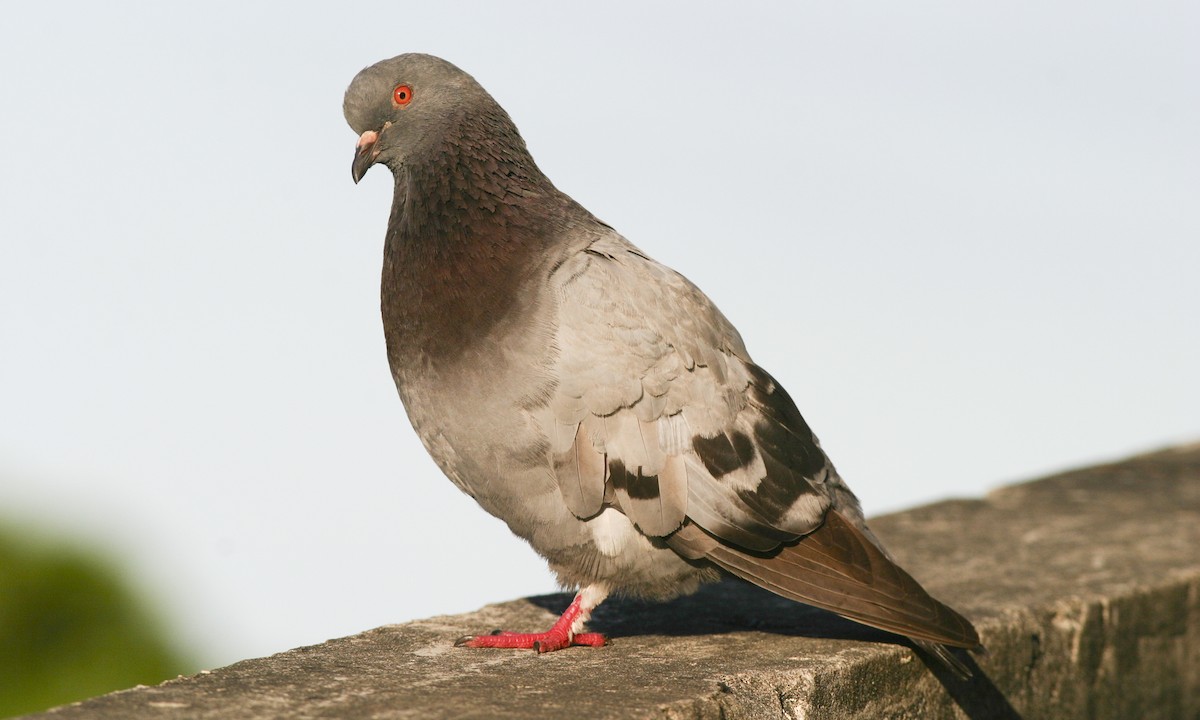
How to identify the Rock Dove (Feral Pigeon)
Columba livia domestica
Spotted a bird? Identify it instantly with the Birdby app
Open the appTo correctly identify the Rock Dove (Feral Pigeon) (Columba livia domestica), check each of these features. Birds can be tricky: habit, habitat, and call often confirm a sighting that a single photo cannot.
Size at a glance
- Length
- 30-35 cm (12-14 in)
- Wingspan
- 60-70 cm (24-28 in)
- Weight
- 230-380 g (8.1-13.4 oz)
Physical features to check
- 1
Plumage
Overall feather coloration and pattern.
Highly variable due to domestication and interbreeding. The ancestral wild type is slate-grey with iridescent green and purple sheens on the neck and breast, two prominent black wing bars, and a white rump. Feral populations exhibit a wide range of colors including solid black, white, brown, pied (mixed colors), and various shades of grey, often with reduced or absent wing bars. The primary flight feathers are typically darker.
- 2
Beak shape
Shape and color of the bill: a key field mark.
Slender, dark grey to black, with a prominent white cere (fleshy patch) at the base of the upper mandible.
- 3
Eye color
Iris color and any distinctive eye markings.
Typically orange-red, sometimes yellow or dark brown, with a pale orbital ring.
- 4
Leg color
Leg and foot color.
Reddish-pink to dark red, scaly.
- 5
Distinguishing features
Standout features that separate this species.
Variable plumage, characteristic head-bobbing walk, stout body, relatively small head, and short legs. The white cere at the base of the beak is a consistent feature.
- 6
Juvenile appearance
How young birds differ from adults.
Juveniles resemble adults but have duller plumage, less iridescence on the neck, and a greyish cere that gradually whitens with age. Their eyes may also appear duller.
- 7
Seasonal changes
Plumage variation between breeding and non-breeding seasons.
No significant seasonal plumage changes. Plumage variations are primarily genetic and age-related.
- 8
Sexual dimorphism
How males and females differ.
Minimal. Males tend to be slightly larger and have more pronounced iridescence on the neck, and may display more vigorous courtship bowing. However, these differences are often subtle and not reliable for field identification.
Key field marks
- Plumage Variability. Look for the wide range of colors and patterns, from classic grey with two black wing bars to solid black, white, brown, or pied. The ancestral grey form with a white rump is a good indicator, but many variations exist.
- Head and Beak. Note the relatively small head, the slender dark beak, and especially the prominent white, fleshy cere at the base of the upper mandible.
- Walk and Behavior. Observe its characteristic head-bobbing walk while foraging on the ground. Its comfort and presence in urban environments are strong indicators.
- Flight. Watch for its strong, direct flight with rapid wing beats. Often seen flying in flocks.
- Vocalization. Listen for the soft, guttural 'coo-COO-coo-coo' call, especially during courtship or when interacting with others.
Explore the Rock Dove (Feral Pigeon)
Identify birds anywhere
Free on iOS, Android, and Web. Photo & sound identification, full species database, and your personal life list.