
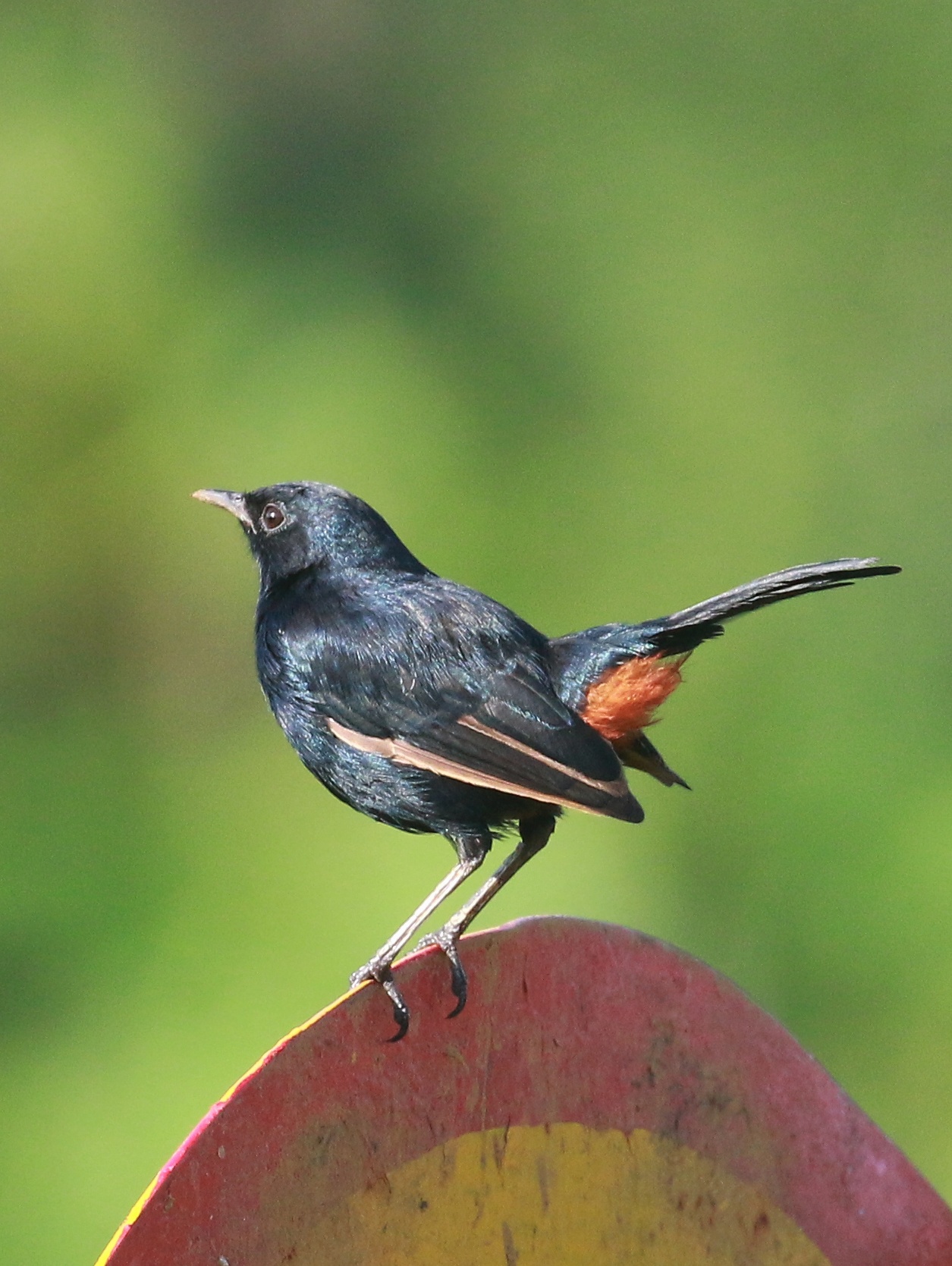
How to identify the Indian Robin
Copsychus fulicatus
Spotted a bird? Identify it instantly with the Birdby app
Open the appTo correctly identify the Indian Robin (Copsychus fulicatus), check each of these features. Birds can be tricky: habit, habitat, and call often confirm a sighting that a single photo cannot.
Size at a glance
- Length
- 15-16 cm
- Wingspan
- 20-23 cm
- Weight
- 17-24 g
Physical features to check
- 1
Plumage
Overall feather coloration and pattern.
Males are glossy black with a prominent chestnut-red vent and undertail coverts. They have a white patch on the wing, visible in flight and sometimes at rest. Females are duller, grayish-brown above and paler grayish-brown below, with a rufous vent that is less extensive and duller than the male's. They also have a smaller, less conspicuous white wing patch.
- 2
Beak shape
Shape and color of the bill: a key field mark.
Slender, pointed, and black, adapted for catching insects.
- 3
Eye color
Iris color and any distinctive eye markings.
Dark brown
- 4
Leg color
Leg and foot color.
Black
- 5
Distinguishing features
Standout features that separate this species.
Upright posture, constantly flicking tail up and down, and the striking chestnut-red vent (especially in males).
- 6
Juvenile appearance
How young birds differ from adults.
Juveniles are dull brown, mottled with buff spots on the upperparts and streaked on the underparts. The rufous vent is present but duller and less defined. They gradually acquire adult plumage over several months.
- 7
Seasonal changes
Plumage variation between breeding and non-breeding seasons.
No significant seasonal plumage changes; plumage remains consistent throughout the year, though wear can make it appear duller.
- 8
Sexual dimorphism
How males and females differ.
Pronounced. Males are glossy black with a bright rufous vent; females are dull grayish-brown with a duller, less extensive rufous vent.
Key field marks
- Size and Shape. Small, slender bird with a relatively long tail, often held cocked upwards. Has an upright posture.
- Male Plumage. Look for the glossy black body with a striking chestnut-red vent and a white patch on the wing (visible in flight or at rest).
- Female Plumage. Observe the dull grayish-brown upperparts and paler underparts, with a duller, less extensive rufous vent. The white wing patch is smaller and less obvious than in males.
- Behavior. Watch for its characteristic tail-flicking behavior (tail constantly moved up and down) and its ground-foraging style of running, stopping, and pecking.
- Song. Listen for its rich, varied, and melodious song, especially during the breeding season.
Explore the Indian Robin
Identify birds anywhere
Free on iOS, Android, and Web. Photo & sound identification, full species database, and your personal life list.