
Spotted a bird? Identify it instantly with the Birdby app
Open the appAbout
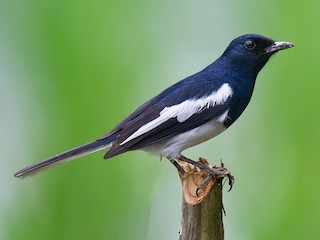
The Oriental Magpie-Robin is a small passerine bird that was formerly classified as a member of the thrush family Turdidae, but is now considered an Old World flycatcher in the family Muscicapidae. They are distinctive for their black and white plumage, long tail, and melodious song. They are common in urban gardens as well as forests.
Size & lifespan
- Length
- 19-23 cm
- Wingspan
- 28-32 cm
- Weight
- 29-42 g
- Lifespan
- 5-8 years in the wild
- Diet
- Insectivore, occasionally consuming nectar, small geckos, leeches, centipedes, and fish
Physical characteristics
- Plumage
- Males have glossy black upperparts, head, and throat, with a prominent white shoulder patch and white underparts from the breast down. The outer tail feathers are white, contrasting with the black central tail feathers. Females are duller, with greyish-black upperparts and head, and greyish-white underparts. The white shoulder patch is less prominent or absent in females.
- Beak shape
- Slender, pointed, and black
- Eye color
- Dark brown
- Leg color
- Black
- Distinguishing features
- The striking black and white plumage, especially the white shoulder patch (more prominent in males), and the upright posture with a frequently cocked tail are key features. The long tail is often fanned or held cocked.
- Juvenile appearance
- Juveniles are similar to females but have a brownish tinge to their plumage, especially on the head and back, and often have buffy mottling or scaling on the breast and throat. The white shoulder patch is less defined.
- Seasonal changes
- No significant seasonal plumage changes. Plumage remains consistent throughout the year, though wear and tear can make it appear duller before molting.
- Sexual dimorphism
- Pronounced. Males are glossy black and white, while females are duller greyish-black and greyish-white. The white shoulder patch is larger and brighter in males.
How to identify
- 1
Plumage Pattern
Look for the distinct black and white pattern. Males have glossy black upperparts and head, white underparts, and a prominent white shoulder patch. Females are similar but duller greyish-black and greyish-white.
- 2
Tail Movement
Observe its tail, which is often held cocked upwards and frequently fanned or flicked, especially when foraging or agitated.
- 3
Song
Listen for its loud, clear, and melodious song, often delivered from a high perch. It's a complex series of whistles and trills, sometimes mimicking other birds.
- 4
Foraging Behavior
Watch for its characteristic ground-foraging style, hopping and running on lawns or open ground, pausing to scan for insects.
- 5
Habitat
They are commonly found in human-modified environments like gardens, parks, and cultivated areas, making them relatively easy to spot near human habitation.
Habitat & range
- Biomes
- Tropical and subtropical forests, woodlands, scrublands, agricultural areas, urban gardens, and parks.
- Geographic range
- Widely distributed across the Indian subcontinent and parts of Southeast Asia, including Bangladesh, Bhutan, Brunei, Cambodia, China, India, Indonesia, Laos, Malaysia, Myanmar, Nepal, Pakistan, Philippines, Singapore, Sri Lanka, Thailand, and Vietnam.
- Elevation range
- Sea level up to approximately 2,000 meters (6,500 feet), though most common in lowlands.
- Preferred environments
- Prefers open woodlands, cultivated areas, gardens, and human-modified landscapes with scattered trees and shrubs. They are highly adaptable to urban environments.
Behavior
- Activity time
- Diurnal, most active during the early morning and late afternoon.
- Feeding habits
- Forages primarily on the ground, hopping and running to catch insects such as ants, termites, beetles, caterpillars, and crickets. They also hawk insects in flight and occasionally consume small vertebrates or fruit.
- Social behavior
- Generally solitary or found in pairs, especially during the breeding season. They are territorial and will defend their breeding grounds.
- Flight pattern
- Flight is typically short, undulating, and low to the ground. They often fly between perches or across open spaces with rapid wing beats.
- Migration pattern
- Mostly resident throughout its range, with some local movements in response to food availability or habitat changes. No significant long-distance migration.
- Territoriality
- Highly territorial, especially males during the breeding season. They use their song and displays to defend their territory against rivals.
Song & calls
- Song
- A rich, varied, and melodious song consisting of a series of clear, fluty whistles, trills, and mimicry of other birds. Often sung from a prominent perch, especially at dawn and dusk.
- Call
- Common calls include a sharp 'tseet' or 'chick' alarm call, and a harsh 'skree' when agitated. They also have a soft 'churr' contact call.
- When they vocalize
- Males sing frequently throughout the day, particularly during the breeding season (February to July), and often at dawn and dusk. They are known for their early morning chorus.
Breeding & reproduction
- Breeding season
- Primarily February to July, varying slightly by region.
- Nesting habits
- Nests are typically built in tree hollows, crevices in walls, old buildings, or artificial structures like nest boxes. The nest is a cup-shaped structure made of grass, roots, leaves, and hair, lined with finer materials.
- Clutch size
- 3-6 eggs, usually 4-5.
- Egg description
- Eggs are pale blue to greenish-blue, speckled with reddish-brown or purplish-brown spots, particularly at the broader end. Typically oval-shaped.
- Incubation period
- 11-14 days, primarily by the female.
- Fledging period
- 12-14 days after hatching, both parents feed the young.
- Parental care
- Both parents participate in feeding and caring for the young. The male often continues to feed the fledglings while the female may begin a second clutch.
Where to find
Urban Gardens and Parks
One of the most common places to find them, especially in areas with scattered trees, shrubs, and open lawns.
Open Woodlands and Forest Edges
They prefer the edges of forests or open woodland areas rather than dense interior forest.
Agricultural Areas
Often seen in cultivated fields, orchards, and plantations with suitable perches and foraging grounds.
Near Human Habitation
Highly adaptable to human presence, they can be found in villages, towns, and even bustling cities.
Field tips
- Listen for their song. Their distinctive and loud song is often the first indication of their presence, especially at dawn and dusk.
- Look on the ground. They spend a significant amount of time foraging on the ground, so scan lawns, pathways, and open areas under trees.
- Check prominent perches. Males often sing from high, exposed perches like treetops, utility wires, or antenna.
- Observe tail movements. The frequent cocking and fanning of their tail is a characteristic behavior that helps in identification.
Similar species
Indian Robin
Saxicoloides fulicatus
The Indian Robin is smaller, has a rufous vent and undertail coverts, and lacks the prominent white shoulder patch of the Oriental Magpie-Robin. Its song is also different, being less varied and more repetitive.
Pied Bushchat
Saxicola caprata
The Pied Bushchat is smaller and more compact, with a shorter tail. Males are entirely black with a white rump and wing patch, lacking the white belly and extensive white on the tail of the Magpie-Robin. Females are dull brown.
White-rumped Shama
Copsychus malabaricus
The White-rumped Shama is larger with a much longer tail, and males have a chestnut belly and rump, contrasting with the Magpie-Robin's white belly. The Shama's song is also more complex and varied.
Quick facts
- Scientific Name:
- Copsychus saularis
- Family:
- Muscicapidae (Old World Flycatchers)
- Diet:
- Mainly insects
- Habitat:
- Gardens, parks, open woodlands
- Conservation Status:
- Least Concern
- Sexual Dimorphism:
- Present (males brighter)
- Migration:
- Resident
Fun facts
- The Oriental Magpie-Robin is the national bird of Bangladesh, where it is known as the 'Doel'.
- Males are known for their elaborate and varied songs, often incorporating mimicry of other bird species.
- They are highly adaptable and thrive in urban environments, often nesting in man-made structures.
- Despite their robin-like appearance, they are not closely related to European or American Robins, belonging instead to the Old World flycatcher family.
Scientific classification
- Kingdom
- Animalia
- Phylum
- Chordata
- Class
- Aves
- Order
- Passeriformes
- Family
- Muscicapidae
- Genus
- Copsychus
- Species
- Copsychus saularis
Explore the Oriental Magpie-Robin
Identify birds anywhere
Free on iOS, Android, and Web. Photo & sound identification, full species database, and your personal life list.