
How to identify the Oriental Magpie-Robin
Copsychus saularis
Spotted a bird? Identify it instantly with the Birdby app
Open the appTo correctly identify the Oriental Magpie-Robin (Copsychus saularis), check each of these features. Birds can be tricky: habit, habitat, and call often confirm a sighting that a single photo cannot.
Size at a glance
- Length
- 19-23 cm
- Wingspan
- 28-32 cm
- Weight
- 29-42 g
Physical features to check
- 1
Plumage
Overall feather coloration and pattern.
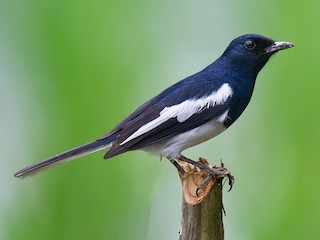
Males have glossy black upperparts, head, and throat, with a prominent white shoulder patch and white underparts from the breast down. The outer tail feathers are white, contrasting with the black central tail feathers. Females are duller, with greyish-black upperparts and head, and greyish-white underparts. The white shoulder patch is less prominent or absent in females.
- 2
Beak shape
Shape and color of the bill: a key field mark.
Slender, pointed, and black
- 3
Eye color
Iris color and any distinctive eye markings.
Dark brown
- 4
Leg color
Leg and foot color.
Black
- 5
Distinguishing features
Standout features that separate this species.
The striking black and white plumage, especially the white shoulder patch (more prominent in males), and the upright posture with a frequently cocked tail are key features. The long tail is often fanned or held cocked.
- 6
Juvenile appearance
How young birds differ from adults.
Juveniles are similar to females but have a brownish tinge to their plumage, especially on the head and back, and often have buffy mottling or scaling on the breast and throat. The white shoulder patch is less defined.
- 7
Seasonal changes
Plumage variation between breeding and non-breeding seasons.
No significant seasonal plumage changes. Plumage remains consistent throughout the year, though wear and tear can make it appear duller before molting.
- 8
Sexual dimorphism
How males and females differ.
Pronounced. Males are glossy black and white, while females are duller greyish-black and greyish-white. The white shoulder patch is larger and brighter in males.
Key field marks
- Plumage Pattern. Look for the distinct black and white pattern. Males have glossy black upperparts and head, white underparts, and a prominent white shoulder patch. Females are similar but duller greyish-black and greyish-white.
- Tail Movement. Observe its tail, which is often held cocked upwards and frequently fanned or flicked, especially when foraging or agitated.
- Song. Listen for its loud, clear, and melodious song, often delivered from a high perch. It's a complex series of whistles and trills, sometimes mimicking other birds.
- Foraging Behavior. Watch for its characteristic ground-foraging style, hopping and running on lawns or open ground, pausing to scan for insects.
- Habitat. They are commonly found in human-modified environments like gardens, parks, and cultivated areas, making them relatively easy to spot near human habitation.
Explore the Oriental Magpie-Robin
Identify birds anywhere
Free on iOS, Android, and Web. Photo & sound identification, full species database, and your personal life list.