
Spotted a bird? Identify it instantly with the Birdby app
Open the appAbout
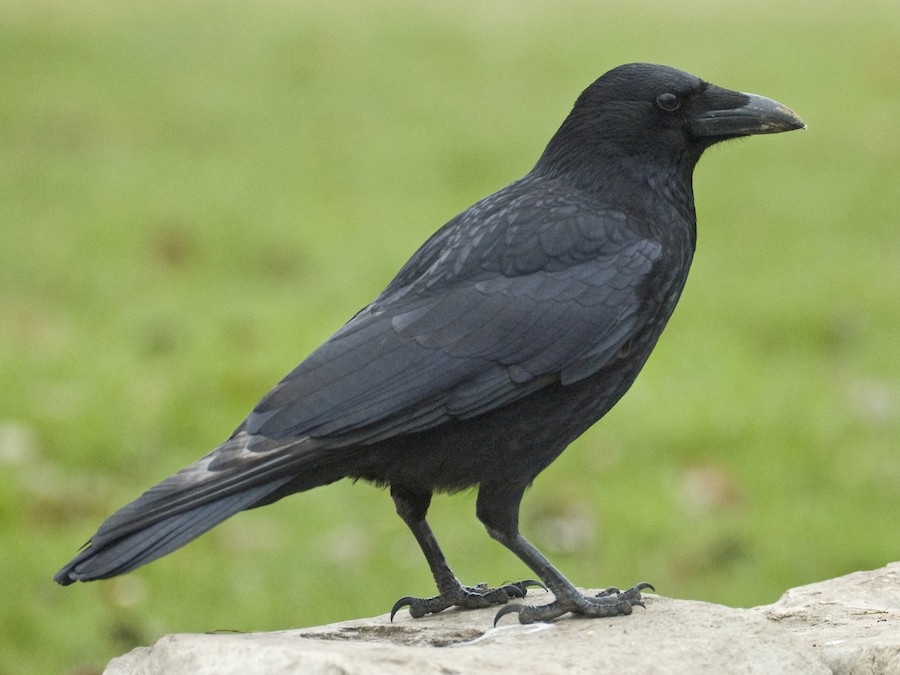
The Carrion Crow is a highly intelligent and adaptable passerine bird, widely distributed across Western Europe and parts of Asia. It is characterized by its entirely black plumage, robust build, and distinctive 'caw' calls. Often found in a variety of habitats, from urban parks to agricultural land, it is an opportunistic omnivore and a common sight in many landscapes.
Size & lifespan
- Length
- 45-51 cm
- Wingspan
- 93-104 cm
- Weight
- 390-600 g
- Lifespan
- Up to 20 years in the wild, typically 5-10 years
- Diet
- Omnivore, highly opportunistic. Diet includes carrion, insects, worms, seeds, fruits, small mammals, eggs, nestlings, and human refuse.
Physical characteristics
- Plumage
- Entirely glossy black plumage, often with a greenish or purplish sheen visible in good light. The feathers are dense and sleek.
- Beak shape
- Strong, heavy, and slightly decurved black beak.
- Eye color
- Dark brown to black
- Leg color
- Black
- Distinguishing features
- Uniformly black plumage, relatively large head, and a strong, straight-edged bill. Its flight is characterized by steady, powerful wingbeats.
- Juvenile appearance
- Juveniles resemble adults but have duller, less glossy black plumage, often with a brownish tinge. Their eyes are typically blue-grey, gradually changing to dark brown within the first year.
- Seasonal changes
- No significant seasonal plumage changes. The glossiness of the plumage may appear more pronounced during the breeding season due to feather condition.
- Sexual dimorphism
- Minimal to none; males are typically slightly larger than females but are indistinguishable in the field based on plumage or coloration.
How to identify
- 1
Overall Plumage
Look for entirely glossy black plumage. No grey patches, no bare facial skin.
- 2
Size and Build
A medium-large, robust crow. Larger than a Jackdaw, smaller than a Raven. Proportional head and bill.
- 3
Bill Shape
Strong, heavy, and relatively straight black bill, without the bare grey patch seen on Rooks.
- 4
Tail Shape in Flight
Observe the tail in flight; it is fan-shaped or slightly rounded, not wedge-shaped like a Raven's.
- 5
Vocalization
Listen for the characteristic harsh, guttural 'caw-caw-caw' call, distinct from the deeper 'cronk' of a Raven or the 'chak' of a Jackdaw.
- 6
Behavior
Often seen singly or in pairs, especially during breeding season, contrasting with the large flocks and colonial nesting of Rooks.
Habitat & range
- Biomes
- Temperate forests, woodlands, agricultural land, urban and suburban areas, coastal cliffs, moorlands.
- Geographic range
- Western Europe (west of the Elbe River in Germany), British Isles, and parts of Asia (eastern Siberia, Japan, China). The species complex 'Corvus corone' is split into the Western Carrion Crow (Corvus corone corone) and the Eastern Hooded Crow (Corvus corone cornix), which hybridize in a narrow zone.
- Elevation range
- Sea level up to 2,000 meters, occasionally higher in mountainous regions.
- Preferred environments
- Highly adaptable, preferring open country with scattered trees, parks, gardens, cultivated land, and urban environments where food sources are abundant and nesting sites are available.
Behavior
- Activity time
- Diurnal, active from dawn to dusk.
- Feeding habits
- Highly opportunistic and versatile feeder. Forages on the ground, in trees, and scavenges. Known to cache food. Uses tools in some instances (e.g., dropping nuts to crack them).
- Social behavior
- Typically seen in pairs or small family groups during the breeding season. Outside of breeding, they can form large communal roosts, sometimes numbering in the thousands, often with other corvids. Highly territorial during nesting.
- Flight pattern
- Direct and powerful flight with steady, deep wingbeats. Can soar on thermals. Often glides for short distances. Agile in the air, especially when mobbing predators.
- Migration pattern
- Mostly resident throughout its range. Northern populations may undertake short-distance movements or partial migrations to milder areas during harsh winters, but long-distance migration is uncommon.
- Territoriality
- Highly territorial during the breeding season, aggressively defending their nest and foraging area from other crows and potential predators.
Song & calls
- Song
- Carrion Crows do not have a complex song. Their vocalizations are primarily calls.
- Call
- The most characteristic call is a harsh, guttural 'caw-caw-caw', often repeated several times. They also produce a variety of other calls including softer 'kraa' sounds, alarm calls, and begging calls from juveniles. Calls can vary in pitch and intensity depending on context.
- When they vocalize
- Vocalize throughout the day, particularly active during dawn and dusk, and when communicating with mates, defending territory, or mobbing predators.
Breeding & reproduction
- Breeding season
- March to July, with peak egg-laying in April.
- Nesting habits
- Nests are typically large, bulky structures made of sticks, twigs, and mud, lined with softer materials like hair, wool, grass, and sometimes even wire or plastic. Nests are usually built high in trees, often near the canopy, but can also be found on cliffs, pylons, or buildings.
- Clutch size
- 3-6 eggs, most commonly 4-5.
- Egg description
- 3-6 eggs, typically pale blue-green or olive-green, heavily spotted and blotched with dark brown or grey, particularly at the broader end. Eggs measure approximately 4.0 x 2.9 cm.
- Incubation period
- 18-20 days, primarily by the female.
- Fledging period
- 29-35 days after hatching. Young remain dependent on parents for several weeks after fledging.
- Parental care
- Both parents participate in feeding the young. The female incubates, while the male brings food to her and later to the nestlings. Fledglings are fed by both parents and often remain with them as a family group for some time.
Where to find
Urban and Suburban Areas
Parks, gardens, city centers, residential areas, and refuse dumps are common places to find them due to abundant food sources.
Agricultural Land
Open fields, pastures, and cultivated areas, especially where crops are grown or livestock are present.
Woodlands and Forests
Edges of woodlands, scattered trees in open country, and small copses provide nesting and roosting sites.
Coastal Areas
Cliffs, beaches, and estuaries, where they scavenge for food.
Field tips
- Listen for Calls. Their distinctive 'caw' call is often the first indication of their presence. Learn to distinguish it from other corvid calls.
- Look for Scavenging Behavior. Observe areas with potential food sources like roadsides (carrion), bins, or freshly ploughed fields.
- Check High Perches. They often perch on prominent high points like treetops, lampposts, or buildings to survey their territory.
- Observe Flight. Their direct, powerful flight with steady wingbeats is characteristic. Look for the fan-shaped tail.
Similar species
Rook
Corvus frugilegus
Rooks have a distinctive bare, greyish-white patch of skin at the base of their bill (adults only), which Carrion Crows lack. Rooks also have a more pointed, slender bill and often appear more 'shaggy' around the legs due to loose thigh feathers. In flight, Rooks often have more 'fingered' primary feathers. Rooks are highly gregarious, nesting in large colonies (rookeries), while Carrion Crows are typically solitary nesters.
Raven
Corvus corax
Ravens are significantly larger than Carrion Crows (up to 67 cm length, 120 cm wingspan). They have a much heavier, more powerful bill, and a shaggy throat plumage (hackles). In flight, Ravens have a wedge-shaped tail (Carrion Crows have a fan-shaped tail) and often soar more. Their call is a deeper, more resonant 'cronk' compared to the crow's 'caw'.
Jackdaw
Coloeus monedula
Jackdaws are much smaller than Carrion Crows (33-39 cm length). They have distinctive pale grey eyes and a grey nape and ear-coverts, contrasting with their black body plumage. Their flight is more agile and buoyant. Their call is a sharp 'chak' or 'tchack'.
Hooded Crow
Corvus cornix
The Hooded Crow is considered a subspecies or closely related species to the Carrion Crow, with a distinct grey body and black head, wings, and tail. Where their ranges overlap (e.g., parts of Germany, Scotland), hybrids with intermediate plumage can occur. The Carrion Crow is entirely black.
Quick facts
- Scientific Name:
- Corvus corone
- Family:
- Corvidae
- Diet:
- Omnivore
- Conservation Status:
- Least Concern
- Key ID Feature:
- Entirely glossy black plumage, strong bill, 'caw' call
- Habitat:
- Highly adaptable; urban, agricultural, woodland, coastal
Fun facts
- Carrion Crows are known for their intelligence, capable of problem-solving, tool use, and complex social learning.
- They can mimic a variety of sounds, including human speech, though this is less common than in some other corvids.
- The Carrion Crow and Hooded Crow (Corvus cornix) were once considered the same species, but are now often treated as distinct species due to limited hybridization in their overlap zones.
- They are known to mob larger birds of prey, such as buzzards and owls, to drive them away from their territory.
Scientific classification
- Kingdom
- Animalia
- Phylum
- Chordata
- Class
- Aves
- Order
- Passeriformes
- Family
- Corvidae
- Genus
- Corvus
- Species
- Corvus corone
Explore the Carrion Crow
Identify birds anywhere
Free on iOS, Android, and Web. Photo & sound identification, full species database, and your personal life list.