
Spotted a bird? Identify it instantly with the Birdby app
Open the appAbout
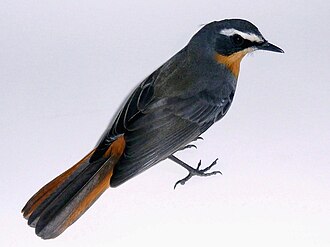
The Cape Robin-Chat is a medium-sized passerine bird with a distinctive combination of grey, orange, and white plumage. It is known for its melodious and varied song, often mimicking other bird species, and its confiding nature in suburban gardens. This species is an adaptable insectivorous bird that also consumes fruit, making it a common and beloved resident across much of southern and eastern Africa. It is a territorial bird, particularly vocal during breeding season.
Size & lifespan
- Length
- 16-18 cm
- Wingspan
- 24-27 cm
- Weight
- 22-34 g
- Lifespan
- Typically 6-8 years in the wild, up to 10+ years recorded.
- Diet
- Primarily insects (beetles, ants, termites, caterpillars), other invertebrates (spiders, centipedes, snails, earthworms). Also consumes a significant proportion of fruit and berries, especially during autumn and winter months, and nectar.
Physical characteristics
- Plumage
- Adults have a slate-grey head and upperparts, with a prominent white supercilium extending from the lores to behind the eye. The chin and throat are white, bordered by a thin black malar stripe. The underparts are mainly rufous-orange, fading to whitish on the lower belly and vent. The outer tail feathers are rufous, contrasting with the dark central rectrices; this rufous flash is a key identification feature. The remiges (flight feathers) are dark greyish-brown.
- Beak shape
- Slender, straight, and pointed, suitable for gleaning insects.
- Eye color
- Dark brown.
- Leg color
- Dark grey to blackish.
- Distinguishing features
- The most distinctive features are the bright rufous-orange underparts, the white supercilium, and the rufous outer tail feathers which are often fanned or flicked. Its upright posture and frequent tail-flicking are also characteristic.
- Juvenile appearance
- Juveniles are heavily mottled brown and black on the upperparts and breast, rather than slate-grey and orange. The supercilium is less distinct, and the rufous tail patch is present but often duller. They gradually attain adult plumage through multiple molts.
- Seasonal changes
- No significant seasonal plumage changes. Plumage may appear slightly duller when worn, brightening after molt.
- Sexual dimorphism
- Males and females are similar in plumage and size; no significant sexual dimorphism. Males may be slightly larger on average, but this is not discernible in the field.
How to identify
- 1
Plumage Coloration
Look for the slate-grey head and upperparts contrasted with vivid rufous-orange underparts and a clean white supercilium. The black malar stripe separating the white throat from the orange breast is a good marker.
- 2
Tail Pattern
Crucial ID feature: as the bird moves or takes flight, note the rufous outer tail feathers visible against dark central ones. Often flicks its tail.
- 3
Vocalization
Learn its rich, varied, and often mimic-filled song. It's one of the most frequently heard garden birds in its range.
- 4
Behavior
Observe its foraging behavior – hopping on the ground, pausing, then flicking its tail. Often quite bold and visible in human-modified environments.
- 5
Habitat
While found in various habitats, its common presence in suburban gardens, parks, and dense shrubbery close to human habitation is indicative.
Habitat & range
- Biomes
- Fynbos, grassland, savanna, forest edges, suburban gardens, parks, plantations, riparian woodlands.
- Geographic range
- Southern and eastern Africa, from South Africa northwards through Zimbabwe, Zambia, Malawi, Mozambique, eastern Democratic Republic of Congo, Rwanda, Burundi, Uganda, Kenya, and parts of Tanzania.
- Elevation range
- Sea level up to approximately 3000 meters in some mountainous regions.
- Preferred environments
- Favors areas with dense undergrowth, bushes, and scattered trees that provide cover, foraging opportunities, and nesting sites. Adapts well to human altered environments like gardens and parks where food and cover are available.
Behavior
- Activity time
- Diurnal, most active during early morning and late afternoon. Sings frequently during these periods.
- Feeding habits
- Forages mostly on the ground, often among leaf litter, by hopping and then pausing to scan. It gleans insects from foliage and probes into crevices with its bill. Will also catch insects in flight, and readily visits bird tables for fruit or fat. Often observed flicking its tail up and down while foraging.
- Social behavior
- Generally solitary or found in pairs, especially during the breeding season. Can be quite confiding around humans in suburban areas. Highly territorial.
- Flight pattern
- Flight is typically short, low, and somewhat undulating, usually between patches of cover. Not known for long-distance flights.
- Migration pattern
- Mostly resident throughout its range. Some altitudinal migration may occur, with birds moving to lower elevations during colder months. Local movements in response to food availability are also observed.
- Territoriality
- Highly territorial, especially during breeding. Males defend their territory vocally and physically against other robin-chats. These territories can be vigorously defended year-round.
Song & calls
- Song
- A rich, varied, and melodious song, often incorporating mimicry of other bird species both accurately and abstractly. Phrases are typically short, repetitive, and sung with clear, fluty notes, often starting with a whistled 'whee-too-whee' or 'cherooo cherooo'. Sings from a prominent perch or within dense cover. Known for singing throughout the day and sometimes at night, particularly on moonlit nights.
- Call
- Calls include a sharp 'chip' or 'tsit' alarm call. A harsh 'churr' or 'chick-chick-chick' is also given when agitated or displaying.
- When they vocalize
- Sings most frequently during the breeding season (spring and summer), particularly at dawn and dusk. Can be heard singing throughout the year, especially in temperate regions. Occasional nocturnal singing.
Breeding & reproduction
- Breeding season
- Primarily August to March in southern Africa, with peaks often correlating with summer rainfall. Can vary geographically and with local conditions.
- Nesting habits
- Monogamous. Nests are typically an open cup woven from moss, roots, leaves, and plant fibers, lined with fine grass, hair, or feathers. They are usually placed within a concealed cavity or crevice, often in bank erosion, among tree roots, under eaves of buildings, or in dense shrubs near the ground. Both sexes contribute to nest building, though the female does most of the work.
- Clutch size
- 2-4 eggs, most commonly 2-3.
- Egg description
- 2-4 eggs, typically pale blue to bluish-green, sometimes plain or faintly speckled with reddish-brown markings, particularly at the larger end.
- Incubation period
- Approximately 14-16 days, primarily by the female.
- Fledging period
- Chicks fledge around 14-18 days after hatching. Both parents feed the nestlings.
- Parental care
- Both parents are involved in feeding the young. After fledging, the young are still dependent on parents for several weeks. Two broods are common per breeding season, occasionally three.
Where to find
Gardens and Parks
Highly adaptable and commonly found in urban and suburban gardens, parks, school grounds, and golf courses, especially where there is dense shrubbery and leaf litter.
Forest Edges and Riparian Zones
Frequent in the ecotone between forests and open areas, and along riverbanks with dense vegetation.
Thick Bush and Shrubbery
Favors areas with good cover like thorny bushes, thickets, and dense undergrowth.
Field tips
- Listen for the Song. Their distinctive and varied song is often the first indication of their presence. They sing from obscured perches or more open spots.
- Scan the Ground. They are ground-foragers. Watch for movement in leaf litter beneath shrubs and trees.
- Check Shady Areas. Often found in cooler, shaded areas, especially during hotter parts of the day.
- Observe Bird Tables. They frequently visit bird tables for fruit, particularly chopped apple or papaya.
- Look for Tail-Flicking. Their characteristic tail-flicking movement is a strong clue to their identity, even when partially obscured.
Similar species
White-browed Robin-Chat
Cossypha heuglini
The White-browed Robin-Chat (also known as Heuglin's Robin-Chat) is larger, with a longer tail, and its rufous-orange extends further up the flanks. It has a more extensive and brighter white supercilium and lacks the grey upperparts, being olive-brown instead. Its song is also distinct, though similarly rich and mimetic. Found further north than most of the Cape Robin-Chat's range.
Natal Robin-Chat
Cossypha natalensis
The Natal Robin-Chat is entirely rufous-orange on the underparts and has an olive-brown head and upperparts, lacking the distinct grey head and white supercilium of the Cape Robin-Chat. It also has a more intense rufous wash on the wings. Prefers denser evergreen forest habitats.
Starred Robin
Pogonocichla stellata
The Starred Robin is smaller, with a distinctive white 'star' on the throat and yellow belly. It has olive-green upperparts and lacks the broad white supercilium. Primarily a forest species, it is less often found in open gardens than the Cape Robin-Chat.
Quick facts
- Voice:
- Melodious, varied song with mimicry
- Diet:
- Insects, invertebrates, fruit
- Habitat:
- Gardens, forests, bushy areas
- Status:
- Least Concern
- Key Feature:
- Rufous underparts, white supercilium, rufous outer tail feathers
Fun facts
- The Cape Robin-Chat is considered one of the most skillful mimics in its range, often incorporating calls of multiple other bird species into its own song.
- Despite its confiding nature in suburban areas, it is a shy bird in wilder, less disturbed habitats, preferring to forage within dense cover.
- Its 'robin' designation comes from its superficial resemblance to European Robins, particularly in its rich, melodic song and upright posture, though they are not closely related.
- In many parts of its range, it is one of the first birds to sing at dawn and one of the last to sing at dusk, earning it the nickname 'dawn and dusk singer'.
Scientific classification
- Kingdom
- Animalia
- Phylum
- Chordata
- Class
- Aves
- Order
- Passeriformes
- Family
- Muscicapidae
- Genus
- Cossypha
- Species
- Cossypha caffra
Explore the Cape Robin-Chat
Identify birds anywhere
Free on iOS, Android, and Web. Photo & sound identification, full species database, and your personal life list.