
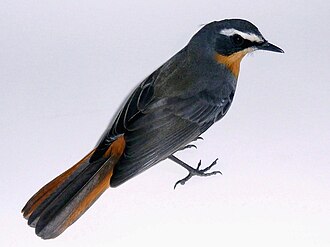
How to identify the Cape Robin-Chat
Cossypha caffra
Spotted a bird? Identify it instantly with the Birdby app
Open the appTo correctly identify the Cape Robin-Chat (Cossypha caffra), check each of these features. Birds can be tricky: habit, habitat, and call often confirm a sighting that a single photo cannot.
Size at a glance
- Length
- 16-18 cm
- Wingspan
- 24-27 cm
- Weight
- 22-34 g
Physical features to check
- 1
Plumage
Overall feather coloration and pattern.
Adults have a slate-grey head and upperparts, with a prominent white supercilium extending from the lores to behind the eye. The chin and throat are white, bordered by a thin black malar stripe. The underparts are mainly rufous-orange, fading to whitish on the lower belly and vent. The outer tail feathers are rufous, contrasting with the dark central rectrices; this rufous flash is a key identification feature. The remiges (flight feathers) are dark greyish-brown.
- 2
Beak shape
Shape and color of the bill: a key field mark.
Slender, straight, and pointed, suitable for gleaning insects.
- 3
Eye color
Iris color and any distinctive eye markings.
Dark brown.
- 4
Leg color
Leg and foot color.
Dark grey to blackish.
- 5
Distinguishing features
Standout features that separate this species.
The most distinctive features are the bright rufous-orange underparts, the white supercilium, and the rufous outer tail feathers which are often fanned or flicked. Its upright posture and frequent tail-flicking are also characteristic.
- 6
Juvenile appearance
How young birds differ from adults.
Juveniles are heavily mottled brown and black on the upperparts and breast, rather than slate-grey and orange. The supercilium is less distinct, and the rufous tail patch is present but often duller. They gradually attain adult plumage through multiple molts.
- 7
Seasonal changes
Plumage variation between breeding and non-breeding seasons.
No significant seasonal plumage changes. Plumage may appear slightly duller when worn, brightening after molt.
- 8
Sexual dimorphism
How males and females differ.
Males and females are similar in plumage and size; no significant sexual dimorphism. Males may be slightly larger on average, but this is not discernible in the field.
Key field marks
- Plumage Coloration. Look for the slate-grey head and upperparts contrasted with vivid rufous-orange underparts and a clean white supercilium. The black malar stripe separating the white throat from the orange breast is a good marker.
- Tail Pattern. Crucial ID feature: as the bird moves or takes flight, note the rufous outer tail feathers visible against dark central ones. Often flicks its tail.
- Vocalization. Learn its rich, varied, and often mimic-filled song. It's one of the most frequently heard garden birds in its range.
- Behavior. Observe its foraging behavior – hopping on the ground, pausing, then flicking its tail. Often quite bold and visible in human-modified environments.
- Habitat. While found in various habitats, its common presence in suburban gardens, parks, and dense shrubbery close to human habitation is indicative.
Explore the Cape Robin-Chat
Identify birds anywhere
Free on iOS, Android, and Web. Photo & sound identification, full species database, and your personal life list.