
Spotted a bird? Identify it instantly with the Birdby app
Open the appAbout
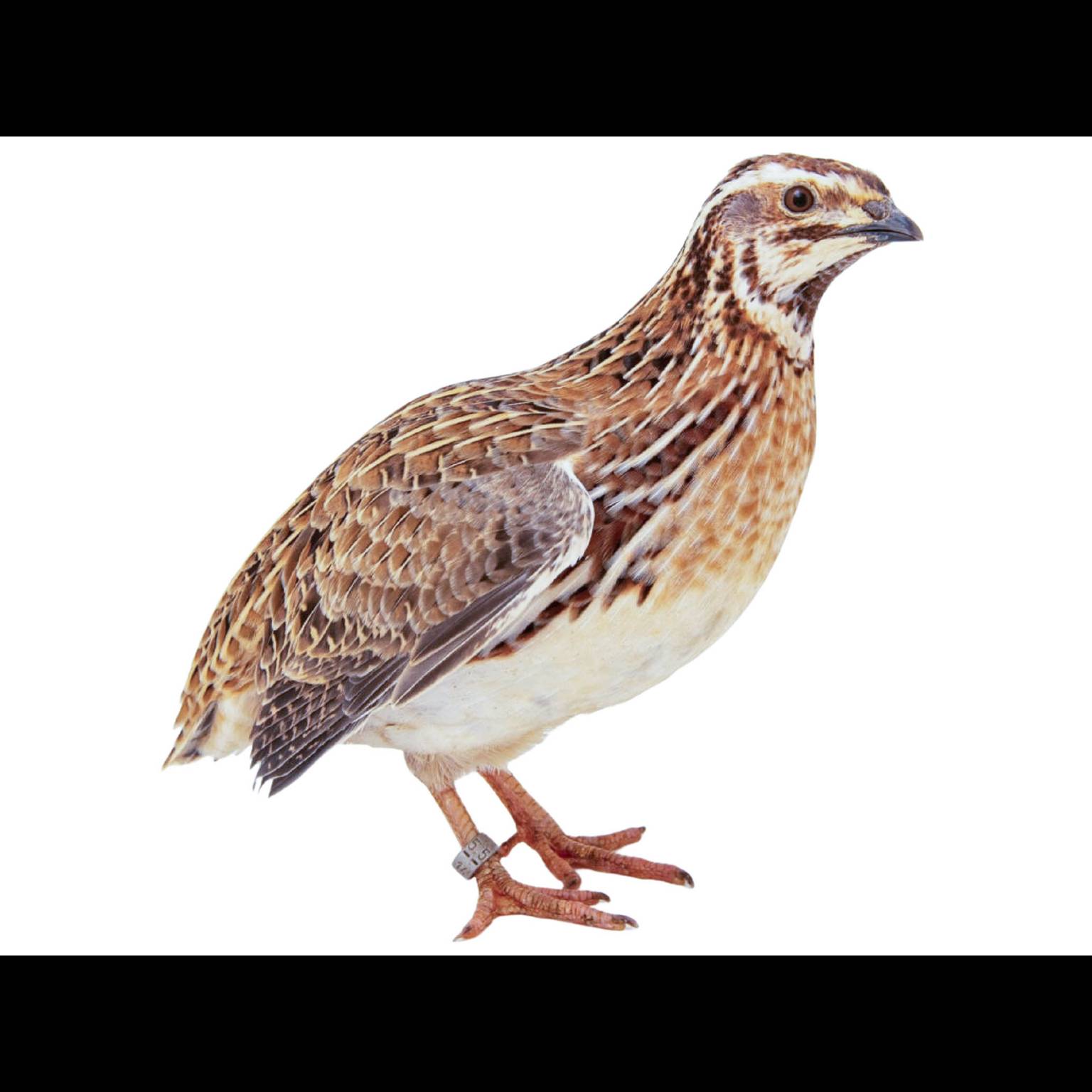
The Common Quail is a small, ground-dwelling game bird, renowned for its cryptic plumage and distinctive 'wet-my-lips' call. It is highly migratory across much of its range, often overlooked due to its secretive nature and preference for dense vegetation. Despite its small size, it undertakes impressive migratory journeys between its breeding grounds in Eurasia and Africa.
Size & lifespan
- Length
- 16-18 cm
- Wingspan
- 32-35 cm
- Weight
- 70-150 g
- Lifespan
- 2-3 years in the wild
- Diet
- Omnivore
Physical characteristics
- Plumage
- Overall streaky brown and buff plumage, providing excellent camouflage. Upperparts are dark brown with buff streaks and blackish barring. Underparts are paler, buffish-white, with fine dark streaking on the flanks. The head has a dark crown with a pale central stripe, and a pale supercilium.
- Beak shape
- Short, conical, and stout, adapted for pecking seeds and insects from the ground. Color is typically dark grey to brownish.
- Eye color
- Dark brown.
- Leg color
- Pale flesh-colored to yellowish-brown.
- Distinguishing features
- Small size, short tail, streaky brown plumage, and a distinctive head pattern with a pale central crown stripe and supercilium. Males have a more prominent dark throat patch and often a dark 'anchor' pattern on the breast.
- Juvenile appearance
- Juveniles resemble adult females but are generally duller, with less defined markings and often more extensive streaking on the underparts. The head pattern is less distinct.
- Seasonal changes
- No significant seasonal plumage changes. Plumage remains cryptic year-round, optimized for camouflage in grassy habitats.
- Sexual dimorphism
- Males (cocks) typically have a more distinct blackish-brown throat patch and a dark 'anchor' or 'double anchor' pattern on the breast, which can vary in prominence. Females (hens) lack the prominent throat patch, having a paler, often unstreaked, buffish throat and breast, sometimes with fine dark spots or streaks. Females are also slightly larger on average.
How to identify
- 1
Size and Shape
Look for a very small, plump, short-tailed game bird that is reluctant to fly. It has a compact, rounded body.
- 2
Plumage
Observe the streaky brown and buff camouflage. Note the pale central crown stripe and pale supercilium on the head. Males have a dark throat patch and often a dark 'anchor' pattern on the breast.
- 3
Behavior
Watch for its secretive nature, preferring to run and hide in dense vegetation. When flushed, it flies low and fast for short distances.
- 4
Vocalization
Listen for the male's distinctive 'wet-my-lips' or 'quick-quick-quick' call, especially at dawn and dusk during the breeding season. This is often the easiest way to detect its presence.
Habitat & range
- Biomes
- Grasslands, agricultural fields, steppes, meadows, open woodlands, and heathlands.
- Geographic range
- Widespread breeding range across Europe, Asia, and parts of Africa. Winters primarily in sub-Saharan Africa and parts of India.
- Elevation range
- Sea level up to 2,000 meters, occasionally higher in some mountainous regions during migration.
- Preferred environments
- Prefers dense, tall vegetation such as cereal crops (wheat, barley), hayfields, alfalfa fields, and natural grasslands, which provide cover from predators and ample food sources. Avoids dense forests and arid deserts.
Behavior
- Activity time
- Diurnal, though often most active at dawn and dusk. Migratory flights occur primarily at night.
- Feeding habits
- Primarily ground-foraging. Diet consists mainly of seeds from grasses and weeds, grains (especially cereal crops), and small invertebrates such as insects (beetles, ants, grasshoppers), snails, and worms. Chicks are almost exclusively insectivorous.
- Social behavior
- Generally solitary or found in pairs during the breeding season. During migration, they can form loose flocks, especially at stopover sites.
- Flight pattern
- Reluctant to fly, preferring to run and hide in dense vegetation. When flushed, it flies low and fast with rapid wingbeats, often for only short distances before dropping back into cover. Flight is direct and powerful during migration.
- Migration pattern
- A long-distance migrant. European and West Asian populations migrate south to winter in sub-Saharan Africa. East Asian populations winter in India and Southeast Asia. Migration occurs at night, often in large numbers, making them vulnerable to hunting pressure.
- Territoriality
- Males establish territories during the breeding season, defending them with their distinctive calls. They are polygynous, often mating with multiple females within their territory.
Song & calls
- Song
- The most characteristic vocalization is the male's advertising call, a distinctive, rhythmic 'wet-my-lips' or 'quick-quick-quick' call, often transcribed as 'whit-whit-whit' or 'quip-quip-quip'. It is a three-note phrase, repeated continuously, especially at dawn and dusk.
- Call
- Various contact calls, alarm calls, and soft clucking sounds are used. Females have a softer, more guttural 'whirr-whirr' or 'prrrip' call, particularly when flushed or with chicks. Alarm calls are sharp 'chick-chick' notes.
- When they vocalize
- Males call frequently during the breeding season, from late spring to mid-summer, primarily at dawn, dusk, and sometimes throughout the night. Calls are less frequent outside the breeding season.
Breeding & reproduction
- Breeding season
- Typically May to August, varying geographically. Can have multiple broods in warmer regions.
- Nesting habits
- Nests are simple scrapes on the ground, usually well-hidden in dense vegetation, often at the base of a tussock or under a bush. Lined with grass and leaves.
- Clutch size
- 6-18 eggs, commonly 8-13.
- Egg description
- Eggs are typically 6-18, oval to pyriform, smooth, glossy, and vary in color from pale buff to olive-brown, heavily spotted or blotched with dark brown or black.
- Incubation period
- 17-20 days, primarily by the female.
- Fledging period
- Chicks are precocial and leave the nest shortly after hatching (within hours). They can fly short distances at about 11 days and are fully independent at 30-50 days.
- Parental care
- Mainly by the female. She incubates the eggs and cares for the precocial chicks. Males may remain in the vicinity but typically do not participate in incubation or direct chick-rearing.
Where to find
Agricultural Fields
Cereal crops (wheat, barley, oats), alfalfa fields, and hayfields are prime habitats, especially during the breeding season.
Grasslands and Meadows
Extensive natural grasslands, open meadows with tall grasses, and steppes provide suitable cover and food.
Heathlands
Areas with low, dense shrubby vegetation and grasses can also host Common Quail.
Field tips
- Listen for the Call. The male's 'wet-my-lips' call is the most reliable way to locate Common Quail. Listen at dawn or dusk in suitable habitats.
- Walk Slowly Through Fields. If you suspect quail are present, walking slowly through dense fields may flush them, allowing for a brief view as they fly off.
- Use a Dog (where permitted). In some regions, trained pointing dogs are used to locate quail, as they are masters of camouflage.
- Be Patient and Observant. Quail are very secretive. Patience is key, and often only a fleeting glimpse is possible.
Similar species
Japanese Quail
Coturnix japonica
Very similar in appearance and often considered conspecific with Common Quail. Males of Japanese Quail typically have a plain, unstreaked rufous breast and throat, lacking the dark 'anchor' pattern of Common Quail. Females are virtually indistinguishable in the field. Range overlap is limited, with Japanese Quail primarily in East Asia.
Rain Quail
Coturnix coromandelica
Smaller and darker overall than Common Quail. Males have a distinct black breast band and a black patch on the lower throat. Found in the Indian subcontinent.
Stubble Quail
Coturnix pectoralis
Found in Australia. Males have a prominent black breast band and a white throat with a black central stripe. Females are similar to Common Quail but generally paler.
Quick facts
- Status:
- Least Concern
- Diet:
- Omnivore (seeds, grains, insects)
- Habitat:
- Grasslands, agricultural fields
- Migration:
- Long-distance migrant
- Key ID Feature:
- Male's 'wet-my-lips' call
Fun facts
- The Common Quail is the only Old World quail species that undertakes long-distance migrations.
- Despite its small size, it can fly thousands of kilometers during migration, often crossing large bodies of water like the Mediterranean Sea.
- Its cryptic plumage makes it incredibly difficult to spot on the ground, even when very close.
- The species has been domesticated for centuries, primarily for its eggs and meat, leading to the development of the Japanese Quail (Coturnix japonica) as a distinct domestic strain.
- In ancient Egypt, the Common Quail was a symbol and was often depicted in hieroglyphs.
Scientific classification
- Kingdom
- Animalia
- Phylum
- Chordata
- Class
- Aves
- Order
- Galliformes
- Family
- Phasianidae
- Genus
- Coturnix
- Species
- Coturnix coturnix
Explore the Common Quail
Identify birds anywhere
Free on iOS, Android, and Web. Photo & sound identification, full species database, and your personal life list.