
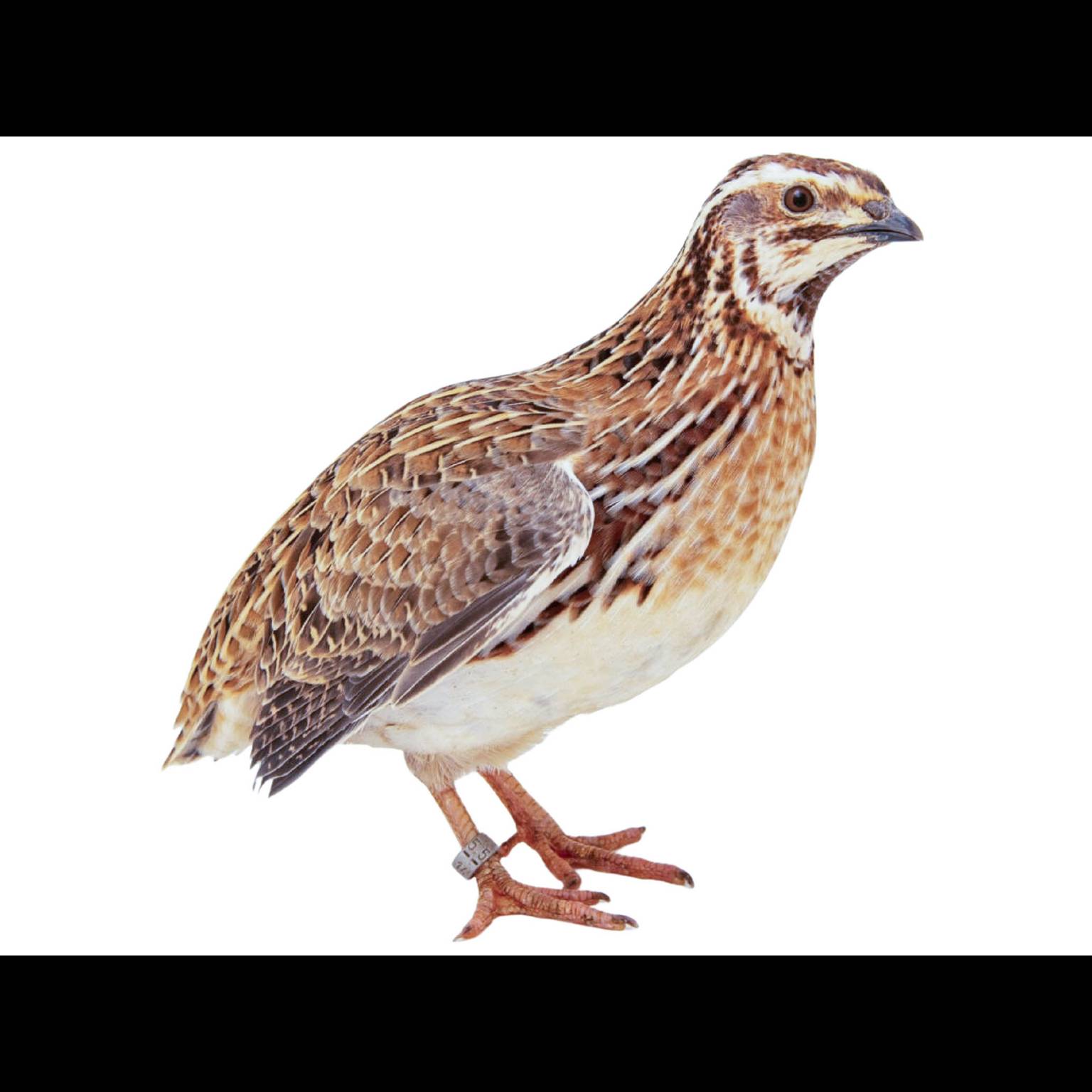
How to identify the Common Quail
Coturnix coturnix
Spotted a bird? Identify it instantly with the Birdby app
Open the appTo correctly identify the Common Quail (Coturnix coturnix), check each of these features. Birds can be tricky: habit, habitat, and call often confirm a sighting that a single photo cannot.
Size at a glance
- Length
- 16-18 cm
- Wingspan
- 32-35 cm
- Weight
- 70-150 g
Physical features to check
- 1
Plumage
Overall feather coloration and pattern.
Overall streaky brown and buff plumage, providing excellent camouflage. Upperparts are dark brown with buff streaks and blackish barring. Underparts are paler, buffish-white, with fine dark streaking on the flanks. The head has a dark crown with a pale central stripe, and a pale supercilium.
- 2
Beak shape
Shape and color of the bill: a key field mark.
Short, conical, and stout, adapted for pecking seeds and insects from the ground. Color is typically dark grey to brownish.
- 3
Eye color
Iris color and any distinctive eye markings.
Dark brown.
- 4
Leg color
Leg and foot color.
Pale flesh-colored to yellowish-brown.
- 5
Distinguishing features
Standout features that separate this species.
Small size, short tail, streaky brown plumage, and a distinctive head pattern with a pale central crown stripe and supercilium. Males have a more prominent dark throat patch and often a dark 'anchor' pattern on the breast.
- 6
Juvenile appearance
How young birds differ from adults.
Juveniles resemble adult females but are generally duller, with less defined markings and often more extensive streaking on the underparts. The head pattern is less distinct.
- 7
Seasonal changes
Plumage variation between breeding and non-breeding seasons.
No significant seasonal plumage changes. Plumage remains cryptic year-round, optimized for camouflage in grassy habitats.
- 8
Sexual dimorphism
How males and females differ.
Males (cocks) typically have a more distinct blackish-brown throat patch and a dark 'anchor' or 'double anchor' pattern on the breast, which can vary in prominence. Females (hens) lack the prominent throat patch, having a paler, often unstreaked, buffish throat and breast, sometimes with fine dark spots or streaks. Females are also slightly larger on average.
Key field marks
- Size and Shape. Look for a very small, plump, short-tailed game bird that is reluctant to fly. It has a compact, rounded body.
- Plumage. Observe the streaky brown and buff camouflage. Note the pale central crown stripe and pale supercilium on the head. Males have a dark throat patch and often a dark 'anchor' pattern on the breast.
- Behavior. Watch for its secretive nature, preferring to run and hide in dense vegetation. When flushed, it flies low and fast for short distances.
- Vocalization. Listen for the male's distinctive 'wet-my-lips' or 'quick-quick-quick' call, especially at dawn and dusk during the breeding season. This is often the easiest way to detect its presence.
Explore the Common Quail
Identify birds anywhere
Free on iOS, Android, and Web. Photo & sound identification, full species database, and your personal life list.