
Spotted a bird? Identify it instantly with the Birdby app
Open the appAbout
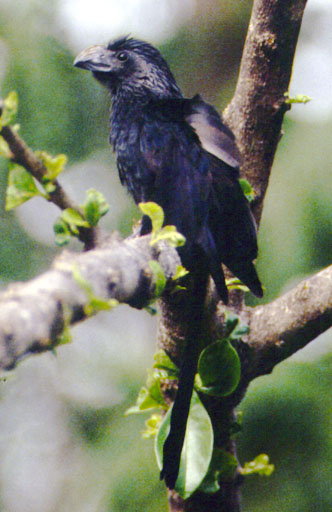
The Smooth-billed Ani is a medium-sized, glossy black cuckoo with a distinctive, deep, laterally compressed bill. It is known for its highly social behavior, often found in small flocks, and its cooperative breeding strategy where multiple females lay eggs in a single communal nest.
Size & lifespan
- Length
- 30-36 cm (12-14 in)
- Wingspan
- 43-46 cm (17-18 in)
- Weight
- 70-100 g (2.5-3.5 oz)
- Lifespan
- Approximately 5-7 years in the wild
- Diet
- Omnivore (primarily insectivore)
Physical characteristics
- Plumage
- Entirely glossy black plumage, often appearing iridescent blue-purple or green in good light. The feathers on the head and neck can appear somewhat shaggy.
- Beak shape
- Large, deep, and laterally compressed (knife-like) black bill with a prominent arch to the culmen. The bill is smooth, lacking the grooves found in the Groove-billed Ani.
- Eye color
- Dark brown to black
- Leg color
- Black
- Distinguishing features
- The most distinctive feature is its large, smooth, arched black bill. Its overall glossy black appearance and long tail are also characteristic. The tail is often held loosely and appears somewhat disheveled.
- Juvenile appearance
- Juveniles resemble adults but may have a duller, less glossy black plumage and a slightly less developed bill structure. Their eyes may appear lighter brown initially.
- Seasonal changes
- No significant seasonal plumage changes. They maintain their glossy black plumage year-round.
- Sexual dimorphism
- Males and females are monomorphic, appearing identical in plumage and size.
How to identify
- 1
Bill Shape
Look for the large, deep, and smooth black bill with a prominent arch. This is the key differentiator from the Groove-billed Ani.
- 2
Plumage
Observe the entirely glossy black plumage, which can show iridescent blue or purple hues in sunlight. The feathers often appear somewhat shaggy, especially on the head.
- 3
Social Behavior
Anis are almost always seen in small, noisy flocks, foraging together on the ground or perched closely in trees. Solitary individuals are rare.
- 4
Vocalizations
Listen for their distinctive rising 'whee-oo' whistle and harsh 'churrr' calls. Their calls are often the first indication of their presence.
- 5
Habitat
Check open, grassy areas with scattered shrubs and trees, especially pastures or agricultural fields, where they often follow livestock.
Habitat & range
- Biomes
- Tropical and subtropical lowlands, including open woodlands, savannas, pastures, agricultural fields, forest edges, and mangroves.
- Geographic range
- Southeastern United States (Florida), West Indies, Central America, and South America east of the Andes, south to northern Argentina. Introduced to some Caribbean islands.
- Elevation range
- Typically found from sea level up to 1,000 meters (3,300 feet), occasionally higher.
- Preferred environments
- Prefers open, grassy areas with scattered shrubs and trees, often near water. Frequently found in disturbed habitats, such as cattle pastures and cultivated lands, where insects are abundant.
Behavior
- Activity time
- Diurnal
- Feeding habits
- Primarily insectivorous, feeding on a wide variety of insects (grasshoppers, crickets, beetles, caterpillars, spiders) and other arthropods. They often forage on the ground, walking or running, and frequently follow grazing livestock to catch insects disturbed by their movement. They also consume small vertebrates (lizards, frogs) and some fruits and seeds, especially during the dry season.
- Social behavior
- Highly social, typically found in small flocks of 3-10 individuals, sometimes up to 20. These flocks are often family groups that engage in cooperative breeding. They are vocal and often perch together, preening each other.
- Flight pattern
- Weak, somewhat clumsy, and undulating flight with rapid wing beats, often interspersed with short glides. They typically fly short distances between perches or across open fields.
- Migration pattern
- Mostly resident throughout its range. Northern populations in Florida may show some local dispersal or short-distance movements, but no true long-distance migration.
- Territoriality
- Flocks maintain a communal territory, which they defend against other ani groups. Within the flock, there is a complex social hierarchy, particularly during breeding.
Song & calls
- Song
- Not known for a complex song. Their vocalizations are primarily calls.
- Call
- A variety of distinctive calls, including a rising, whistled 'whee-oo' or 'whee-ooo-ee', often repeated. Also a harsh, scolding 'churrr' or 'chur-chur-chur', and a nasal 'klee-uh' or 'klee-oh'. They are quite noisy birds, especially when foraging in groups.
- When they vocalize
- Vocalize frequently throughout the day, particularly when foraging, interacting with flock members, or when disturbed.
Breeding & reproduction
- Breeding season
- Varies geographically, typically coinciding with the rainy season and peak insect abundance. In Florida, March to August; in Central and South America, often April to September.
- Nesting habits
- Cooperative breeders. Multiple females (up to 4-5) lay their eggs in a single, large, cup-shaped communal nest, usually built 1-6 meters (3-20 feet) high in a thorny bush or tree. The nest is constructed from twigs and lined with leaves.
- Clutch size
- Individual females lay 3-5 eggs, but communal nests can contain 10-20 eggs, sometimes up to 29.
- Egg description
- Pale blue-green to dark blue-green, often covered with a chalky white layer that can be scraped off to reveal the true color. Elongated oval shape. Approximately 30-38 mm (1.2-1.5 in) long.
- Incubation period
- 13-15 days, shared by all breeding adults in the flock.
- Fledging period
- 10-12 days after hatching, young leave the nest but remain dependent on the flock for several weeks.
- Parental care
- All adult members of the flock participate in incubation, brooding, and feeding the young. There is often a dominant pair that contributes most to incubation, but all adults feed the chicks.
Where to find
Pastures and Agricultural Fields
Often found in open fields with grazing cattle, where they feed on insects disturbed by the animals.
Forest Edges and Open Woodlands
Look along the edges of forests, in clearings, and in areas with scattered trees and dense undergrowth.
Mangroves and Coastal Thickets
In some parts of their range, they can be found in coastal scrub and mangrove habitats.
Suburban Parks and Gardens
In areas where their range overlaps with human habitation, they may adapt to parks and large gardens with suitable vegetation.
Field tips
- Listen for Calls. Their distinctive calls are often heard before the birds are seen. Learn their 'whee-oo' whistle and harsh 'churrr' calls.
- Look for Flocks. Anis are rarely alone. Scan for groups of glossy black birds moving together on the ground or perched in low trees and bushes.
- Check Near Livestock. If in suitable habitat with cattle or other grazing animals, observe the ground around them, as anis frequently follow them to catch insects.
- Observe Flight. Their somewhat clumsy, undulating flight is characteristic. They often fly low over open ground.
Similar species
Groove-billed Ani
Crotophaga sulcirostris
The most reliable distinction is the bill. The Smooth-billed Ani has a smooth bill, while the Groove-billed Ani has distinct grooves or ridges on the upper mandible. Groove-billed Anis are generally slightly smaller and have a less arched bill. Their calls also differ.
Greater Ani
Crotophaga major
The Greater Ani is significantly larger (up to 46 cm) with a longer tail and a more massive, less arched bill. Its plumage is also glossy black, but it often has a more bluish sheen. It is typically found in more aquatic habitats, such as marshes and along rivers, and its range is primarily South America.
Quick facts
- Diet:
- Mainly insects, some small vertebrates and fruit
- Social Structure:
- Highly social, cooperative breeders in flocks
- Nest Type:
- Communal cup-shaped nest
- Bill Feature:
- Large, deep, smooth, arched black bill
- Plumage Color:
- Glossy black with iridescent sheen
Fun facts
- Smooth-billed Anis are cooperative breeders, meaning multiple females lay their eggs in a single nest, and all adults in the flock help incubate and raise the young. This is a rare strategy among birds.
- They are often seen following cattle or other grazing animals, using them as 'beaters' to flush out insects from the grass, a behavior known as commensal feeding.
- Despite being cuckoos, they are not brood parasites like many Old World cuckoos. Instead, they build their own nests, albeit communally.
- The chalky white layer on their eggs is unique and can be scraped off to reveal the true blue-green color underneath.
Scientific classification
- Kingdom
- Animalia
- Phylum
- Chordata
- Class
- Aves
- Order
- Cuculiformes
- Family
- Cuculidae
- Genus
- Crotophaga
- Species
- Crotophaga ani
Explore the Smooth-billed Ani
Identify birds anywhere
Free on iOS, Android, and Web. Photo & sound identification, full species database, and your personal life list.