
Spotted a bird? Identify it instantly with the Birdby app
Open the appAbout
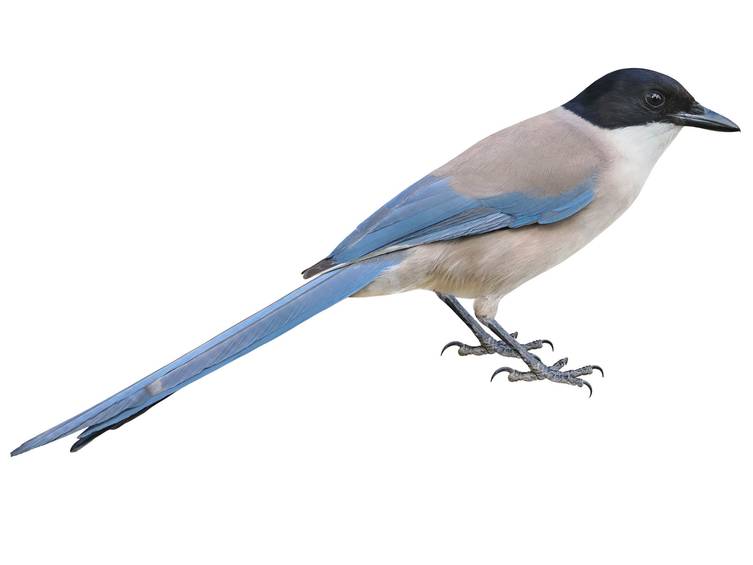
The Azure-winged Magpie is a medium-sized passerine bird belonging to the crow family, Corvidae. It is characterized by its striking azure-blue wings and tail, contrasting with a black cap and greyish-brown body. Known for its social behavior, it often moves in noisy flocks.
Size & lifespan
- Length
- 31-35 cm
- Wingspan
- 38-45 cm
- Weight
- 65-90 g
- Lifespan
- Up to 10-15 years in the wild
- Diet
- Omnivore
Physical characteristics
- Plumage
- Adults have a glossy black cap extending from the forehead to the nape, contrasting sharply with a white throat and greyish-brown underparts and back. The most distinctive features are the bright azure-blue wings and a long, graduated azure-blue tail. The primary feathers are darker, almost blackish-blue. The rump is typically a lighter grey.
- Beak shape
- Relatively small, slender, and slightly decurved black bill.
- Eye color
- Dark brown
- Leg color
- Black
- Distinguishing features
- The combination of a black cap, white throat, grey body, and brilliant azure-blue wings and tail is unique. The long, graduated tail is particularly noticeable in flight.
- Juvenile appearance
- Juveniles resemble adults but have a duller, browner black cap, less vibrant blue on the wings and tail, and often a slightly shorter tail. The body plumage may also appear more mottled or less uniform grey.
- Seasonal changes
- No significant seasonal changes in plumage. The plumage remains consistent throughout the year.
- Sexual dimorphism
- None significant; males and females are virtually identical in plumage and size.
How to identify
- 1
Black Cap
Look for the distinct, glossy black cap that covers the head from the forehead to the nape, contrasting sharply with the white throat.
- 2
Azure-blue Wings and Tail
The most striking feature. The wings and long, graduated tail are a vibrant azure-blue. This is particularly evident in flight.
- 3
Grey Body
The back and underparts are a uniform greyish-brown, providing a clear contrast to the black cap and blue extremities.
- 4
Social Behavior
Often seen in noisy flocks, moving through trees or foraging on the ground. Their social calls are a good indicator of their presence.
- 5
Flight Pattern
Observe their undulating flight, which highlights the long blue tail and blue wings.
Habitat & range
- Biomes
- Temperate forests, woodlands, parks, gardens, and agricultural areas with scattered trees.
- Geographic range
- The species has a disjunct distribution, with two main populations: one in East Asia (China, Korea, Japan, Mongolia) and another in the Iberian Peninsula (Spain and Portugal).
- Elevation range
- Typically found from sea level up to 1,500 meters, occasionally higher in some parts of its Asian range.
- Preferred environments
- Prefers open woodlands, especially those dominated by oaks (Quercus spp.) and pines (Pinus spp.), cork oak forests, olive groves, orchards, and suburban parks. Requires areas with a good understory for foraging and dense canopy for nesting.
Behavior
- Activity time
- Diurnal
- Feeding habits
- Highly omnivorous, feeding on a wide variety of items. Diet includes acorns, pine nuts, seeds, fruits, berries, insects (especially caterpillars, beetles, and grasshoppers), spiders, small reptiles, eggs, and nestlings of other birds. They often cache food, particularly acorns, for later consumption. Forages both on the ground and in trees.
- Social behavior
- Highly social birds, typically found in flocks of 5-30 individuals, sometimes forming larger aggregations outside the breeding season. They are cooperative breeders, with non-breeding individuals often assisting breeding pairs. They are known for their communal roosts.
- Flight pattern
- Flight is undulating and rather direct, often in loose flocks. The long tail and blue wings are prominent during flight. They are agile flyers within dense canopy.
- Migration pattern
- Mostly resident throughout its range, though some local movements may occur, especially in response to food availability. Not considered a migratory species.
- Territoriality
- Breeding pairs defend a nesting territory, but outside the breeding season, they are less territorial and forage communally.
Song & calls
- Song
- Not known for a complex song. Vocalizations are generally harsh and varied, often described as chattering or scolding.
- Call
- Common calls include a harsh, grating 'kzaar-kzaar' or 'shree-shree', a metallic 'chink-chink', and various chattering or whistling notes. They can also produce a soft, conversational 'chup-chup' within the flock. Alarm calls are typically sharper and more insistent.
- When they vocalize
- Vocalizes throughout the day, especially when foraging in flocks or when disturbed. Most vocal during the breeding season and when communicating within the flock.
Breeding & reproduction
- Breeding season
- April to July, with peak activity in May and June.
- Nesting habits
- Nests are typically built in the forks of trees or dense bushes, often at a height of 3-10 meters. Both sexes participate in nest construction, which is a bulky cup-shaped structure made of twigs, roots, moss, and lined with softer materials like hair, wool, and feathers. Nests are often placed in loose colonies.
- Clutch size
- 3-9 eggs
- Egg description
- 3-9 eggs (typically 6-8), pale greenish-blue or buffish-white, heavily spotted and blotched with olive-brown, grey, and purplish markings, particularly at the broader end. Eggs measure approximately 29 x 21 mm.
- Incubation period
- 15-16 days, primarily by the female, though the male may assist.
- Fledging period
- 16-19 days after hatching. Young are fed by both parents and often by helpers from the flock.
- Parental care
- Both parents feed and care for the young. In many cases, non-breeding individuals (often offspring from previous years) act as 'helpers at the nest', assisting with feeding and defending the nest.
Where to find
Oak Woodlands
Especially cork oak and holm oak forests in the Iberian Peninsula, and various oak species in East Asia.
Pine Forests
Mixed pine and broadleaf woodlands are also favored habitats.
Orchards and Olive Groves
Agricultural areas with scattered trees provide foraging opportunities and nesting sites.
Parks and Gardens
In suburban and urban areas, they can be found in large parks and gardens with mature trees.
Field tips
- Listen for their calls. Their chattering and harsh calls often reveal their presence before they are seen, especially when they are moving in flocks.
- Look for movement in trees. They are active foragers, moving through the canopy and understory. Scan trees for movement and flashes of blue.
- Visit during autumn. In autumn, they are particularly active caching acorns and other seeds, making them easier to observe.
- Observe flocks. They are rarely solitary. If you see one, look around for more, as they typically move and forage in groups.
Similar species
Eurasian Magpie
Pica pica
The Eurasian Magpie is larger, has a much longer tail, and its plumage is predominantly black and white with iridescent green and purple sheens on the wings and tail. It lacks the distinct black cap and grey body of the Azure-winged Magpie, and its blue coloration is limited to iridescence, not a solid azure hue.
Iberian Magpie
Cyanopica cooki
Until recently, the Iberian Magpie was considered a subspecies of the Azure-winged Magpie. The main difference is genetic, but morphologically, C. cooki (Iberian) tends to have a slightly duller blue on the wings and tail, and a slightly browner tone to its grey body compared to the East Asian C. cyanus. Field identification between the two is virtually impossible without knowing the geographic location.
Quick facts
- Distinctive Feature:
- Azure-blue wings and tail with a black cap
- Social Structure:
- Highly social, often in flocks
- Dietary Preference:
- Omnivorous, with a fondness for acorns
- Conservation Status:
- Least Concern
- Geographic Anomaly:
- Disjunct distribution in East Asia and Iberian Peninsula
Fun facts
- The disjunct distribution of the Azure-winged Magpie, with populations in East Asia and the Iberian Peninsula, has long puzzled ornithologists. Genetic studies have confirmed that the Iberian population (now often recognized as a separate species, Cyanopica cooki) diverged from the East Asian population (Cyanopica cyanus sensu stricto) millions of years ago, likely due to ancient climatic shifts.
- Azure-winged Magpies are known for their intelligence and problem-solving abilities, typical of the Corvidae family. They are adept at caching food, particularly acorns, and remembering their locations.
- They are cooperative breeders, meaning that non-breeding individuals, often offspring from previous years, assist the breeding pair in raising their young. This behavior is thought to increase the reproductive success of the breeding pair.
- Despite their striking coloration, they can be surprisingly cryptic when moving through dense foliage, blending in with the dappled light and shadows.
Scientific classification
- Kingdom
- Animalia
- Phylum
- Chordata
- Class
- Aves
- Order
- Passeriformes
- Family
- Corvidae
- Genus
- Cyanopica
- Species
- Cyanopica cyanus
Explore the Azure-winged Magpie
Identify birds anywhere
Free on iOS, Android, and Web. Photo & sound identification, full species database, and your personal life list.