
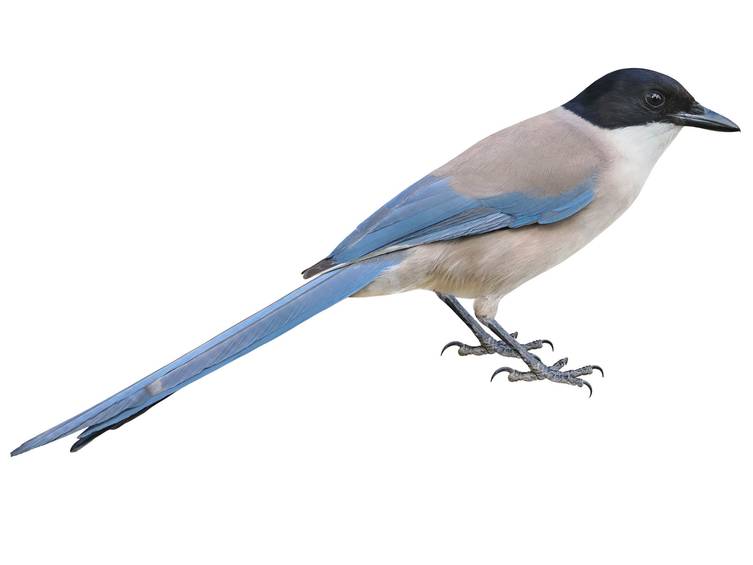
Where does the Azure-winged Magpie live?
Cyanopica cyanus
Spotted a bird? Identify it instantly with the Birdby app
Open the appThe Azure-winged Magpie lives in specific habitats and regions. Knowing where, and when, to look improves your chances of a successful sighting.
Biomes
Temperate forests, woodlands, parks, gardens, and agricultural areas with scattered trees.
Geographic range
The species has a disjunct distribution, with two main populations: one in East Asia (China, Korea, Japan, Mongolia) and another in the Iberian Peninsula (Spain and Portugal).
Preferred environments
Prefers open woodlands, especially those dominated by oaks (Quercus spp.) and pines (Pinus spp.), cork oak forests, olive groves, orchards, and suburban parks. Requires areas with a good understory for foraging and dense canopy for nesting.
Elevation range
Typically found from sea level up to 1,500 meters, occasionally higher in some parts of its Asian range.
Where to look
Oak Woodlands
Especially cork oak and holm oak forests in the Iberian Peninsula, and various oak species in East Asia.
Pine Forests
Mixed pine and broadleaf woodlands are also favored habitats.
Orchards and Olive Groves
Agricultural areas with scattered trees provide foraging opportunities and nesting sites.
Parks and Gardens
In suburban and urban areas, they can be found in large parks and gardens with mature trees.
Field tips
- Listen for their calls. Their chattering and harsh calls often reveal their presence before they are seen, especially when they are moving in flocks.
- Look for movement in trees. They are active foragers, moving through the canopy and understory. Scan trees for movement and flashes of blue.
- Visit during autumn. In autumn, they are particularly active caching acorns and other seeds, making them easier to observe.
- Observe flocks. They are rarely solitary. If you see one, look around for more, as they typically move and forage in groups.
Migration
Mostly resident throughout its range, though some local movements may occur, especially in response to food availability. Not considered a migratory species.
Explore the Azure-winged Magpie
Identify birds anywhere
Free on iOS, Android, and Web. Photo & sound identification, full species database, and your personal life list.