
Spotted a bird? Identify it instantly with the Birdby app
Open the appAbout
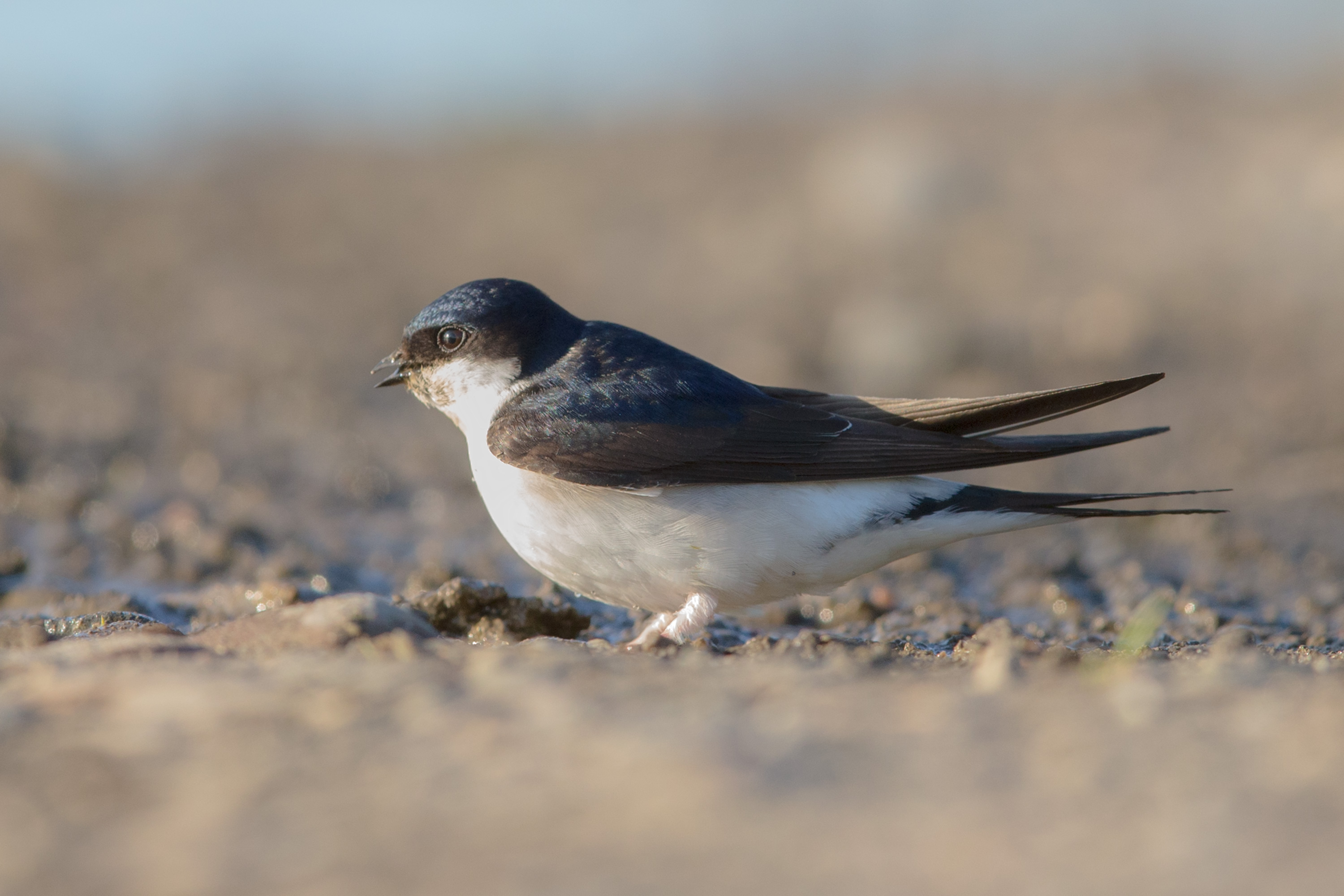
The House Martin is a small passerine bird in the swallow family, Hirundinidae. It is characterized by its glossy blue-black upperparts, pure white underparts, and a distinctive white rump. Known for its aerial insectivorous feeding and colonial nesting habits, often building mud nests under the eaves of buildings.
Size & lifespan
- Length
- 13-15 cm
- Wingspan
- 26-29 cm
- Weight
- 15-22 g
- Lifespan
- 2-5 years (up to 10 years recorded)
- Diet
- Insectivore
Physical characteristics
- Plumage
- Adults have glossy blue-black upperparts, including the head, back, and upperwing coverts. The rump is conspicuously pure white, contrasting sharply with the dark back and tail. Underparts are entirely pure white. The tail is forked, but less deeply than that of a Barn Swallow.
- Beak shape
- Small, flattened, and triangular, adapted for catching insects in flight. Black in color.
- Eye color
- Dark brown
- Leg color
- Short, feathered white legs and feet, often appearing fluffy.
- Distinguishing features
- The most distinctive feature is the pure white rump, which is highly visible in flight. The feathered white legs are also unique among European swallows and martins. Its flight is typically more buoyant and fluttering than the Barn Swallow.
- Juvenile appearance
- Juveniles are duller than adults, with sooty-brown upperparts instead of glossy blue-black. The white underparts may be tinged with grey or buff, and the white rump is less bright. The feathers on the legs are less developed.
- Seasonal changes
- No significant seasonal plumage changes. Breeding and non-breeding plumages are similar, though plumage may appear slightly worn by the end of the breeding season.
- Sexual dimorphism
- Males and females are virtually identical in plumage and size. There is no discernible sexual dimorphism.
How to identify
- 1
Rump Color
Look for the striking, pure white rump that contrasts sharply with the dark back. This is the most reliable field mark.
- 2
Underparts
Observe the entirely pure white underparts, lacking any streaking or rufous coloration.
- 3
Upperparts
Note the glossy blue-black upperparts, which can appear dark blue in good light.
- 4
Tail Shape
The tail is forked, but relatively short and less deeply forked than a Barn Swallow's, lacking long streamers.
- 5
Legs
If seen at rest or closely, the white feathered legs and feet are a unique identifier among European swallows/martins.
- 6
Flight Style
Its flight is often described as more buoyant, fluttering, and less direct than the Barn Swallow, with frequent glides.
- 7
Nesting Sites
Look for mud nests built under eaves of buildings, bridges, or cliffs, often in colonies.
Habitat & range
- Biomes
- Temperate grasslands, open country, agricultural areas, urban and suburban environments.
- Geographic range
- Breeds across most of Europe and temperate Asia, from Ireland and Portugal east to Japan and Kamchatka. Winters in sub-Saharan Africa and tropical Asia.
- Elevation range
- Typically found from sea level up to 2,000 meters, occasionally higher in mountainous regions during migration.
- Preferred environments
- Prefers open country with access to water and suitable nesting sites, primarily man-made structures like houses, bridges, and cliffs. Often found near human habitation.
Behavior
- Activity time
- Diurnal. Active from dawn to dusk, primarily foraging during daylight hours.
- Feeding habits
- Strictly aerial insectivores, catching insects (flies, aphids, small beetles, mosquitoes) on the wing. They forage at various heights, often higher than Barn Swallows, especially in good weather. They drink by skimming over water surfaces.
- Social behavior
- Highly colonial, especially during breeding. Nests are often built in close proximity, forming large colonies. They also roost communally outside the breeding season, sometimes in very large numbers.
- Flight pattern
- Graceful, buoyant, and agile flight, characterized by rapid wing beats interspersed with glides. Often flies in tight, erratic patterns when foraging. Less direct and more fluttering than the Barn Swallow.
- Migration pattern
- Long-distance migratory. European populations migrate south to sub-Saharan Africa for the winter, while Asian populations winter in tropical Asia. They migrate in large flocks, often following broad fronts.
- Territoriality
- While nesting in colonies, individual pairs defend a small area immediately around their nest. Foraging areas are generally shared.
Song & calls
- Song
- A soft, warbling, chattering song, often delivered from the nest or a perch. It is less varied and musical than the Barn Swallow's song, consisting of a series of short, twittering notes.
- Call
- Common calls include a short, sharp 'chip' or 'chrrrp' contact call, especially in flight or around the colony. An alarm call is a more insistent 'tseep'.
- When they vocalize
- Most vocal during the breeding season, particularly around the nest site. Calls are frequently heard in flight as they forage or gather.
Breeding & reproduction
- Breeding season
- Typically May to August in Europe, with two or sometimes three broods per season.
- Nesting habits
- Builds a distinctive enclosed cup-shaped nest made of mud pellets, lined with grass and feathers. Nests are typically attached to vertical surfaces under eaves, overhangs, bridges, or cliffs, often in colonies.
- Clutch size
- Typically 4-5 eggs, occasionally 3-7.
- Egg description
- Usually 4-5 pure white, unmarked, slightly glossy eggs. Approximately 19.5 x 13.5 mm.
- Incubation period
- 13-16 days, primarily by the female, though both parents may participate.
- Fledging period
- 22-32 days after hatching. Young are fed by both parents.
- Parental care
- Both parents participate in nest building, incubation (to a lesser extent for the male), feeding of nestlings, and post-fledging care. Young birds are fed for several days after leaving the nest.
Where to find
Urban and Suburban Areas
Look for them nesting on houses, churches, and other buildings, especially under eaves or sheltered ledges.
Open Countryside
Forage over fields, meadows, and agricultural land, particularly near water bodies.
Lakes and Rivers
Often seen foraging over water, where insect abundance is high, and skimming to drink.
Coastal Cliffs
In some areas, they will nest on natural cliff faces, especially where human structures are scarce.
Field tips
- Look Up. House Martins spend most of their time in the air. Scan the sky above buildings, open fields, and water bodies.
- Observe Nests. During the breeding season (spring/summer), locate colonies of mud nests under eaves. Birds will be constantly flying to and from these nests.
- Listen for Calls. Their characteristic 'chip' or 'chrrrp' calls are often heard as they fly, especially near colonies.
- Migration Hotspots. During spring and autumn migration, large flocks can be seen passing through coastal areas, mountain passes, or gathering at roost sites.
- Watch for Foraging. Observe their agile, buoyant flight as they chase insects. They often fly higher than Barn Swallows.
Similar species
Barn Swallow
Hirundo rustica
The Barn Swallow has a deeply forked tail with long streamers, a dark blue-black back, and rufous-orange underparts (especially on the throat and forehead). It lacks the pure white rump of the House Martin and has unfeathered legs. Its flight is more direct and swooping.
Sand Martin (Bank Swallow)
Riparia riparia
The Sand Martin is smaller and duller brown above, with a distinct brown breast band across its white underparts. It lacks the glossy blue-black upperparts and white rump of the House Martin. Its tail is only slightly forked. It nests in burrows in sand banks.
Red-rumped Swallow
Cecropis daurica
The Red-rumped Swallow has a rufous-orange rump (not white), a rufous nape, and streaked underparts. Its tail streamers are much longer than those of the House Martin. It builds a mud nest with a tubular entrance.
Quick facts
- Key ID Feature:
- Pure white rump
- Nest Type:
- Enclosed mud cup under eaves
- Diet:
- Flying insects
- Sociality:
- Highly colonial
- Migration:
- Long-distance migrant
Fun facts
- House Martins often reuse their mud nests year after year, sometimes repairing them or building new ones on top of old foundations.
- They are highly dependent on human structures for nesting, making them one of the most synanthropic (associated with humans) bird species.
- A single House Martin nest can contain thousands of mud pellets, each collected individually by the birds.
- Despite their small size, House Martins undertake epic migrations, covering thousands of kilometers between their breeding and wintering grounds.
- They are known to occasionally hybridize with Barn Swallows, though this is relatively rare.
Scientific classification
- Kingdom
- Animalia
- Phylum
- Chordata
- Class
- Aves
- Order
- Passeriformes
- Family
- Hirundinidae
- Genus
- Delichon
- Species
- urbicum
Explore the House Martin
Identify birds anywhere
Free on iOS, Android, and Web. Photo & sound identification, full species database, and your personal life list.