
Spotted a bird? Identify it instantly with the Birdby app
Open the appAbout
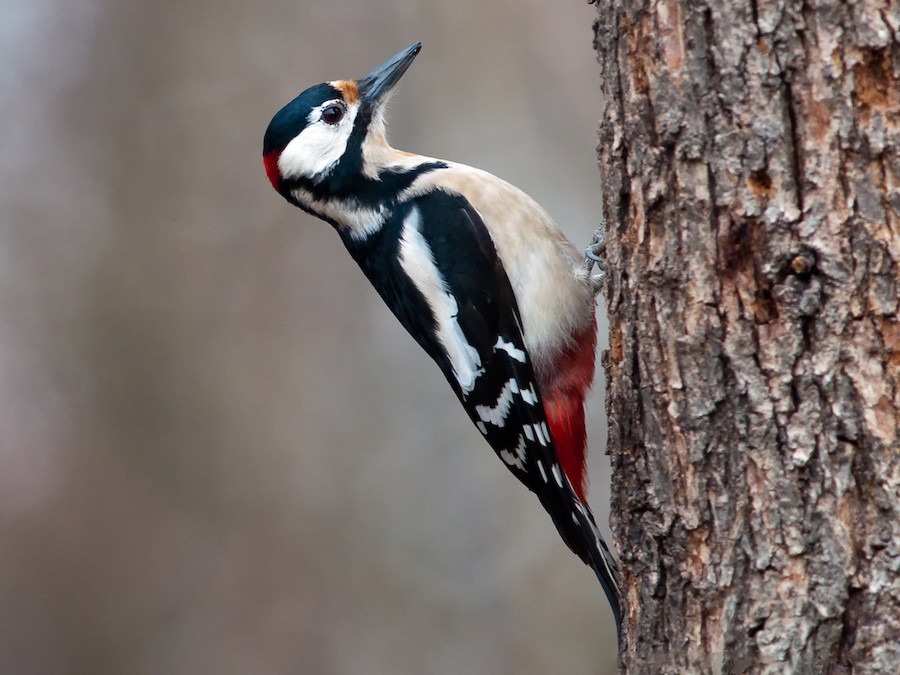
The Great Spotted Woodpecker is a medium-sized woodpecker with striking black and white plumage and a distinctive red patch. It is one of the most widespread and familiar woodpecker species across Eurasia, known for its drumming on trees to communicate and excavate nests.
Size & lifespan
- Length
- 20-24 cm
- Wingspan
- 34-39 cm
- Weight
- 70-90 g
- Lifespan
- Up to 11 years in the wild, typically 2-3 years
- Diet
- Omnivore, primarily insectivorous, especially during breeding season. Also consumes seeds, nuts, berries, and tree sap.
Physical characteristics
- Plumage
- Predominantly black and white. Black upperparts with large white oval patches on the shoulders. White underparts, often with a buffy wash on the flanks. A prominent red vent (undertail coverts). Black crown and nape, with white cheeks and a black moustachial stripe extending from the base of the bill to the nape.
- Beak shape
- Strong, chisel-shaped, dark grey to black bill, adapted for drilling into wood.
- Eye color
- Dark red to reddish-brown.
- Leg color
- Dark grey to blackish-grey.
- Distinguishing features
- Large white shoulder patches, red vent, and a distinctive black moustachial stripe. The red patch on the nape (males) or crown (juveniles) is a key identifier.
- Juvenile appearance
- Juveniles of both sexes have a red crown (forehead to nape), which is often brighter and more extensive than the adult male's nape patch. Their plumage can appear duller overall, and the white underparts may have a more streaky or dirty appearance.
- Seasonal changes
- No significant seasonal plumage changes. Plumage remains consistent throughout the year.
- Sexual dimorphism
- Males have a prominent red patch on the nape (back of the head). Females lack this red nape patch, having an entirely black crown and nape.
How to identify
- 1
Plumage Pattern
Look for the striking black and white pattern, especially the large white oval patches on the shoulders and the bright red undertail coverts (vent).
- 2
Head Markings
Note the black crown and nape, white cheeks, and the distinctive black moustachial stripe that extends from the bill to the nape. Males have an additional red patch on the nape; juveniles have a red crown.
- 3
Vocalizations
Listen for the sharp 'kik' call and, more importantly, its rapid, resonant drumming, which is a key identification feature, especially in spring.
- 4
Behavior
Observe its foraging behavior: climbing tree trunks, probing bark, and hammering at wood. Its undulating flight pattern is also characteristic.
- 5
Size
It's a medium-sized woodpecker, larger than a sparrow but smaller than a crow, which helps distinguish it from Lesser Spotted and Green Woodpeckers respectively.
Habitat & range
- Biomes
- Temperate forests, boreal forests, mixed woodlands, parks, gardens, orchards.
- Geographic range
- Widespread across the Palearctic, from Western Europe and North Africa through Asia to Japan. Absent from Iceland, Ireland, and parts of the Mediterranean islands.
- Elevation range
- Sea level up to 2,000 meters, occasionally higher in mountainous regions.
- Preferred environments
- Prefers mature deciduous and coniferous woodlands, but is highly adaptable and can be found in suburban parks and large gardens with mature trees. Requires trees for foraging, nesting, and roosting.
Behavior
- Activity time
- Diurnal.
- Feeding habits
- Forages by climbing tree trunks and branches, probing bark crevices with its bill, and excavating wood to extract insects and larvae. Also consumes seeds from cones (especially conifers), nuts (often wedged into bark crevices to be hammered open), berries, and occasionally raids nests for eggs or young birds. Known to visit bird feeders for suet and peanuts.
- Social behavior
- Generally solitary or found in pairs during the breeding season. Highly territorial, especially around nesting and drumming sites. Juveniles disperse after fledging.
- Flight pattern
- Undulating, bouncy flight pattern, typical of woodpeckers, with rapid wing beats followed by a short glide on closed wings.
- Migration pattern
- Mostly resident throughout its range. Northern populations may undertake short-distance irruptive movements in years of poor cone crops, moving south or west.
- Territoriality
- Highly territorial, especially during the breeding season. Males defend territories through drumming, calls, and aggressive displays. Both sexes participate in defending the nest site.
Song & calls
- Song
- Does not have a complex song. Its primary vocal communication is a sharp, explosive 'kik' or 'tschick' call, often repeated. Also produces a rapid, rattling 'krr-krr-krr' call.
- Call
- The most characteristic sound is its drumming, a rapid, resonant burst of hammering on a tree trunk or branch. Drumming lasts about 0.5-1 second and consists of 10-16 beats, used for territorial advertisement and attracting a mate. It is much faster and shorter than the drumming of other woodpeckers.
- When they vocalize
- Calls and drumming are most frequent during the breeding season (late winter to early summer) but can be heard year-round, particularly drumming in late winter/early spring.
Breeding & reproduction
- Breeding season
- April to July, with peak activity in May.
- Nesting habits
- Nests in self-excavated cavities in dead or decaying trees, or sometimes in live trees with soft wood. Both sexes participate in excavating the nest hole, which typically has a round entrance hole. Nest sites are usually 2-8 meters above the ground.
- Clutch size
- 3-7 eggs.
- Egg description
- 3-7 (typically 4-6) glossy white, oval eggs.
- Incubation period
- 10-13 days, shared by both parents.
- Fledging period
- 20-24 days after hatching. Young remain dependent on parents for several weeks after fledging.
- Parental care
- Both parents incubate the eggs and feed the nestlings. They continue to feed the fledglings for several weeks after they leave the nest, teaching them foraging skills.
Where to find
Forests and Woodlands
Deciduous, coniferous, and mixed forests are prime habitats. Look for them on tree trunks and larger branches.
Parks and Gardens
Common in urban and suburban areas with mature trees, especially those with older or dead wood. They frequently visit bird feeders.
Orchards and Avenues
Areas with scattered trees, such as orchards, avenues, and hedgerows, can also host Great Spotted Woodpeckers.
Field tips
- Listen for Drumming. In late winter and spring, listen for their distinctive, rapid drumming. This is often the first indication of their presence.
- Look for Foraging Signs. Scan tree trunks for holes, flaked bark, or areas where they have been excavating for insects. They often work their way up a tree.
- Check Bird Feeders. They are frequent visitors to feeders offering suet, peanuts, and sunflower seeds, especially in winter.
- Patience and Stealth. Woodpeckers can be shy. Move slowly and quietly through wooded areas. Binoculars are essential for detailed observation.
- Observe Flight. If you see a bird flying between trees, look for the characteristic undulating flight pattern.
Similar species
Syrian Woodpecker
Dendrocopos syriacus
The Syrian Woodpecker lacks the black moustachial stripe connecting to the nape, giving it a cleaner white cheek patch. Its black malar stripe is shorter and does not reach the nape. The red vent is also typically paler and less extensive. Its range is more restricted to southeastern Europe and the Middle East.
Middle Spotted Woodpecker
Dendrocopos medius
The Middle Spotted Woodpecker has a red crown (in both sexes, though duller in females) and lacks the black moustachial stripe, giving it a 'clean' white face. It also lacks the large white shoulder patches of the Great Spotted Woodpecker and has streaky flanks. Its drumming is much softer and less frequent, often replaced by a 'giggling' call.
Lesser Spotted Woodpecker
Dryobates minor
Significantly smaller (sparrow-sized) than the Great Spotted Woodpecker. It has barred black and white upperparts (not large white shoulder patches) and lacks a red vent. Males have a red crown, females have a white crown.
Quick facts
- Primary Diet:
- Insects, larvae, seeds, nuts, berries
- Nesting:
- Cavity nester, excavates own holes
- Communication:
- Drumming and sharp calls
- Status:
- Common and widespread
- Key ID Feature:
- Large white shoulder patches, red vent, male's red nape
Fun facts
- Great Spotted Woodpeckers can drum up to 10-16 times per second, and their skulls are specially adapted to absorb the shock, preventing brain damage.
- They use their long, barbed tongue, which can extend far beyond the bill, to extract insects from deep crevices.
- These woodpeckers are known to 'anvil' nuts and pine cones, wedging them into bark crevices or holes to hold them steady while they hammer them open.
- While primarily insectivorous, they are opportunistic feeders and have been observed preying on small birds and eggs, especially during the breeding season when protein demands are high.
- The Great Spotted Woodpecker is one of the few bird species that can cling vertically to tree trunks, thanks to its strong zygodactyl feet (two toes pointing forward, two backward) and stiff tail feathers used as a prop.
Scientific classification
- Kingdom
- Animalia
- Phylum
- Chordata
- Class
- Aves
- Order
- Piciformes
- Family
- Picidae
- Genus
- Dendrocopos
- Species
- Dendrocopos major
Explore the Great Spotted Woodpecker
Identify birds anywhere
Free on iOS, Android, and Web. Photo & sound identification, full species database, and your personal life list.