
Spotted a bird? Identify it instantly with the Birdby app
Open the appAbout
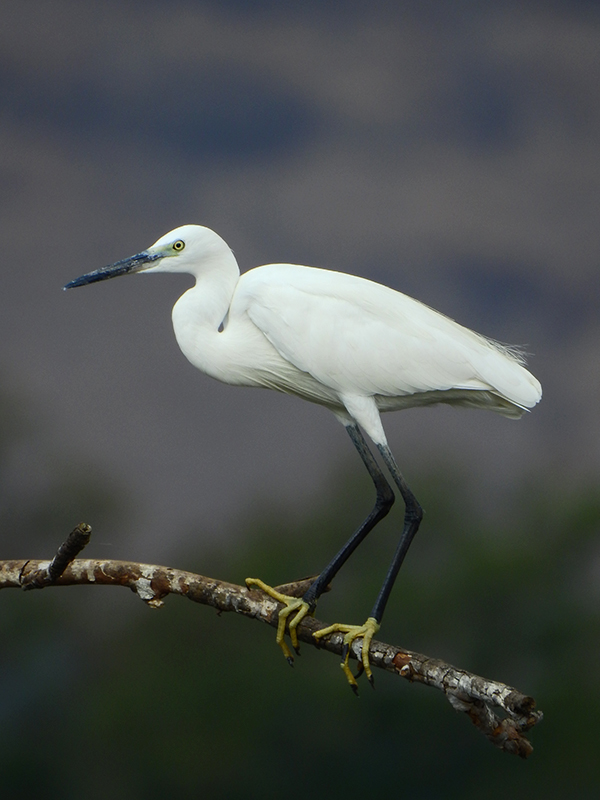
The Little Egret is a small, white heron with a slender black bill, black legs, and striking yellow feet. It is a widespread species, found across much of the Old World and increasingly in the New World, often seen wading in shallow waters hunting for small prey.
Size & lifespan
- Length
- 55-65 cm (22-26 in)
- Wingspan
- 88-106 cm (35-42 in)
- Weight
- 350-550 g (12-19 oz)
- Lifespan
- Up to 10-15 years in the wild
- Diet
- Carnivore (primarily fish, amphibians, insects, crustaceans)
Physical characteristics
- Plumage
- Entirely pure white plumage. In breeding season, it develops two long, delicate nuchal plumes (aigrettes) extending from the back of the head, and lacy scapular plumes (nuptial plumes) on its back and breast.
- Beak shape
- Slender, pointed, and entirely black. The lores (skin between the eye and bill) are greyish-blue in non-breeding birds and turn bright blue-green during breeding season.
- Eye color
- Yellow iris.
- Leg color
- Black legs with conspicuously bright yellow feet. The yellow feet are a key identification feature.
- Distinguishing features
- Pure white plumage, slender black bill, black legs, and bright yellow feet. The long nuchal plumes and lacy scapular plumes in breeding plumage are also distinctive.
- Juvenile appearance
- Juveniles resemble non-breeding adults but may have duller, greenish-yellow feet and a slightly duller bill. They lack the ornamental plumes of breeding adults.
- Seasonal changes
- During the breeding season, adults develop two long, filamentous plumes from the nape (aigrettes) and lacy, elongated plumes on the lower back and breast. The lores also change from greyish-blue to bright blue-green.
- Sexual dimorphism
- Males and females are outwardly similar in plumage and size, though males may be slightly larger on average.
How to identify
- 1
Size and Shape
Medium-sized, slender white heron with a relatively long neck and legs.
- 2
Plumage
Always pure white. Look for ornamental plumes in breeding season: two long plumes from the nape and lacy plumes on the back and breast.
- 3
Bill Color
Always black, slender, and pointed.
- 4
Leg and Foot Color
Black legs with bright yellow feet. This is the most reliable field mark to distinguish it from other white egrets in its range.
- 5
Lores Color
Greyish-blue in non-breeding birds, turning bright blue-green during the breeding season.
- 6
Behavior
Active foraging style, often seen 'foot-stirring' or 'wing-flicking' to flush prey.
Habitat & range
- Biomes
- Wetlands, coastal areas, estuaries, marshes, rivers, lakes, rice paddies, flooded fields.
- Geographic range
- Widespread across Europe, Africa, Asia, and Australia. Has expanded its range into the Americas (Caribbean, North and South America) in recent decades.
- Elevation range
- Typically found from sea level up to 1,000 meters (3,300 feet), occasionally higher in some regions.
- Preferred environments
- Shallow freshwater and saltwater habitats, including estuaries, lagoons, mudflats, saltmarshes, rivers, lakes, and artificial wetlands like fish farms and irrigation channels. Prefers areas with emergent vegetation for nesting and roosting.
Behavior
- Activity time
- Diurnal, primarily active during daylight hours, especially in the early morning and late afternoon.
- Feeding habits
- A highly active and opportunistic feeder. It employs a variety of hunting techniques, including standing still and waiting for prey, walking slowly, shuffling its feet to disturb prey, 'foot-stirring', 'wing-flicking' (flashing the underside of its wings to startle prey), and even running and chasing. Primarily feeds on small fish, amphibians (frogs, newts), aquatic insects and their larvae, crustaceans (shrimp, crabs), and occasionally small reptiles or mammals.
- Social behavior
- Often solitary when foraging, but can be found in small groups. Highly colonial during the breeding season, forming large mixed-species colonies (heronries) with other egrets and herons. Roosts communally outside the breeding season.
- Flight pattern
- Flies with slow, deliberate wingbeats, with its neck retracted into an S-shape and legs trailing behind the body, extending beyond the tail. Appears graceful and buoyant in flight.
- Migration pattern
- Northern populations are migratory, moving south for the winter. Southern populations are largely resident or undertake local dispersive movements. European birds typically migrate to Africa, while Asian populations move to Southeast Asia. The species has shown significant range expansion, including colonization of the New World.
- Territoriality
- Defends a small feeding territory when foraging, but is colonial during nesting, with individual nests defended within the larger colony.
Song & calls
- Song
- Generally a quiet bird outside the breeding colony. No complex song. Vocalizations are mostly harsh calls.
- Call
- Common calls include a harsh, croaking 'kraak' or 'arrk' when disturbed or in flight. In the breeding colony, a variety of guttural, gurgling, and squawking calls are used during interactions, courtship, and territorial disputes.
- When they vocalize
- Most vocal during the breeding season within the colony, or when disturbed. Otherwise, generally silent.
Breeding & reproduction
- Breeding season
- Varies geographically, typically spring and summer (e.g., March-July in Europe, year-round in tropical regions).
- Nesting habits
- Nests colonially, often in mixed-species heronries, in trees, bushes, or reedbeds, usually over water or on islands. The nest is a platform of sticks and twigs, lined with finer material, built by both parents.
- Clutch size
- 3-5 eggs
- Egg description
- 3-5 (occasionally 2-6) pale blue-green, oval eggs, unspotted. Dimensions average 46 x 34 mm.
- Incubation period
- 21-25 days, incubated by both parents.
- Fledging period
- Chicks fledge (leave the nest) at about 30-35 days, but remain dependent on parents for several more weeks.
- Parental care
- Both parents share incubation duties and care for the young, feeding them regurgitated food.
Where to find
Coastal Wetlands
Estuaries, lagoons, mudflats, and saltmarshes are prime locations, especially during migration and winter.
Inland Wetlands
Rivers, lakes, ponds, marshes, and flooded fields, particularly those with shallow water and emergent vegetation.
Artificial Habitats
Fish farms, sewage treatment works, irrigation channels, and rice paddies often attract Little Egrets.
Field tips
- Look for yellow feet. This is the most crucial identification feature. Even from a distance, the contrast of yellow feet against black legs is often visible.
- Observe foraging behavior. Their active and varied hunting techniques, such as foot-stirring, are characteristic and can help confirm identification.
- Check bill color. A slender, entirely black bill distinguishes it from other white egrets like Cattle or Great Egrets.
- Visit heronries. During the breeding season, Little Egrets gather in large, often mixed-species, colonies. These can be noisy and active places to observe them.
- Scan shallow waters. They prefer shallow water for foraging, so focus your search in these areas.
Similar species
Snowy Egret
Egretta thula
The Snowy Egret, found in the Americas, is extremely similar. Key differences are the lores (yellow in Snowy, grey-blue/blue-green in Little Egret), and the extent of yellow on the legs (Snowy has black legs with yellow only on the feet, while Little Egret has entirely black legs with yellow feet, but the yellow is often more restricted to the toes in Snowy, and the black extends further down the tarsus). The ornamental plumes can also differ subtly in shape and number.
Great Egret
Ardea alba
Much larger than the Little Egret (90-100 cm length). Has a yellow bill (black in Little Egret) and black legs and feet (black legs, yellow feet in Little Egret). Lacks the nuchal plumes of the breeding Little Egret.
Cattle Egret
Bubulcus ibis
Smaller and stockier than the Little Egret. Has a yellow bill (black in Little Egret) and yellowish-grey legs (black legs, yellow feet in Little Egret). In breeding plumage, develops buffy-orange plumes on the head, neck, and back, which are absent in the pure white Little Egret. Often found in drier habitats, associating with livestock.
Intermediate Egret
Ardea intermedia
Larger than the Little Egret (65-72 cm length). Has a yellow bill (black in Little Egret) and blackish legs (black legs, yellow feet in Little Egret). Lacks the nuchal plumes of the breeding Little Egret and has a shorter, thicker neck.
Quick facts
- Key ID Feature:
- Black legs with bright yellow feet
- Bill Color:
- Black
- Plumage:
- Pure white
- Foraging Style:
- Active, varied techniques including foot-stirring
- Conservation Status:
- Least Concern
Fun facts
- The Little Egret's ornamental plumes, known as 'aigrettes', were highly prized in the millinery trade in the late 19th and early 20th centuries, leading to severe population declines before conservation efforts intervened.
- This species has shown a remarkable range expansion in recent decades, colonizing new territories in the Americas, a phenomenon known as 'range shift' or 'colonization event'.
- Little Egrets are known to sometimes forage alongside other large waterbirds, and even livestock, taking advantage of prey disturbed by their movements.
- Their bright yellow feet are thought to play a role in their unique 'foot-stirring' foraging technique, possibly attracting or startling prey.
Scientific classification
- Kingdom
- Animalia
- Phylum
- Chordata
- Class
- Aves
- Order
- Pelecaniformes
- Family
- Ardeidae
- Genus
- Egretta
- Species
- Egretta garzetta
Explore the Little Egret
Identify birds anywhere
Free on iOS, Android, and Web. Photo & sound identification, full species database, and your personal life list.