
Spotted a bird? Identify it instantly with the Birdby app
Open the appAbout
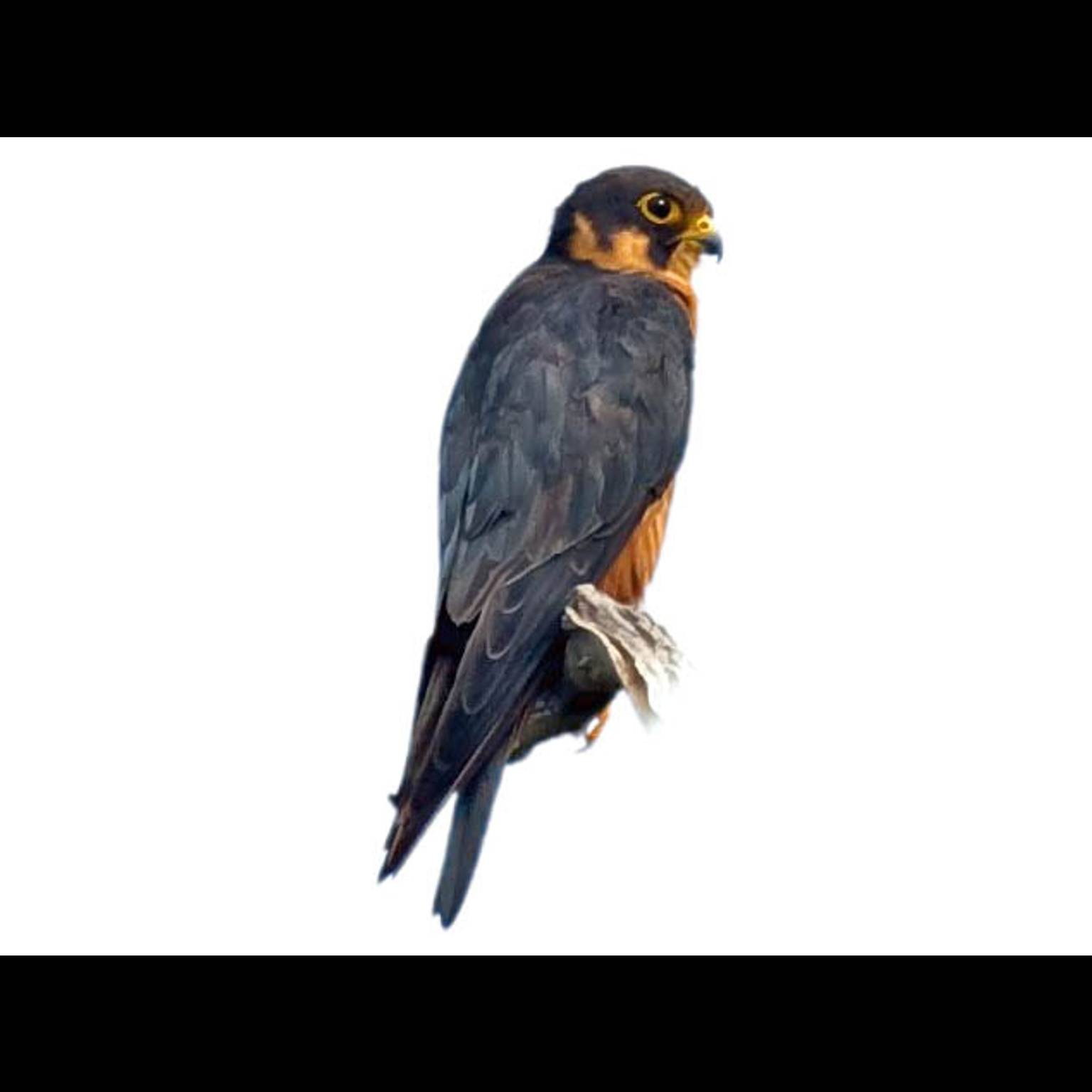
The African Hobby (Falco cuvierii) is a small, slender falcon found across much of sub-Saharan Africa. It is characterized by its dark plumage, rufous underparts, and swift, agile flight, often seen hunting insects and small birds at dusk. It is a highly aerial predator, adapted for capturing prey on the wing.
Size & lifespan
- Length
- 25-30 cm
- Wingspan
- 60-72 cm
- Weight
- 120-180 g
- Lifespan
- Approximately 8-12 years in the wild
- Diet
- Carnivore (primarily insects and small birds)
Physical characteristics
- Plumage
- Adults are dark slate-grey to blackish on the upperparts, including the head and nape. The underparts are rufous, often with fine dark streaking on the breast and flanks. The throat is white, contrasting with a dark malar stripe (moustache). The undertail coverts are plain rufous. The flight feathers are dark, and the tail is relatively short and dark.
- Beak shape
- Short, sharply hooked, dark grey to black with a yellow cere.
- Eye color
- Dark brown, surrounded by a yellow eye-ring.
- Leg color
- Yellow
- Distinguishing features
- Distinctive rufous underparts, dark upperparts, prominent dark malar stripe, and swift, agile flight. The long, pointed wings are characteristic of hobbies.
- Juvenile appearance
- Juveniles are duller and browner overall than adults, with more extensive streaking on the underparts, which are a paler rufous or buff. The upperparts may have faint pale feather edgings, giving a somewhat scaled appearance. The cere and eye-ring may be duller yellow.
- Seasonal changes
- No significant seasonal plumage changes. Plumage remains consistent year-round.
- Sexual dimorphism
- Females are generally slightly larger and heavier than males, but plumage is similar.
How to identify
- 1
Plumage Coloration
Look for the combination of dark slate-grey to blackish upperparts and rich rufous underparts. The white throat and dark malar stripe are also key.
- 2
Flight Style
Observe its swift, agile, and acrobatic flight, often involving rapid wing beats and sudden changes in direction, especially when hunting insects or small birds.
- 3
Size and Shape
Note its relatively small, slender build with long, pointed wings typical of hobbies. It's larger than a kestrel but smaller than most larger falcons.
- 4
Habitat
Consider the habitat – open woodlands, savannas, and forest edges are prime locations. Often seen perching on prominent dead trees or snags.
- 5
Vocalizations
Listen for its characteristic high-pitched, rapid 'kik-kik-kik' calls, especially if disturbed or during the breeding season.
Habitat & range
- Biomes
- Savanna, open woodlands, forest edges, clearings, cultivated areas, and sometimes urban parks.
- Geographic range
- Widespread across sub-Saharan Africa, from Senegal and Gambia east to Ethiopia and south to Angola, northern Namibia, Botswana, and northeastern South Africa.
- Elevation range
- Typically found from sea level up to 2,000 meters, occasionally higher.
- Preferred environments
- Prefers areas with scattered tall trees for perching and nesting, adjacent to open spaces for hunting. Often associated with riparian woodlands and areas near water bodies.
Behavior
- Activity time
- Diurnal, but often most active at dawn and dusk (crepuscular), especially when hunting insects.
- Feeding habits
- Primarily an aerial hunter. It preys on a wide variety of insects, especially large flying insects like termites, grasshoppers, beetles, and moths, often caught in flight at dusk. It also hunts small birds, particularly swifts, swallows, and martins, which it pursues with remarkable agility. Occasionally takes small bats or lizards. Hunts from a high perch or by soaring and stooping.
- Social behavior
- Generally solitary or found in pairs, especially during the breeding season. May gather in small groups at abundant insect hatches or communal roosts.
- Flight pattern
- Characterized by swift, powerful, and agile flight with rapid wing beats and impressive aerial maneuvers. Often seen gliding on thermals or hovering briefly before a dive. Very acrobatic when pursuing prey.
- Migration pattern
- Partially migratory or nomadic in some parts of its range, particularly in response to rainfall and insect availability. Northern populations may move south during the dry season, and southern populations may move north. However, many populations are resident.
- Territoriality
- Pairs defend a breeding territory, particularly around the nest site.
Song & calls
- Song
- Not known for a complex song. Vocalizations are typically calls.
- Call
- A rapid, high-pitched 'kik-kik-kik-kik' or 'ki-ki-ki-ki' call, often given in alarm or during territorial disputes. Also a softer 'wheet' or 'chip' call.
- When they vocalize
- Most vocal during the breeding season, especially around the nest, and when alarmed.
Breeding & reproduction
- Breeding season
- Varies geographically, typically coinciding with the end of the rainy season or early dry season when insect populations are high. For example, September-December in southern Africa, March-May in West Africa.
- Nesting habits
- Does not build its own nest. Typically uses abandoned nests of other birds, such as crows, raptors, or even hamerkops, often high in tall trees. Nests are usually located in the canopy of large trees, often near water.
- Clutch size
- 2-4 eggs, usually 3.
- Egg description
- Typically 2-4 eggs, whitish or pale buff, often sparsely marked with reddish-brown spots or blotches.
- Incubation period
- Approximately 28-31 days, primarily by the female.
- Fledging period
- Chicks fledge around 28-32 days after hatching. They remain dependent on parents for several weeks post-fledging.
- Parental care
- Both parents participate in raising the young. The female incubates and broods, while the male provides most of the food during incubation and early chick-rearing. Both parents hunt for the older chicks.
Where to find
Savanna and Open Woodlands
These are primary habitats. Look for them perched on tall trees overlooking open areas.
Forest Edges and Clearings
They often hunt along the interface between dense forest and open ground.
Riparian Zones
Areas near rivers and lakes with tall trees can be good, as these often attract abundant insect life.
Cultivated Areas and Parks
In some regions, they adapt to human-modified landscapes, especially if suitable trees and prey are available.
Field tips
- Scan the Skies at Dusk and Dawn. African Hobbies are often most active during these crepuscular periods, hawking for insects.
- Look for High Perches. They frequently perch conspicuously on the highest branches of dead trees or tall snags, providing a good vantage point for hunting.
- Observe Aerial Hunters. If you see a falcon rapidly pursuing insects or small birds with great agility, it's likely a hobby. Pay attention to its plumage details.
- Listen for Calls. Their distinctive calls can often alert you to their presence, especially if they are agitated or interacting with other birds.
Similar species
Eurasian Hobby
Falco subbuteo
The Eurasian Hobby has a more distinct white throat and cheeks, with a less extensive rufous wash on the underparts, which are heavily streaked. It also has prominent rufous 'trousers' (thighs) which are less distinct or absent in the African Hobby. The African Hobby is generally darker overall with a more uniform rufous belly.
Sooty Falcon
Falco concolor
The Sooty Falcon is uniformly dark grey, lacking the rufous underparts of the African Hobby. It also has a longer tail and more slender build. Its flight is often described as more buoyant.
Red-necked Falcon
Falco chicquera
The Red-necked Falcon has a distinctive rufous nape and hindneck, and barred underparts, which are absent in the African Hobby. It also has a more robust build and different habitat preferences.
Quick facts
- Primary Diet:
- Large flying insects and small birds
- Flight Style:
- Swift, agile, acrobatic
- Nesting:
- Uses abandoned nests of other birds
- Activity Peak:
- Dawn and dusk
- Conservation Status:
- Least Concern
Fun facts
- The African Hobby is a master of aerial pursuit, capable of catching fast-flying insects and birds with incredible precision.
- Its crepuscular hunting habits mean it is often seen at the same time as bats, sometimes even preying on them.
- Unlike many raptors, it does not build its own nest, relying entirely on the abandoned structures of other species.
- Its scientific name 'cuvierii' honors the French zoologist Frédéric Cuvier.
Scientific classification
- Kingdom
- Animalia
- Phylum
- Chordata
- Class
- Aves
- Order
- Falconiformes
- Family
- Falconidae
- Genus
- Falco
- Species
- Falco cuvierii
Explore the African Hobby
Identify birds anywhere
Free on iOS, Android, and Web. Photo & sound identification, full species database, and your personal life list.