
Spotted a bird? Identify it instantly with the Birdby app
Open the appAbout
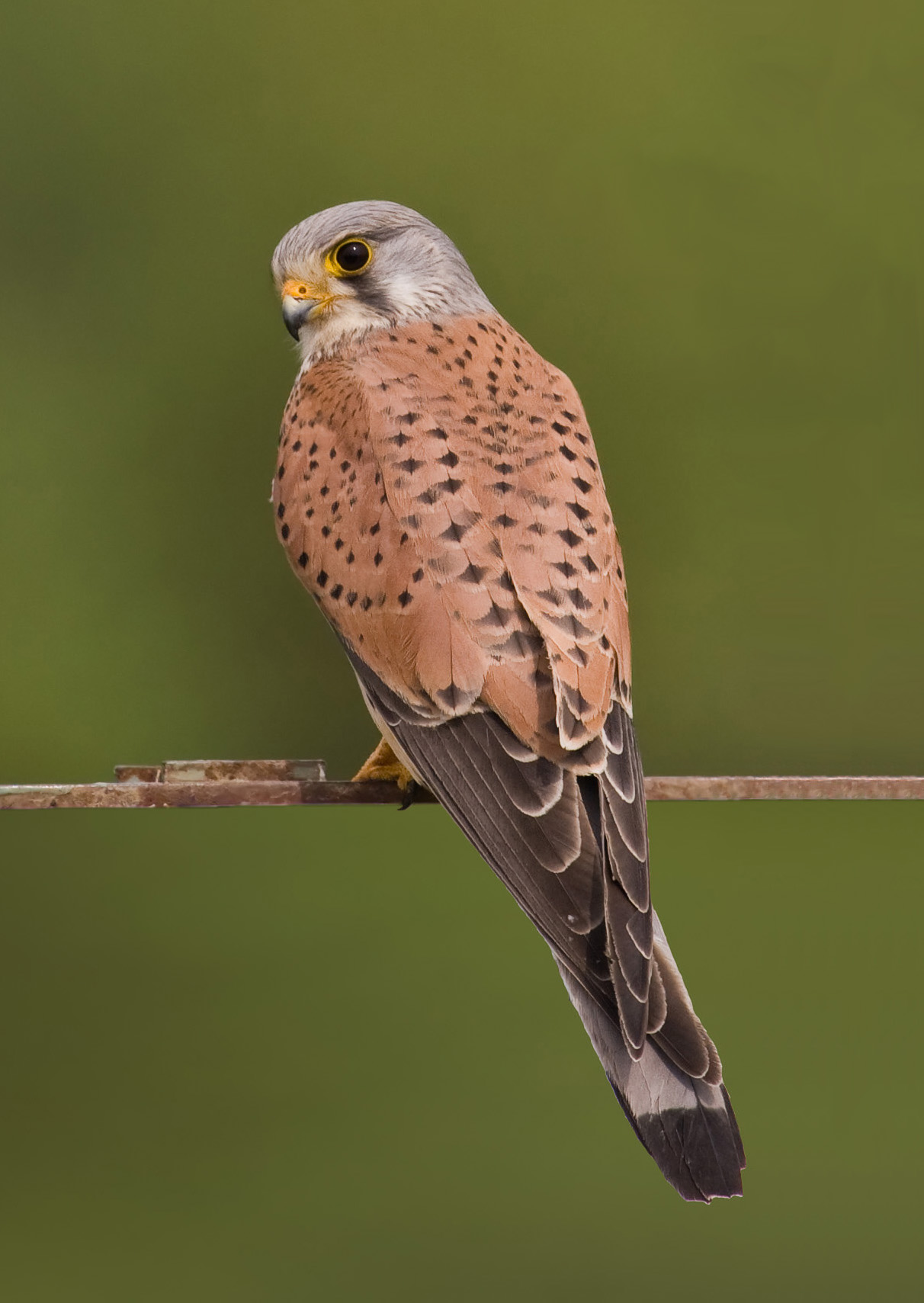
The Common Kestrel is a small, elegant falcon, widely distributed across Europe, Asia, and Africa. Known for its distinctive hovering flight while hunting, it is one of the most familiar birds of prey in many parts of its range. It exhibits sexual dimorphism, with males having a grey head and tail, contrasting with the rufous-brown back, while females and juveniles are uniformly rufous-brown. They are agile predators, primarily feeding on small mammals and insects.
Size & lifespan
- Length
- 32-39 cm (13-15 in)
- Wingspan
- 65-82 cm (26-32 in)
- Weight
- Males: 136-252 g (4.8-8.9 oz), Females: 154-314 g (5.4-11.1 oz)
- Lifespan
- Typically 3-5 years in the wild, up to 16 years in captivity.
- Diet
- Primarily small mammals (voles, mice), large insects (grasshoppers, beetles), small birds, and lizards. Diet varies seasonally and geographically.
Physical characteristics
- Plumage
- Adult male: Rufous-brown back with dark spots, grey head, grey rump and tail with a broad black subterminal band and white tip. Underparts are pale buff, streaked with brown. Adult female: Uniformly rufous-brown above with heavier dark barring and spotting, rufous-brown head, and rufous-brown tail with multiple dark bars and a broader subterminal band. Underparts are streaked brown on a buff background. Juvenile: Resembles adult female, but typically more heavily streaked below and often looks scruffier.
- Beak shape
- Short, hooked, and sharp, typical of falcons, optimized for tearing prey.
- Eye color
- Dark brown
- Leg color
- Yellow
- Distinguishing features
- Long, pointed wings in flight. Distinctive hovering flight with rapid wing beats while holding the head still, scanning the ground. Males have a clear grey head and tail, females and juveniles are browner overall. Black 'tear' stripe below the eye is often visible.
- Juvenile appearance
- Similar to adult females, but often with heavier streaking on the underparts and a less refined plumage overall. The tail barring is usually more irregular or finely barred than in adult females.
- Seasonal changes
- No significant seasonal plumage changes. Plumage wear can make colors appear duller or lighter towards the end of a breeding season.
- Sexual dimorphism
- Pronounced. Males have a grey head, rump, and tail with a single black subterminal band, and a less heavily spotted rufous back. Females are larger, with an all rufous-brown head, barred rufous-brown tail, and more heavily barred and spotted rufous-brown back.
How to identify
- 1
Hovering Flight
Look for a bird maintaining a fixed position in the air, facing the wind, with rapid wing beats. This is a primary hunting technique for Common Kestrels.
- 2
Plumage (Male)
Identify by the distinctive blue-grey head, blue-grey tail with a single broad black subterminal band, and rufous-brown back with black spots.
- 3
Plumage (Female/Juvenile)
Observe the overall rufous-brown coloration with dark barring on the back and tail (multiple bars on tail), and heavy streaking on the underparts.
- 4
Silhouette
In flight, look for long, pointed falcon wings and a relatively long tail. When perched, they appear compact with an upright posture.
- 5
Calls
Listen for their characteristic high-pitched, rapid 'kee-kee-kee-kee' or 'kik-kik-kik-kik' calls.
Habitat & range
- Biomes
- Temperate forests, grasslands, shrublands, deserts, agricultural land, urban areas.
- Geographic range
- Palearctic, Afrotropical, and Indomalayan realms. Widely distributed across Europe, Asia (excluding the Arctic and heavily forested regions), and Africa.
- Elevation range
- Sea level up to 4500 meters or more in mountainous regions.
- Preferred environments
- Open countryside with scattered trees or prominent perches, cliffs, buildings, and often found in mosaics of farmland, heathland, and suburban areas where suitable hunting and nesting sites are available.
Behavior
- Activity time
- Diurnal, active during daylight hours.
- Feeding habits
- Hunts primarily by hovering or 'kiting' into the wind, scanning the ground below for prey. Once prey is sighted, it descends rapidly, sometimes in a shallow dive, to snatch it. Also hunts from a perch. Small prey is often consumed whole, larger prey is dismembered. Pellets containing indigestible material are regurgitated.
- Social behavior
- Generally solitary outside the breeding season. Pairs form for breeding. Not typically colonial, but sometimes nests in loose aggregations if suitable sites are abundant.
- Flight pattern
- Characterized by its unique hovering flight, often described as 'kiting,' where it maintains a fixed position against the wind with rapid wing beats. Also has a buoyant, agile flight with quick bursts of wing beats and glides. Soars on thermals.
- Migration pattern
- Varies from resident to migratory depending on geographic location. Northern and eastern European/Asian populations are largely migratory, moving to southern Europe, Africa, and southern Asia for winter. Western and southern European populations are often resident or undertake short-distance dispersive movements.
- Territoriality
- Territorial during the breeding season, defending nesting and immediate hunting areas around the nest site. Outside breeding, shows less territorial aggression.
Song & calls
- Song
- Common Kestrels do not have a complex song. Their vocalizations are primarily calls.
- Call
- Most common call is a rapid, high-pitched 'kee-kee-kee-kee' or 'kik-kik-kik-kik', often given when agitated, defending territory, or attracting a mate. Alarm calls are sharper and more insistent. Begging calls of juveniles are distinct and continuous.
- When they vocalize
- Most vocal during the breeding season, especially around the nest when adults exchange duties or when juveniles are calling for food. Alarm calls can be heard year-round if disturbed.
Breeding & reproduction
- Breeding season
- Typically April to July in temperate regions, varying geographically to align with prey availability.
- Nesting habits
- Does not build its own nest. Primarily uses old raven, crow, or magpie nests in trees. Also readily nests in tree cavities, cliff crevices, ledges of buildings, and artificial nest boxes. Both sexes participate in nest site selection, but the female does most incubation.
- Clutch size
- Usually 3-6 eggs.
- Egg description
- 3-6 (sometimes 2-8) eggs, typically dull white or creamy-buff, heavily mottled or blotched with reddish-brown.
- Incubation period
- 27-29 days, primarily by the female, with the male providing food.
- Fledging period
- 27-32 days after hatching. Young begin to fly, but remain dependent on parents for several weeks.
- Parental care
- Both parents care for the young. The male provides most of the food during incubation and early chick-rearing. The female broods and feeds the young with prey brought by the male. Both parents feed the fledglings until they become independent.
Where to find
Open Countryside
Look for them hunting over fields, meadows, and agricultural land, often perched on isolated trees, power lines, or fence posts.
Cliffs and Quarries
They often nest on ledges in natural cliffs or abandoned quarries. Look for them flying near these structures.
Urban and Suburban Areas
Increasingly found in urban environments, nesting on tall buildings or church towers, and hunting over parks, gardens, and urban green spaces.
Woodland Edges
While not deep forest dwellers, krestels use woodland edges to find perches that overlook open hunting grounds.
Field tips
- Scan Overhead. When in suitable habitat, frequently scan the skies, especially into the wind, for their characteristic hovering flight.
- Check Perches. Look for them perched conspicuously on exposed branches of trees, utility poles, or high points, often overlooking open ground.
- Listen for Calls. Their calls, especially when agitated or in breeding season, can draw attention to their presence.
- Look for Pellets. Around known perches or nesting sites, look for regurgitated pellets containing fur and bones, indicating their presence.
- Nest Boxes. In areas with conservation efforts, check artificial nest boxes that may have been installed for kestrels.
Similar species
Lesser Kestrel
Falco naumanni
Lesser Kestrels are slightly smaller, have unspotted rufous backs in both sexes (males lack spots entirely), and typically lack the prominent black 'tear' stripe of the Common Kestrel. Males have unmarked grey wing coverts. Lesser Kestrels are more colonial nesters and have a more graceful flight without the same intense hovering. Their calls are also distinct, being softer and less harsh.
American Kestrel
Falco sparverius
While also a small kestrel, the American Kestrel is native to the Americas. Plumage differences are evident: American Kestrels have distinct double black facial stripes, blue-grey wings in males (different from the grey rump of Common Kestrel), and a more intricately patterned head. Their calls are also different.
Eurasian Hobby
Falco subbuteo
Eurasian Hobbies are larger, darker, and more slender with a faster, more agile flight profile, akin to a large swift. They chase and catch birds and large insects in the air. They lack the consistent hovering behavior of the Common Kestrel and have prominent red 'trousers' (vent feathers) and dark streaking on the underparts.
Quick facts
- Primary Hunting Method:
- Hovering (kiting)
- Sexual Dimorphism:
- Present (males with grey head/tail)
- Nesting Type:
- Uses old nests or natural cavities
- Diet Staple:
- Small mammals (voles)
- Conservation Status:
- Least Concern
Fun facts
- Common Kestrels can see ultraviolet light, which helps them locate voles by spotting their urine trails, which reflect UV light.
- During their characteristic hovering flight, their heads remain remarkably still, allowing them to precisely track prey movements below.
- Despite being called 'Common Kestrel,' they are not always the most common kestrel species in all parts of their range.
- They are one of the few raptors that have successfully adapted to urban environments, often nesting on tall buildings.
Scientific classification
- Kingdom
- Animalia
- Phylum
- Chordata
- Class
- Aves
- Order
- Falconiformes
- Family
- Falconidae
- Genus
- Falco
- Species
- Falco tinnunculus
Explore the Common Kestrel
Identify birds anywhere
Free on iOS, Android, and Web. Photo & sound identification, full species database, and your personal life list.