
Spotted a bird? Identify it instantly with the Birdby app
Open the appAbout
The Horned Puffin is a medium-sized seabird in the Auk family, known for its distinctive orange bill with a yellow base and a small, fleshy, horn-like projection above each eye during the breeding season. It is a highly pelagic species, spending most of its life at sea, coming to coastal breeding colonies only to nest.
Size & lifespan
- Length
- 37-41 cm (14.6-16.1 inches)
- Wingspan
- 63-66 cm (24.8-26 inches)
- Weight
- 610-780 g (1.3-1.7 lbs)
- Lifespan
- Typically 15-20 years in the wild, with some individuals living over 25 years.
- Diet
- Primarily small fish (especially juvenile herring, capelin, sandlance, and slender barracudina), as well as squid and marine invertebrates (crustaceans and polychaetes) during the non-breeding season.
Physical characteristics
- Plumage
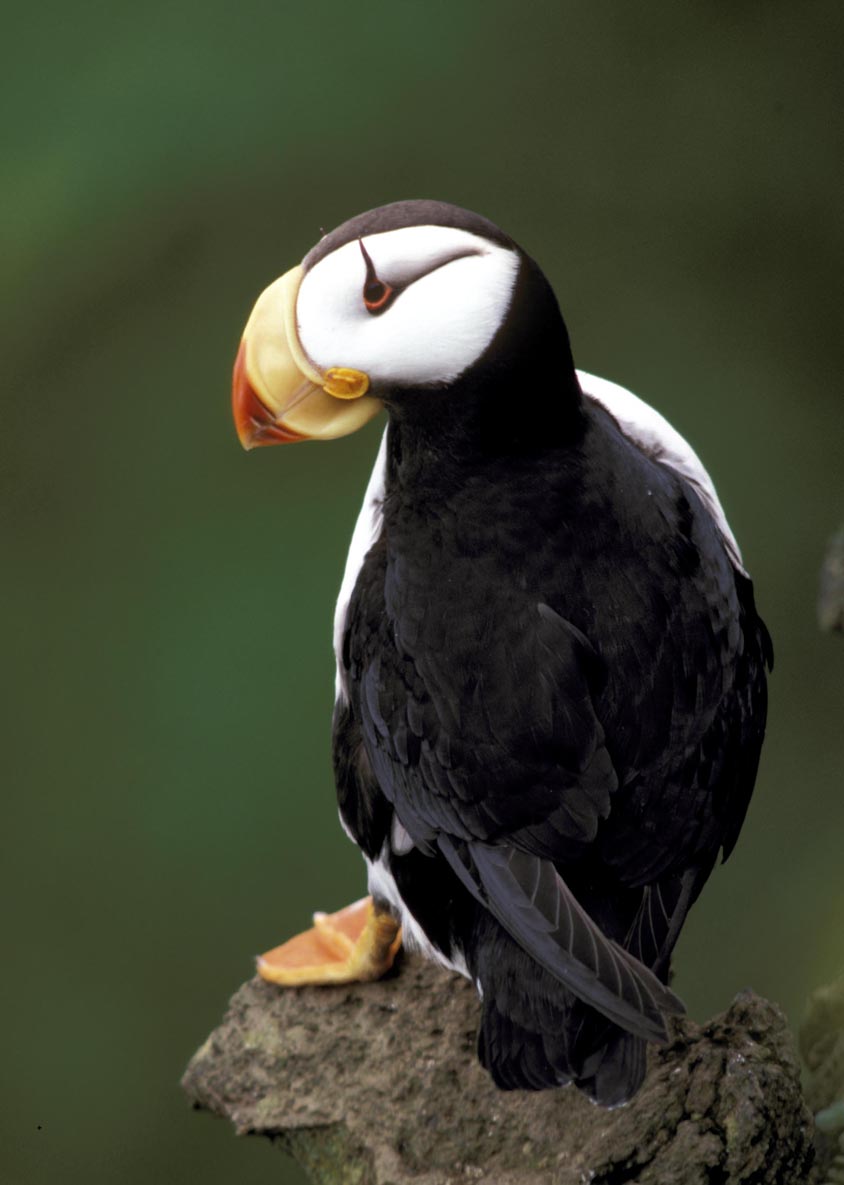
- Breeding adults have a glossy black back and neck, with clean white underparts. The head is white with a black crown and a prominent, fleshy, black, horn-like protrusion above each eye. There is also a thin black stripe extending rearward from the eye. Non-breeding plumage is duller; the white face becomes mottled grey, and the horn above the eye is shed. Juveniles resemble non-breeding adults but have a smaller, duller bill.
- Beak shape
- During breeding, the bill is large and triangular, laterally compressed, with a bright orange tip, a yellow base, and a small blue-grey area at the gape. The bill darkens in non-breeding plumage, becoming smaller and duller orange-red with a grey base.
- Eye color
- Iris is dark, appearing black. A small fleshy 'horn' is present above each eye during breeding.
- Leg color
- Bright orange-red legs and feet during the breeding season, duller orange to yellowish outside of breeding.
- Distinguishing features
- The most defining feature is the small, fleshy, black horn-like projection above each eye during the breeding season. This, combined with its distinctive orange and yellow bill and white face, makes it unmistakable in its breeding range. The dark throat and white breast are also key.
- Juvenile appearance
- Juveniles are similar to non-breeding adults but have a smaller, duller, mostly dark bill (lacking bright orange/yellow), a dark greyish-brown face and throat, and no horn above the eye. Their feet are duller yellowish-orange.
- Seasonal changes
- Pronounced seasonal changes. Breeding adults have bright orange and yellow bills with fleshy black horns, and a clean white face. Non-breeding birds shed the horn, their bill becomes smaller and duller, and the face becomes mottled grey, often with a dark line extending from the gape.
- Sexual dimorphism
- Males and females are similar in appearance, though males can be slightly larger and have slightly larger bills on average.
How to identify
- 1
Horn above the eye
During the breeding season, look for the small, fleshy, black horn-like projection just above each eye. This is unique to the Horned Puffin among puffins.
- 2
Bill coloration
Observe the bill's bright colors: a vivid orange tip, a distinct yellow base, and a small blue-grey area at the gape during breeding plumage.
- 3
Head pattern
Note the clean white face contrasting sharply with the black crown and hindneck, along with the thin black line extending backward from the eye.
- 4
Underparts
Look for immaculate white underparts, which stand out against the black upperparts.
Habitat & range
- Biomes
- Marine, Coastal cliffs, Islands, and open ocean.
- Geographic range
- North Pacific Ocean, ranging from the coast of Siberia and Sakhalin Island east through the Aleutian Islands, Gulf of Alaska, and south along the Pacific coast of North America to British Columbia. Breeding colonies are predominantly in Alaska and the Aleutian Islands.
- Elevation range
- Sea level to the tops of coastal cliffs where colonies are established.
- Preferred environments
- Rocky islands and sea cliffs for breeding, open ocean waters for foraging during non-breeding seasons.
Behavior
- Activity time
- Diurnal. Most active during daylight hours, particularly during breeding when foraging and chick-rearing are constant.
- Feeding habits
- Highly adapted for diving and underwater pursuit. They use their wings for propulsion underwater and their webbed feet for steering. They typically dive to depths of 10-30 meters but can go deeper. They carry multiple fish crosswise in their bills for their chicks, held securely by serrations on the bill and a specialized tongue.
- Social behavior
- Colonial nesters, forming large, often dense, breeding colonies on oceanic islands and coastal cliffs. Highly social during breeding, but more solitary or in small groups at sea during the non-breeding season.
- Flight pattern
- Strong, direct flight with rapid wing beats. They fly relatively low over the water, especially when commuting to and from colonies.
- Migration pattern
- Migratory, moving south from their breeding grounds in Alaska and Siberia to spend the winter months in the open waters of the North Pacific. They can be found as far south as California and Baja California during winter.
- Territoriality
- Exhibit territorial behavior within their breeding colonies, primarily defending their nesting burrows and immediate vicinity from other puffins and potential predators.
Song & calls
- Song
- Horned Puffins are not known for complex songs. Their vocalizations are generally limited to breeding colonies.
- Call
- Calls include low, guttural growls and grunts, particularly when interacting with other puffins at the colony or when alarmed. They emit a deep, throaty "arrr-arrr" sound.
- When they vocalize
- Mostly vocal during the breeding season at their colonies, especially during social interactions, courtship, and when chicks are present. Largely silent at sea.
Breeding & reproduction
- Breeding season
- Typically May to August, with peak egg-laying in late May to mid-June.
- Nesting habits
- Nests in burrows excavated in soft soil on grassy slopes or among rocks on cliff faces. Burrows can be up to 2 meters long, often with a wider chamber at the end. Sometimes they also nest in rock crevices.
- Clutch size
- 1 egg.
- Egg description
- A single, large, dull white egg, sometimes faintly marked with brown or purple.
- Incubation period
- Approximately 40-42 days.
- Fledging period
- Chicks fledge around 38-44 days after hatching, leaving the burrow at night to fly directly to the sea.
- Parental care
- Both parents share incubation duties and extensive chick-rearing, bringing fish back to the burrow in their bills. The chick is fed frequently until it is capable of independent flight and foraging.
Where to find
Breeding Colonies
Look for them on rocky islands and coastal cliffs throughout Alaska (e.g., Aleutian Islands, Pribilof Islands, Gulf of Alaska islands) and parts of Siberia during the summer months. Tour boats often visit these colonies.
Pelagic Waters
During the non-breeding season (fall and winter), they are found far out at sea in the North Pacific Ocean, often requiring pelagic birding trips to spot them.
Field tips
- Visit breeding colonies. The easiest way to see Horned Puffins is to visit their breeding colonies during the summer. They are often quite approachable on land.
- Look for fish in bill. When observing them near colonies, watch for adults returning to their burrows with multiple small fish held crosswise in their bills – a classic puffin behavior.
- Observe behavior on water. At sea, they might be seen floating on the water, resting, or actively foraging, characterized by their buoyant presence and sudden dives.
- Use a scope or binoculars. Especially on cliffs and at sea, good optics are essential for observing details like the 'horn' and bill patterns.
Similar species
Tufted Puffin
Fratercula cirrhata
The Tufted Puffin has long, golden-yellow ear tufts that extend from behind the eye, a solid white face (not just around the bill), and an entirely orange bill (without the distinct yellow base and blue-grey gape of the Horned Puffin). They lack the fleshy horn above the eye.
Atlantic Puffin
Fratercula arctica
The Atlantic Puffin has a grey face with a black triangular patch behind the eye, and a bill that is primarily red and grey (or blue-grey in some subspecies) with yellow ridges, but lacks the distinct yellow base and fleshy horn of the Horned Puffin. Its distribution is in the North Atlantic, not the North Pacific.
Quick facts
- Distinctive Feature:
- Fleshy horn above the eye in breeding plumage.
- Bill Color:
- Bright orange with a yellow base during breeding.
- Nest Type:
- Burrows in soil or rock crevices.
- Diet Specialty:
- Carries multiple small fish crosswise in bill.
- Geographic Range:
- North Pacific (Alaska to Siberia).
Fun facts
- The 'horn' above the eye is a temporary fleshy growth, shed after the breeding season and regrown each spring.
- Like other puffins, Horned Puffins are expert underwater 'fliers', using their wings to propel themselves through the water.
- Their brightly colored bills are like an advertising display, used in courtship and social signaling, and are shed and regrown annually similar to the horns.
- Horned Puffins often winter far offshore, sometimes hundreds of miles from land, enduring harsh ocean conditions.
Scientific classification
- Kingdom
- Animalia
- Phylum
- Chordata
- Class
- Aves
- Order
- Charadriiformes
- Family
- Alcidae
- Genus
- Fratercula
- Species
- Fratercula corniculata
Explore the Horned Puffin
Identify birds anywhere
Free on iOS, Android, and Web. Photo & sound identification, full species database, and your personal life list.