
Spotted a bird? Identify it instantly with the Birdby app
Open the appAbout
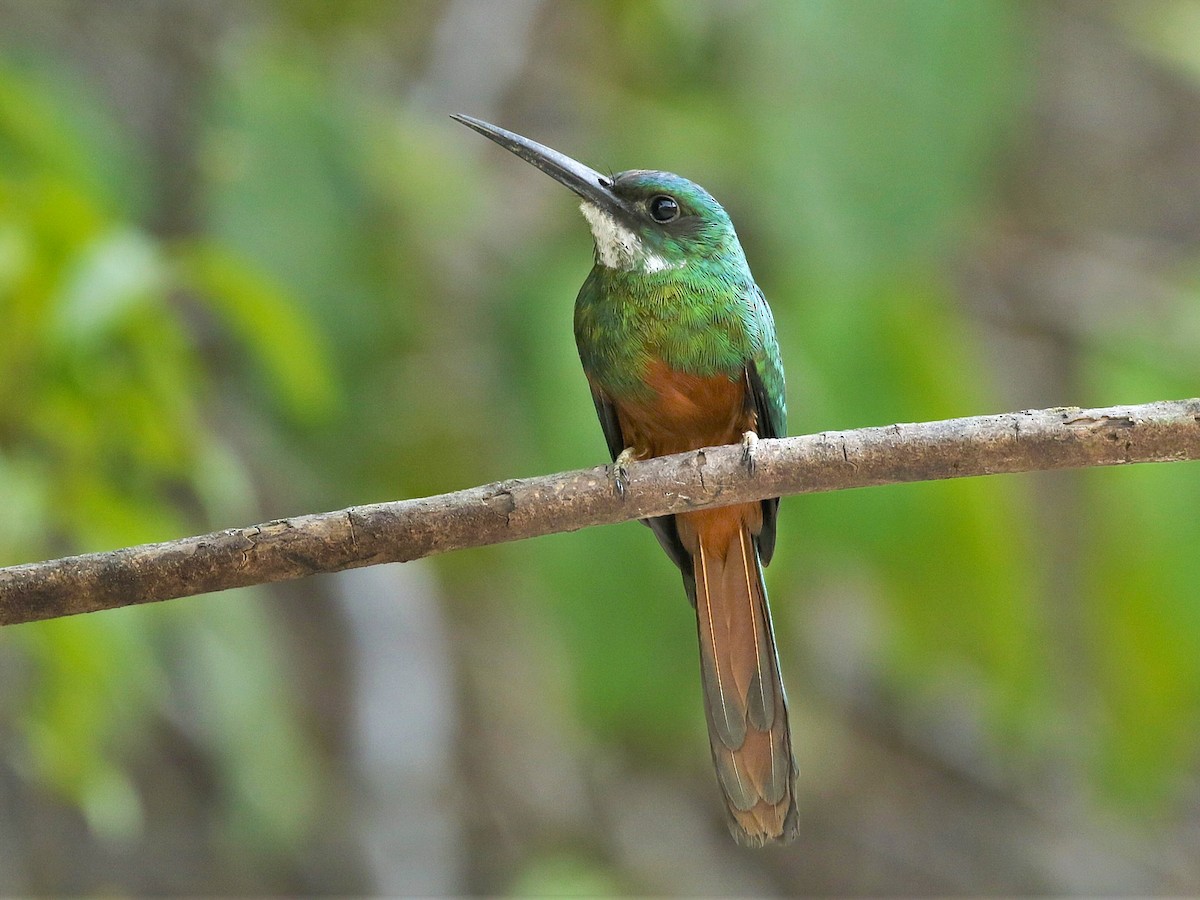
The Rufous-tailed Jacamar is a striking, iridescent Neotropical bird known for its long, pointed bill and long tail. It is a primarily insectivorous bird that perches conspicuously in open forest understory or at forest edges, darting out to catch insects in flight.
Size & lifespan
- Length
- 23-28 cm (9-11 inches)
- Wingspan
- 25-30 cm (10-12 inches)
- Weight
- 25-35 g (0.9-1.2 oz)
- Lifespan
- Reported lifespan in the wild is up to 5-7 years, though more comprehensive data is limited.
- Diet
- Strictly insectivorous, primarily preying on flying insects such as butterflies, moths, dragonflies, bees, wasps, and flies. It also takes spiders occasionally.
Physical characteristics
- Plumage
- Adults have iridescent metallic greenish-bronze upperparts, a rufous (reddish-brown) belly, and a distinctive rufous tail. The throat is emerald green for males and buff to whitish for females. There is a prominent dark mask across the eye and a white malar stripe. The breast band is metallic green.
- Beak shape
- Long, thin, straight and pointed, black.
- Eye color
- Dark brown.
- Leg color
- Dark gray to black.
- Distinguishing features
- Its long, pointed black bill, iridescent green and rufous plumage, and long, graduated rufous tail are key features. The white malar stripe and dark eye mask are also very noticeable.
- Juvenile appearance
- Juveniles are duller overall than adults, with less intense iridescence and a shorter, brownish tail. They may have a duller throat patch that is not distinctly green or buff.
- Seasonal changes
- No significant seasonal plumage changes are observed.
- Sexual dimorphism
- Males have an iridescent emerald green throat, while females typically have a buff to whitish throat. Otherwise, sexes are similar.
How to identify
- 1
Plumage Coloration
Look for the metallic green upperparts, rich rufous belly, and, critically, the rufous tail. Males have an emerald green throat, females a buff/whitish throat.
- 2
Bill Shape
The exceptionally long, thin, and pointed black bill is unmistakable among birds in its range.
- 3
Perching Style
Often perches upright and motionless on exposed branches, typically at eye level or slightly above, in open forest understory or at edges.
- 4
Flight Pattern
Observing its characteristic sallying flight from a perch to catch insects and return is a good identification clue.
- 5
Song
Learn its distinctive, accelerating, high-pitched trill, which often draws attention before the bird is seen.
Habitat & range
- Biomes
- Tropical lowland rainforests, gallery forests, forest edges, secondary growth, clearings with scattered trees, and plantations.
- Geographic range
- Found from southern Mexico through Central America, and extensively in South America east of the Andes, south to Bolivia, Paraguay, and northern Argentina. Absent from the high Andes and drier regions.
- Elevation range
- Typically from sea level up to 1,000 meters (3,300 feet), occasionally higher in some areas, up to 1,800 meters (5,900 feet).
- Preferred environments
- Prefers open woodlands, forest borders, and riparian zones. They often perch on exposed branches in areas with good visibility to spot prey.
Behavior
- Activity time
- Diurnal, most active during the cooler parts of the day, particularly mornings and late afternoons.
- Feeding habits
- Aerial insectivore. It typically perches motionlessly on an exposed branch, often for extended periods, then sallying out to catch an insect in mid-air with an audible snap of its bill. It returns to the same or a nearby perch to consume the prey, often beating larger insects against the branch. Sometimes they will glean insects from foliage.
- Social behavior
- Usually solitary or found in pairs, though small family groups can be observed. They are not typically communal outside of breeding pairs.
- Flight pattern
- Direct and swift when hawking for insects, with quick wing beats. Otherwise, typically short glides between perches.
- Migration pattern
- Generally resident throughout its range, not known to be migratory.
- Territoriality
- Pairs defend a breeding territory, particularly around their nesting burrow, but are generally less territorial outside of the breeding season.
Song & calls
- Song
- A distinctive, accelerating trill, often described as a 'pee-o-o-o-o-o-o-o-o-o-o' that rises slightly in pitch and then fades away. The song can last several seconds.
- Call
- Calls include a sharp 'chip' or 'chup', often given while perched or in flight, and a series of sharp 'kek-kek-kek' notes when agitated or during territorial disputes.
- When they vocalize
- Sings most frequently in the early morning and late afternoon, especially during the breeding season. Calls are given throughout the day.
Breeding & reproduction
- Breeding season
- Varies geographically, generally tied to the rainy season or periods of high insect abundance. For example, March-June in Central America, October-February in parts of South America.
- Nesting habits
- Nests in burrows excavated in earth banks, often along rivers, roadsides, or in ravines. Both sexes participate in digging the nesting tunnel, which can be up to 60 cm (24 inches) long, ending in a slightly wider egg chamber. Sometimes they reuse old nests.
- Clutch size
- Typically 2-4 eggs.
- Egg description
- Usually 2-4 pure white, glossy, oval eggs.
- Incubation period
- Approximately 19-23 days, shared by both parents.
- Fledging period
- Chicks fledge at about 21-26 days after hatching. They are altricial, born naked and helpless.
- Parental care
- Both parents incubate the eggs and feed the young. They bring insects back to the nest for the nestlings.
Where to find
Forest Edges
Frequently found along the borders of tropical forests, where clearings meet denser vegetation.
Riparian Zones
Common along rivers, streams, and other water bodies, particularly where there are exposed banks for nesting.
Secondary Growth
Often present in areas of disturbed forest or regenerating woodland, as long as there are suitable perching sites.
Gardens and Plantations
Can be found in large tropical gardens, coffee plantations, or fruit orchards with suitable tree cover and open areas.
Field tips
- Listen for the Song. Their distinctive accelerating trill is often the first indication of their presence. Learn this vocalization to locate them.
- Scan Exposed Perches. They prefer to perch conspicuously on bare branches at mid-story height, often overlooking an open area from which to hawk insects. Look for dark silhouettes against the sky.
- Patience is Key. Jacamars are sit-and-wait predators; they can remain motionless for long periods. Be patient and scan an area thoroughly.
- Look for Movement. Although often still, watch for sudden, quick flights to catch an insect, followed by a return to a perch.
- Check Nesting Sites. During the breeding season, look for burrows in earthen banks, as pairs will be active around these locations.
Similar species
Green-tailed Jacamar
Galbula galbula
The Green-tailed Jacamar has an entirely green tail, lacking the rufous color of the Rufous-tailed Jacamar. Its underparts are also generally more green than rufous.
Coppery-tailed Jacamar
Galbula pastazae
The Coppery-tailed Jacamar has a copper-colored tail and a more restricted range in the Andes. Its iridescence is generally more coppery-bronze than the greenish-bronze of the Rufous-tailed Jacamar.
Bluish-fronted Jacamar
Galbula cyanescens
This species has a bluish-green forehead and a generally paler rufous underparts. Its range is more restricted to the southwestern Amazon basin.
Quick facts
- Primary Diet:
- Flying insects
- Nesting Type:
- Burrow in earth banks
- Vocalization Style:
- Accelerating trill
- Habitat Preference:
- Forest edges, open woodlands
- Behavioral Trait:
- Sit-and-wait predator
Fun facts
- The iridescent plumage of the Rufous-tailed Jacamar is structural coloration, meaning it's produced by the microscopic structure of the feathers, not by pigments. This causes the colors to shift with light conditions.
- Jacamars are distantly related to kingfishers and woodpeckers, belonging to the order Piciformes, but they are highly specialized insectivores, unlike many of their relatives.
- They often select larger, more nutritious insects like butterflies for prey, sometimes beating them against a branch to dislodge wings or stingers before consumption.
- Despite their bright colors, they can be surprisingly camouflaged in the dappled light of the forest, due to their iridescence.
Scientific classification
- Kingdom
- Animalia
- Phylum
- Chordata
- Class
- Aves
- Order
- Piciformes
- Family
- Galbulidae
- Genus
- Galbula
- Species
- G. ruficauda
Explore the Rufous-tailed Jacamar
Identify birds anywhere
Free on iOS, Android, and Web. Photo & sound identification, full species database, and your personal life list.