
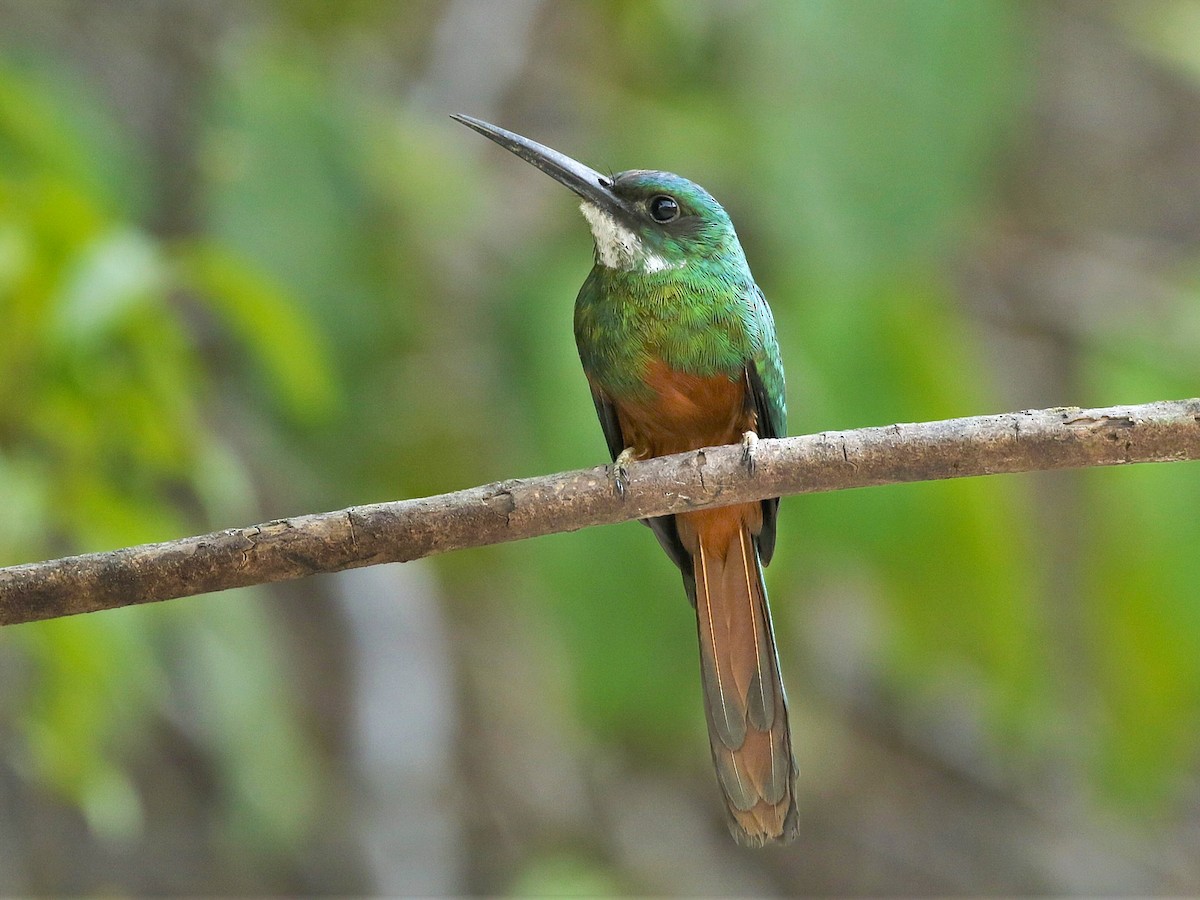
Where does the Rufous-tailed Jacamar live?
Galbula ruficauda
Spotted a bird? Identify it instantly with the Birdby app
Open the appThe Rufous-tailed Jacamar lives in specific habitats and regions. Knowing where, and when, to look improves your chances of a successful sighting.
Biomes
Tropical lowland rainforests, gallery forests, forest edges, secondary growth, clearings with scattered trees, and plantations.
Geographic range
Found from southern Mexico through Central America, and extensively in South America east of the Andes, south to Bolivia, Paraguay, and northern Argentina. Absent from the high Andes and drier regions.
Preferred environments
Prefers open woodlands, forest borders, and riparian zones. They often perch on exposed branches in areas with good visibility to spot prey.
Elevation range
Typically from sea level up to 1,000 meters (3,300 feet), occasionally higher in some areas, up to 1,800 meters (5,900 feet).
Where to look
Forest Edges
Frequently found along the borders of tropical forests, where clearings meet denser vegetation.
Riparian Zones
Common along rivers, streams, and other water bodies, particularly where there are exposed banks for nesting.
Secondary Growth
Often present in areas of disturbed forest or regenerating woodland, as long as there are suitable perching sites.
Gardens and Plantations
Can be found in large tropical gardens, coffee plantations, or fruit orchards with suitable tree cover and open areas.
Field tips
- Listen for the Song. Their distinctive accelerating trill is often the first indication of their presence. Learn this vocalization to locate them.
- Scan Exposed Perches. They prefer to perch conspicuously on bare branches at mid-story height, often overlooking an open area from which to hawk insects. Look for dark silhouettes against the sky.
- Patience is Key. Jacamars are sit-and-wait predators; they can remain motionless for long periods. Be patient and scan an area thoroughly.
- Look for Movement. Although often still, watch for sudden, quick flights to catch an insect, followed by a return to a perch.
- Check Nesting Sites. During the breeding season, look for burrows in earthen banks, as pairs will be active around these locations.
Migration
Generally resident throughout its range, not known to be migratory.
Explore the Rufous-tailed Jacamar
Identify birds anywhere
Free on iOS, Android, and Web. Photo & sound identification, full species database, and your personal life list.