
Spotted a bird? Identify it instantly with the Birdby app
Open the appAbout
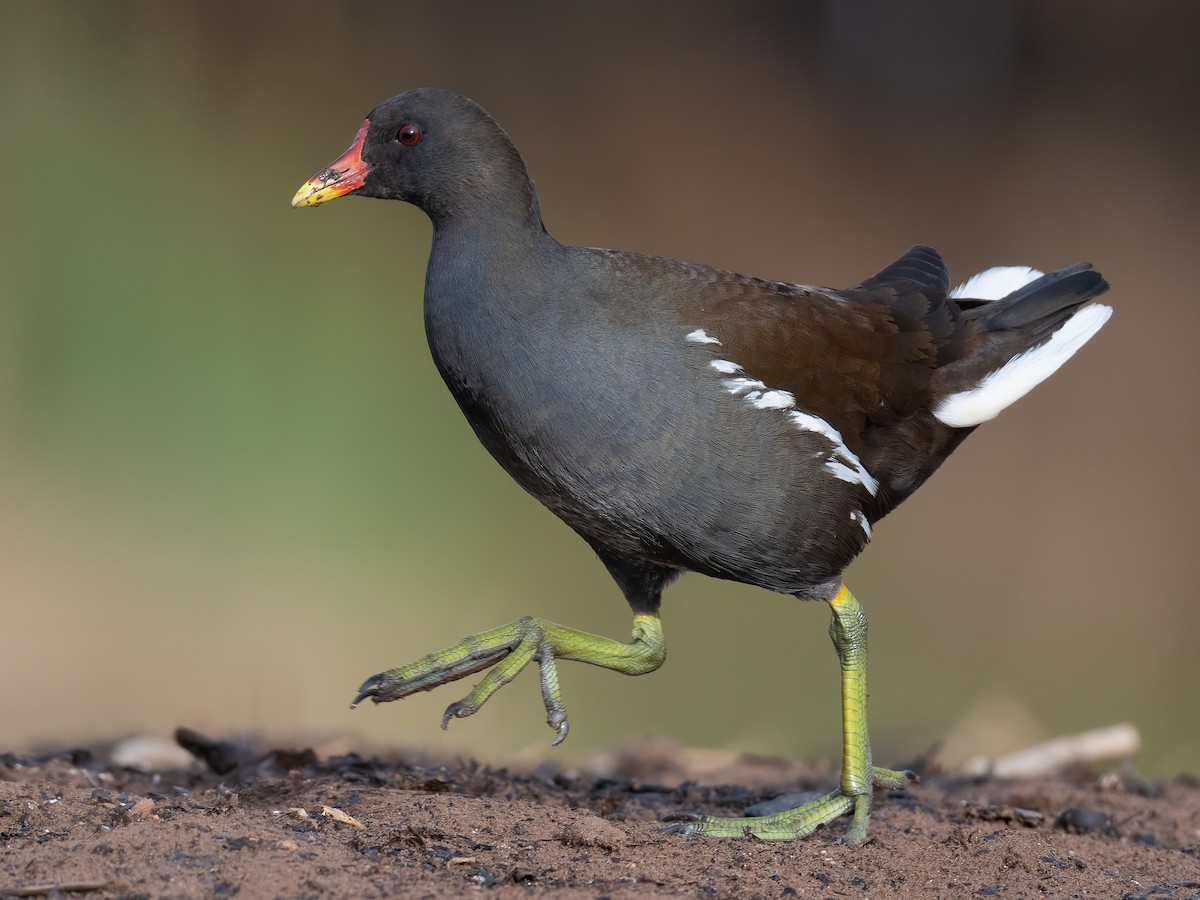
The Eurasian Moorhen is a medium-sized water bird, part of the rail family, characterized by its dark plumage, red frontal shield, and yellow-tipped red bill. It is a common and widespread species found in various freshwater habitats across much of the Old World.
Size & lifespan
- Length
- 30-38 cm
- Wingspan
- 50-55 cm
- Weight
- 190-490 g
- Lifespan
- Up to 10 years in the wild
- Diet
- Omnivore
Physical characteristics
- Plumage
- Adults have dark slate-grey to black plumage on the head, neck, and underparts, contrasting with a brownish-olive back and wings. A prominent white stripe runs along the flanks, and the undertail coverts are white with a central black stripe. The primary flight feathers are dark brown.
- Beak shape
- The bill is conical and bright red, with a distinct yellow tip. A prominent red frontal shield extends from the base of the bill onto the forehead.
- Eye color
- Dark red to reddish-brown.
- Leg color
- Legs and feet are greenish-yellow, often with a reddish tinge on the upper leg, especially during breeding season. The long toes are not webbed, but have broad lobes for swimming.
- Distinguishing features
- The combination of the bright red frontal shield and bill with a yellow tip, the white flank stripe, and the white undertail coverts with a central black stripe are key distinguishing features.
- Juvenile appearance
- Juveniles are duller and browner overall, lacking the bright red frontal shield and bill. Their plumage is more grey-brown, with a paler throat and belly. The bill is dull greenish-brown, and the legs are dull green. The white flank stripe is less distinct, and the undertail coverts are buffy-white without the prominent black stripe.
- Seasonal changes
- There are no significant seasonal plumage changes in adults, though the intensity of the red on the bill and frontal shield may be more vibrant during the breeding season.
- Sexual dimorphism
- Males and females are generally similar in plumage, though males tend to be slightly larger and heavier. The frontal shield may appear slightly larger and brighter in males during the breeding season.
How to identify
- 1
Plumage
Look for the dark slate-grey to black body, brownish back, and the distinctive white stripe along the flanks.
- 2
Bill and Frontal Shield
The bright red bill with a yellow tip and the prominent red frontal shield are unmistakable adult features.
- 3
Undertail Coverts
Observe the white undertail coverts with a central black stripe, especially when the bird flicks its tail.
- 4
Legs and Feet
Note the greenish-yellow legs and feet, which are not fully webbed but have long toes for walking on vegetation and swimming.
- 5
Behavior
Watch for its characteristic head-bobbing while swimming or walking, and its tendency to flick its tail, revealing the undertail pattern.
- 6
Vocalizations
Listen for its sharp, explosive 'krrruk' or 'kik-ik-ik' calls, often given from dense cover.
Habitat & range
- Biomes
- Freshwater wetlands, marshes, ponds, lakes, slow-moving rivers, canals, and ditches.
- Geographic range
- Widespread across Europe, Asia, and Africa. Also found in parts of North and South America (where it is known as the Common Gallinule, though some authorities now treat the American population as a separate species, Gallinula galeata).
- Elevation range
- Typically found from sea level up to 2,000 meters, occasionally higher in some parts of its range.
- Preferred environments
- Prefers still or slow-moving water bodies with dense emergent vegetation (reeds, rushes, sedges) along the edges for cover, foraging, and nesting. Can also be found in more open water if sufficient cover is nearby.
Behavior
- Activity time
- Diurnal, most active during early morning and late afternoon, though they can be active throughout the day.
- Feeding habits
- Forages both in water and on land. It pecks at vegetation, gleans insects from leaves, and dabbles in shallow water. Diet includes a wide variety of plant material (seeds, leaves, shoots, fruits), insects, snails, worms, small fish, and tadpoles.
- Social behavior
- Usually seen singly or in pairs, especially during the breeding season. Outside of breeding, they may gather in small, loose flocks, particularly in winter or at favored feeding sites.
- Flight pattern
- Flight is typically short and low over the water, with rapid wingbeats and dangling legs. When disturbed, it often runs across the water surface before taking flight. Can fly strongly over longer distances during migration.
- Migration pattern
- Northern populations are migratory, moving south for the winter. Southern populations are largely resident. Migration occurs at night. Some populations exhibit partial migration, with some individuals remaining while others move.
- Territoriality
- Highly territorial during the breeding season, with pairs defending their nesting and feeding areas aggressively against other moorhens and sometimes other water birds.
Song & calls
- Song
- Not known for a complex song. Vocalizations are primarily calls.
- Call
- A variety of sharp, explosive calls. The most common call is a sharp, almost metallic 'krrruk' or 'kik-ik-ik'. Also produces a softer 'purrr' or 'churr' call, and a sharp 'whit' when alarmed. Calls are often given from cover.
- When they vocalize
- Calls are given throughout the day, especially when alarmed, communicating with a mate, or defending territory. More vocal during the breeding season.
Breeding & reproduction
- Breeding season
- Typically from March to August, varying geographically.
- Nesting habits
- Nests are usually built on or near water, often well-concealed in dense vegetation such as reeds, sedges, or rushes. They are bulky structures made of woven plant material, sometimes anchored to emergent vegetation or built on floating platforms. Both sexes participate in nest building.
- Clutch size
- 5-11 eggs, typically 6-8.
- Egg description
- Eggs are typically pale buff to olive-brown, speckled or spotted with reddish-brown or purplish-grey markings. They are oval to sub-elliptical in shape.
- Incubation period
- 19-22 days, primarily by the female, though the male may assist.
- Fledging period
- Chicks are precocial and leave the nest shortly after hatching, but remain dependent on parents for food and protection for 40-50 days until they can fly.
- Parental care
- Both parents care for the young. Chicks are fed by both adults and are often seen following their parents. Older chicks from the first brood may assist in feeding younger siblings from a second brood.
Where to find
Ponds and Lakes
Look along the vegetated edges of freshwater ponds, lakes, and reservoirs.
Rivers and Canals
Often found in slow-moving sections of rivers, canals, and ditches with ample bankside vegetation.
Marshes and Wetlands
Dense reedbeds and marshy areas provide ideal habitat for foraging and nesting.
Urban Parks
Common in urban and suburban parks with suitable water features, often becoming quite tame.
Field tips
- Look for movement in vegetation. Moorhens are often secretive and prefer to stay hidden in dense cover. Watch for rustling reeds or subtle movements along the water's edge.
- Observe head-bobbing. Their characteristic head-bobbing motion while swimming or walking is a good indicator of their presence.
- Listen for calls. Their loud, sharp calls are often heard before the bird is seen, especially when disturbed or communicating.
- Check for juveniles. During summer, look for duller, browner juveniles accompanying adults, often begging for food.
- Be patient. While common, they can be shy. Patience and quiet observation will often reward you with good views.
Similar species
Common Coot
Fulica atra
Coots are entirely black with a prominent white frontal shield and bill, lacking any red. They have lobed feet but no white flank stripe or white undertail with a black central stripe. Coots are generally more aquatic and less secretive than Moorhens.
Little Crake
Porzana parva
Little Crakes are much smaller, more secretive, and have a shorter bill. Males have a grey face and underparts, while females are browner. They lack the red frontal shield and bill of the Moorhen.
Water Rail
Rallus aquaticus
Water Rails are more slender, with a longer, thinner red bill. Their plumage is streaky brown on the back and grey on the face and underparts, with barred flanks. They are much shyer and harder to see than Moorhens.
Common Gallinule
Gallinula galeata
Historically considered conspecific, the Common Gallinule (found in the Americas) is now often treated as a separate species. Morphologically, it is very similar to the Eurasian Moorhen, but typically has a slightly larger frontal shield and a more rounded, less pointed, yellow tip to the bill. Field identification between the two where ranges might overlap (e.g., vagrants) is extremely challenging and often relies on subtle structural differences or genetic analysis.
Quick facts
- Key ID Feature:
- Red frontal shield and yellow-tipped red bill
- Habitat:
- Freshwater wetlands with dense vegetation
- Diet:
- Omnivorous (plants, insects, small aquatic animals)
- Vocalization:
- Sharp 'krrruk' or 'kik-ik-ik' calls
- Movement:
- Head-bobbing while swimming/walking, tail-flicking
Fun facts
- Despite being water birds, Moorhens do not have fully webbed feet like ducks, but rather long toes with broad lobes that help them walk on floating vegetation and swim.
- They are known for their aggressive territorial displays, often chasing off intruders with loud calls and even physical attacks.
- Moorhen chicks are precocial, meaning they are born with open eyes and can leave the nest shortly after hatching, though they are still dependent on their parents for food.
- Older chicks from an early brood may help their parents feed and care for younger siblings from a subsequent brood, a behavior known as 'helper at the nest'.
- The name 'Moorhen' derives from 'mere hen', with 'mere' being an old English word for a lake or marsh.
Scientific classification
- Kingdom
- Animalia
- Phylum
- Chordata
- Class
- Aves
- Order
- Gruiformes
- Family
- Rallidae
- Genus
- Gallinula
- Species
- chloropus
Explore the Eurasian Moorhen
Identify birds anywhere
Free on iOS, Android, and Web. Photo & sound identification, full species database, and your personal life list.