
Spotted a bird? Identify it instantly with the Birdby app
Open the appAbout
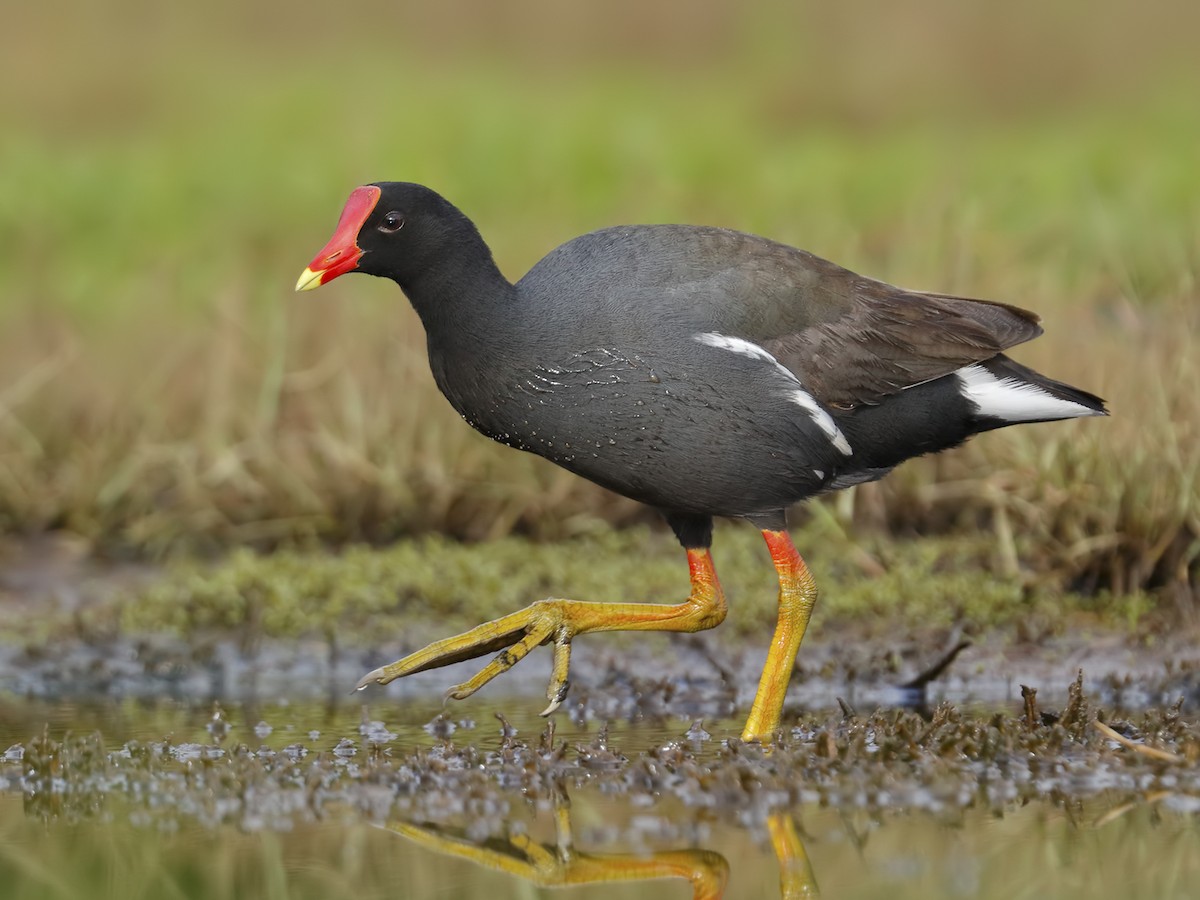
The Common Gallinule, formerly known as the Common Moorhen in North America, is a medium-sized waterbird of the rail family. It is characterized by its dark plumage, bright red frontal shield and bill, and white flank stripe. It is a common inhabitant of freshwater wetlands across much of the Americas.
Size & lifespan
- Length
- 30-38 cm (12-15 in)
- Wingspan
- 50-62 cm (20-24 in)
- Weight
- 200-500 g (7.1-17.6 oz)
- Lifespan
- Up to 10 years in the wild
- Diet
- Omnivore
Physical characteristics
- Plumage
- Adults have a dark slate-gray to blackish body plumage, with a brownish wash on the back and wings. The undertail coverts are white, with a prominent black stripe down the center. A distinct white stripe runs along the flanks.
- Beak shape
- The bill is conical and bright red, tipped with yellow. A prominent, fleshy, bright red frontal shield extends from the base of the bill onto the forehead.
- Eye color
- Dark red to reddish-brown.
- Leg color
- Legs and feet are yellowish-green, often with a reddish tinge on the upper leg, especially during breeding season. The feet are large and unwebbed, but with long toes adapted for walking on floating vegetation.
- Distinguishing features
- The most distinctive features are the bright red frontal shield and bill with a yellow tip, and the white stripe along the flanks. The white undertail coverts with a central black stripe are also a key field mark.
- Juvenile appearance
- Juveniles are duller overall, with brownish-gray plumage, a duller, smaller, brownish-red frontal shield and bill, and duller legs. The white flank stripe is less distinct, and the undertail coverts are buffy white without the strong black central stripe.
- Seasonal changes
- Plumage does not change significantly between breeding and non-breeding seasons, though the intensity of the red on the frontal shield and legs may be brighter during breeding.
- Sexual dimorphism
- Males and females are generally similar in plumage, though males may be slightly larger and have a more prominent frontal shield. Differences are subtle and not reliable for field identification.
How to identify
- 1
Red Frontal Shield and Bill
Look for the distinctive bright red shield on the forehead extending onto the red bill, which has a yellow tip. This is the most reliable field mark for adults.
- 2
White Flank Stripe
Observe the prominent white stripe running along the side of the body, contrasting with the dark plumage. This is visible even when the bird is swimming.
- 3
White Undertail Coverts with Black Stripe
When the bird flicks its tail (a common behavior), notice the white feathers under the tail with a distinct black stripe down the center.
- 4
Legs and Feet
Note the yellowish-green legs and large, unwebbed feet with long toes, adapted for walking on vegetation. The upper leg may show a reddish tinge.
- 5
Behavior
Watch for its characteristic jerky head-bobbing while swimming or walking, and its tendency to hide in dense vegetation when disturbed.
Habitat & range
- Biomes
- Freshwater wetlands, marshes, ponds, lakes, slow-moving rivers, canals.
- Geographic range
- Widespread across the Americas, from southern Canada through the United States, Mexico, Central America, and much of South America. Also found in the Caribbean.
- Elevation range
- Primarily lowlands, from sea level up to approximately 2,000 meters (6,500 feet) in some parts of its range.
- Preferred environments
- Prefers shallow freshwater with dense emergent vegetation (e.g., cattails, reeds, sedges) for cover and nesting, and open water for foraging. Often found in areas with a mix of open water and dense vegetation.
Behavior
- Activity time
- Diurnal, most active during early morning and late afternoon.
- Feeding habits
- Forages by picking food from the water surface, dabbling, or walking on floating vegetation. Diet consists of a wide variety of plant material (seeds, leaves, stems of aquatic plants) and small invertebrates (insects, snails, worms, tadpoles). Occasionally eats small fish or eggs of other birds.
- Social behavior
- Typically seen singly or in pairs during the breeding season. Outside of breeding, they may form small, loose flocks. Can be territorial during nesting.
- Flight pattern
- Flies with rapid, shallow wingbeats, often with legs dangling. Flight is usually short and low over the water, especially when disturbed. Can be reluctant to fly, preferring to run or swim into cover.
- Migration pattern
- Northern populations are migratory, moving south for the winter. Southern populations are resident year-round. Migration occurs at night.
- Territoriality
- Highly territorial during the breeding season, defending nesting and foraging areas from conspecifics and other waterbirds. Displays include chasing, calling, and aggressive posturing.
Song & calls
- Song
- Not known for a complex song. Vocalizations are primarily calls.
- Call
- A variety of calls, often described as clucking, cackling, or squawking. Common calls include a sharp, high-pitched 'kik-kik-kik' or 'krruk-krruk', a harsh 'kerr-r-r', and a softer 'wup' or 'chuck'. Alarm calls are typically louder and more insistent.
- When they vocalize
- Vocalizes throughout the day, especially when disturbed, communicating with mates, or defending territory. More vocal during the breeding season.
Breeding & reproduction
- Breeding season
- Varies geographically, typically from March to August in North America, and year-round in tropical regions.
- Nesting habits
- Nests are typically bulky platforms of dead reeds, cattails, and other aquatic vegetation, often built over shallow water and anchored to emergent plants. Sometimes builds a ramp leading to the nest. Both sexes participate in nest building.
- Clutch size
- 5-10 eggs, sometimes up to 13. Can lay multiple clutches in a season.
- Egg description
- Eggs are buff, pale olive, or greenish-white, speckled with reddish-brown or purplish spots, particularly at the larger end. Oval to sub-elliptical in shape.
- Incubation period
- 19-22 days, incubated by both parents.
- Fledging period
- Chicks are precocial, leaving the nest shortly after hatching. They are able to feed themselves within a few days but are cared for by parents for several weeks, typically fledging (able to fly) at 40-50 days.
- Parental care
- Both parents share incubation duties and care for the young. Older siblings from earlier broods may assist in caring for younger chicks (cooperative breeding).
Where to find
Freshwater Marshes
Look in areas with dense emergent vegetation like cattails, reeds, and sedges, especially where there are small patches of open water.
Ponds and Lakes
Check the vegetated edges of ponds, lakes, and slow-moving rivers. They prefer shallow areas.
Canals and Ditches
In agricultural or suburban areas, they can often be found in vegetated canals, ditches, and retention ponds.
Field tips
- Be Patient and Quiet. Common Gallinules are often shy and will retreat into cover if they feel threatened. Approach quietly and be prepared to wait for them to emerge.
- Look for Movement in Vegetation. Scan the edges of dense aquatic vegetation for subtle movements or glimpses of their dark bodies. They often walk on top of floating plants.
- Listen for Calls. Their distinctive clucking and cackling calls can often reveal their presence even when they are hidden from view.
- Use Binoculars. Binoculars are essential for observing their subtle field marks, especially the red frontal shield and flank stripe, from a distance.
Similar species
American Coot
Fulica americana
Common Gallinules have a red frontal shield and bill with a yellow tip, and a prominent white flank stripe. American Coots have a white bill and frontal shield, and lack the white flank stripe. Coots also have lobed toes, while gallinules have long, unwebbed toes.
Purple Gallinule
Porphyrio martinica
Purple Gallinules are much more brightly colored, with iridescent purple-blue plumage, a pale blue frontal shield, and a red bill with a yellow tip. They also have bright yellow legs and feet. Common Gallinules are dark slate-gray and lack the vibrant coloration.
Sora
Porzana carolina
Soras are much smaller than Common Gallinules, with a short, yellow bill and a black face patch (adults). They are streaky brown and gray, lacking the red frontal shield and white flank stripe of the gallinule.
Quick facts
- Family:
- Rallidae (Rails, Gallinules, and Coots)
- Diet:
- Omnivorous (plants, insects, small invertebrates)
- Habitat:
- Freshwater wetlands with dense vegetation
- Distinguishing Mark:
- Red frontal shield and bill with yellow tip, white flank stripe
- Conservation Status:
- Least Concern
Fun facts
- The Common Gallinule was formerly known as the Common Moorhen in North America, but was split into a distinct species (Gallinula galeata) from the Old World Common Moorhen (Gallinula chloropus) in 2011 based on genetic and morphological differences.
- Despite having unwebbed feet, Common Gallinules are excellent swimmers and divers, often diving to escape predators or forage underwater.
- They exhibit a characteristic head-bobbing motion while swimming or walking, which helps them stabilize their vision.
- Juvenile Common Gallinules from an earlier brood may help their parents care for subsequent broods, a behavior known as cooperative breeding.
Scientific classification
- Kingdom
- Animalia
- Phylum
- Chordata
- Class
- Aves
- Order
- Gruiformes
- Family
- Rallidae
- Genus
- Gallinula
- Species
- Gallinula galeata
Explore the Common Gallinule
Identify birds anywhere
Free on iOS, Android, and Web. Photo & sound identification, full species database, and your personal life list.