
Spotted a bird? Identify it instantly with the Birdby app
Open the appAbout
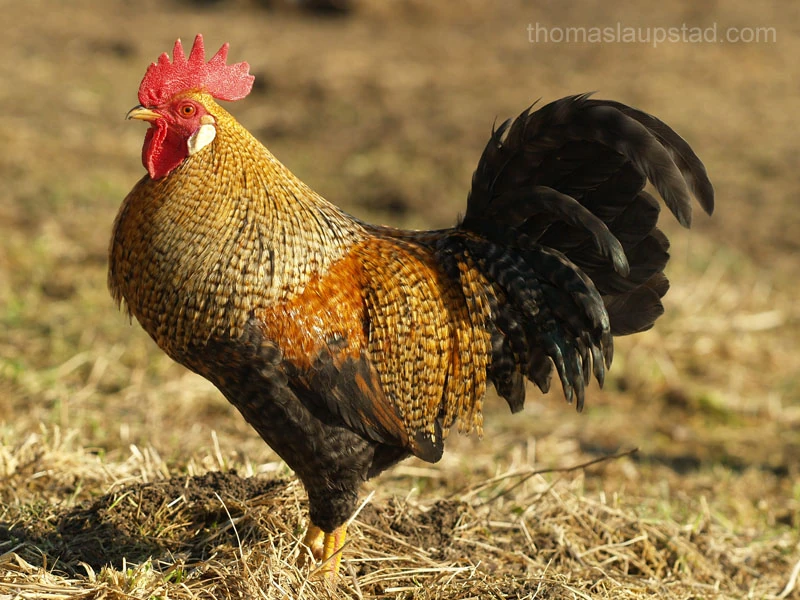
The Chicken (Gallus gallus domesticus) is a domesticated fowl, a subspecies of the Red Junglefowl (Gallus gallus). It is one of the most common and widespread domestic animals, with a global population of more than 25 billion as of 2023. Chickens are raised for their meat and eggs, and sometimes for their feathers. They are known for their social behavior, ground-foraging habits, and distinct vocalizations.
Size & lifespan
- Length
- 40-70 cm (16-28 in)
- Wingspan
- 60-100 cm (24-39 in)
- Weight
- 1.5-5 kg (3.3-11 lbs), highly variable by breed and sex
- Lifespan
- 5-10 years (domesticated, with proper care; wild Red Junglefowl typically 5-8 years)
- Diet
- Omnivore
Physical characteristics
- Plumage
- Highly variable depending on breed. Common colors include white, black, brown, red, buff, grey, and various barred, laced, or mottled patterns. Roosters often have more vibrant and iridescent plumage, especially on the neck (hackle) and tail feathers.
- Beak shape
- Short, conical, and strong, typically yellowish to horn-colored, adapted for pecking and foraging.
- Eye color
- Usually reddish-orange to brown, but can vary by breed.
- Leg color
- Typically yellow, grey, or black, often scaly, with four toes (three forward, one backward) and a prominent spur on roosters.
- Distinguishing features
- Prominent fleshy comb (usually red) on the head and wattles (fleshy growths) below the beak. Roosters have larger, more elaborate combs and wattles, and long, curving tail feathers (sickle feathers).
- Juvenile appearance
- Chicks are covered in down, typically yellow, brown, or mixed patterns, often with stripes. As they mature, they gradually develop adult plumage, with young males (cockerels) beginning to show signs of comb and wattle development and longer tail feathers.
- Seasonal changes
- No significant seasonal plumage changes. Plumage is generally consistent year-round, though molting occurs annually, during which feathers are shed and replaced.
- Sexual dimorphism
- Pronounced. Roosters (males) are generally larger, heavier, and more brightly colored than hens (females). They possess larger combs and wattles, longer and more pointed hackle and saddle feathers, and prominent spurs on their legs. Hens are typically duller in coloration and lack the long, flowing tail feathers and spurs of roosters.
How to identify
- 1
Size and Build
Domestic chickens vary greatly in size and build depending on the breed, from small bantams to large meat breeds. Look for a robust body, short wings, and strong legs.
- 2
Head Ornamentation
Presence of a fleshy comb on the head and wattles below the beak. These are typically red, but size and shape vary significantly by breed and sex (larger in roosters).
- 3
Plumage Coloration
Observe the wide array of plumage colors and patterns. Roosters often have more vibrant, iridescent feathers, especially on the neck and tail.
- 4
Legs and Spurs
Scaly legs, typically yellow, grey, or black. Roosters possess prominent, sharp spurs on the back of their legs, which are absent or much smaller in hens.
- 5
Vocalizations
The distinctive 'cock-a-doodle-doo' of the rooster and the various clucking and cackling sounds of hens are unmistakable.
- 6
Behavior
Ground-foraging behavior (scratching and pecking), short, low flights, and social flocking behavior are characteristic.
Habitat & range
- Biomes
- Anthropogenic (human-modified environments), including farms, rural homesteads, and sometimes urban areas. Its wild ancestor, the Red Junglefowl, inhabits tropical and subtropical forests and scrublands.
- Geographic range
- Globally distributed due to domestication. Originates from Southeast Asia.
- Elevation range
- Sea level to moderate elevations, typically wherever human settlements are found.
- Preferred environments
- Areas with access to food (grains, insects, vegetation), water, and shelter from predators and elements. They thrive in environments where they can forage on the ground and have safe roosting spots.
Behavior
- Activity time
- Diurnal, active during daylight hours, foraging and interacting. They roost at night.
- Feeding habits
- Primarily ground foragers, scratching and pecking at the soil to find seeds, grains, insects, worms, and small invertebrates. They also consume leafy greens and fruits. They swallow grit to aid digestion.
- Social behavior
- Highly social, living in flocks with a distinct pecking order (dominance hierarchy). Roosters often oversee a flock of hens. They communicate through various vocalizations and body language.
- Flight pattern
- Chickens are poor fliers, capable of short, low flights, primarily to escape immediate danger or reach elevated roosting spots. They are not migratory.
- Migration pattern
- Non-migratory; chickens are resident birds wherever they are kept.
- Territoriality
- Roosters can be territorial, especially during breeding season, defending their flock and nesting areas from other roosters or perceived threats. Hens may also exhibit territoriality around their nests.
Song & calls
- Song
- Roosters produce a distinctive 'cock-a-doodle-doo' crow, typically at dawn, but also throughout the day to announce their presence and territorial claims. This is not a song in the typical avian sense but a territorial call.
- Call
- Hens produce a variety of clucking sounds, ranging from soft contentment clucks to louder alarm calls ('cackles') when disturbed or after laying an egg. Chicks emit peeping sounds. Alarm calls are sharp and repetitive.
- When they vocalize
- Roosters crow most frequently at dawn and dusk, but also intermittently throughout the day. Hens cluck continuously while foraging and cackle loudly after laying eggs or when alarmed. Chicks peep constantly when young.
Breeding & reproduction
- Breeding season
- Year-round in domesticated settings, especially with artificial lighting. In more natural conditions, breeding may be more concentrated in warmer months.
- Nesting habits
- Hens lay eggs in secluded, sheltered spots, often in a simple depression on the ground or in a nest box provided by humans. They may share communal nests.
- Clutch size
- A hen can lay 100-300 eggs per year, but a typical clutch for incubation is 8-15 eggs.
- Egg description
- Eggs are typically oval, smooth-shelled, and vary in color from white, brown, blue, or green, depending on the breed. Size also varies significantly by breed, but generally 45-70 grams.
- Incubation period
- 21 days
- Fledging period
- Chicks are precocial, meaning they are covered in down and able to walk and feed themselves shortly after hatching. They remain with the hen for several weeks to months for protection and guidance.
- Parental care
- The hen provides all parental care, incubating the eggs and brooding the chicks after hatching, protecting them and teaching them to forage. Roosters do not participate in incubation or direct chick rearing but protect the flock.
Where to find
Farms and Rural Areas
The most common place to find chickens, kept for agricultural purposes.
Backyard Coops
Increasingly common in suburban and even urban areas as part of the backyard chicken movement.
Wildlife Sanctuaries/Petting Zoos
Often found in educational or recreational settings where domestic animals are kept.
Feral Populations
In some tropical and subtropical regions (e.g., Hawaii, parts of Florida), feral chicken populations exist, often resembling their Red Junglefowl ancestors.
Field tips
- Listen for Vocalizations. The crow of a rooster or the clucking of hens is often the first indication of their presence.
- Look for Foraging Activity. Chickens spend much of their day scratching and pecking at the ground, often in open areas near cover.
- Observe Social Groups. They are typically found in flocks, often with a rooster overseeing several hens.
- Check Roosting Spots. At night, they will seek elevated perches or enclosed coops for safety.
Similar species
Red Junglefowl
Gallus gallus
The wild ancestor of the domestic chicken. Red Junglefowl are generally smaller, more slender, and have a more pronounced flight ability. Their plumage is typically more uniform, with roosters having bright red combs and wattles, iridescent green-black tail feathers, and golden hackle feathers. Domestic chickens exhibit a much wider range of sizes, colors, and comb types due to selective breeding.
Green Junglefowl
Gallus varius
Found in Indonesia. Males have a single, unnotched comb that is blue at the base and red at the top, and iridescent green plumage. Females are duller. Distinctly different from domestic chickens in coloration and comb structure.
Grey Junglefowl
Gallus sonneratii
Found in India. Males have a comb that is yellow with a red edge, and unique 'wax-like' yellow spots on the hackle feathers. Females are duller. Plumage patterns and comb characteristics are distinct from domestic chickens.
Quick facts
- Origin:
- Domesticated from Red Junglefowl (Gallus gallus) in Southeast Asia
- Global Population:
- Over 25 billion (most numerous bird species)
- Primary Uses:
- Meat and eggs
- Flight Capability:
- Limited, short-distance flights
- Social Structure:
- Flocks with a pecking order
Fun facts
- Chickens are believed to have been domesticated over 8,000 years ago.
- There are hundreds of recognized chicken breeds, each with unique characteristics.
- A chicken's comb and wattles help regulate its body temperature.
- Chickens have a good memory and can recognize over 100 different faces, including humans.
- The color of a chicken's egg is determined by its breed, not its diet.
Scientific classification
- Kingdom
- Animalia
- Phylum
- Chordata
- Class
- Aves
- Order
- Galliformes
- Family
- Phasianidae
- Genus
- Gallus
- Species
- Gallus gallus domesticus
Explore the Chicken
Identify birds anywhere
Free on iOS, Android, and Web. Photo & sound identification, full species database, and your personal life list.