
Spotted a bird? Identify it instantly with the Birdby app
Open the appAbout
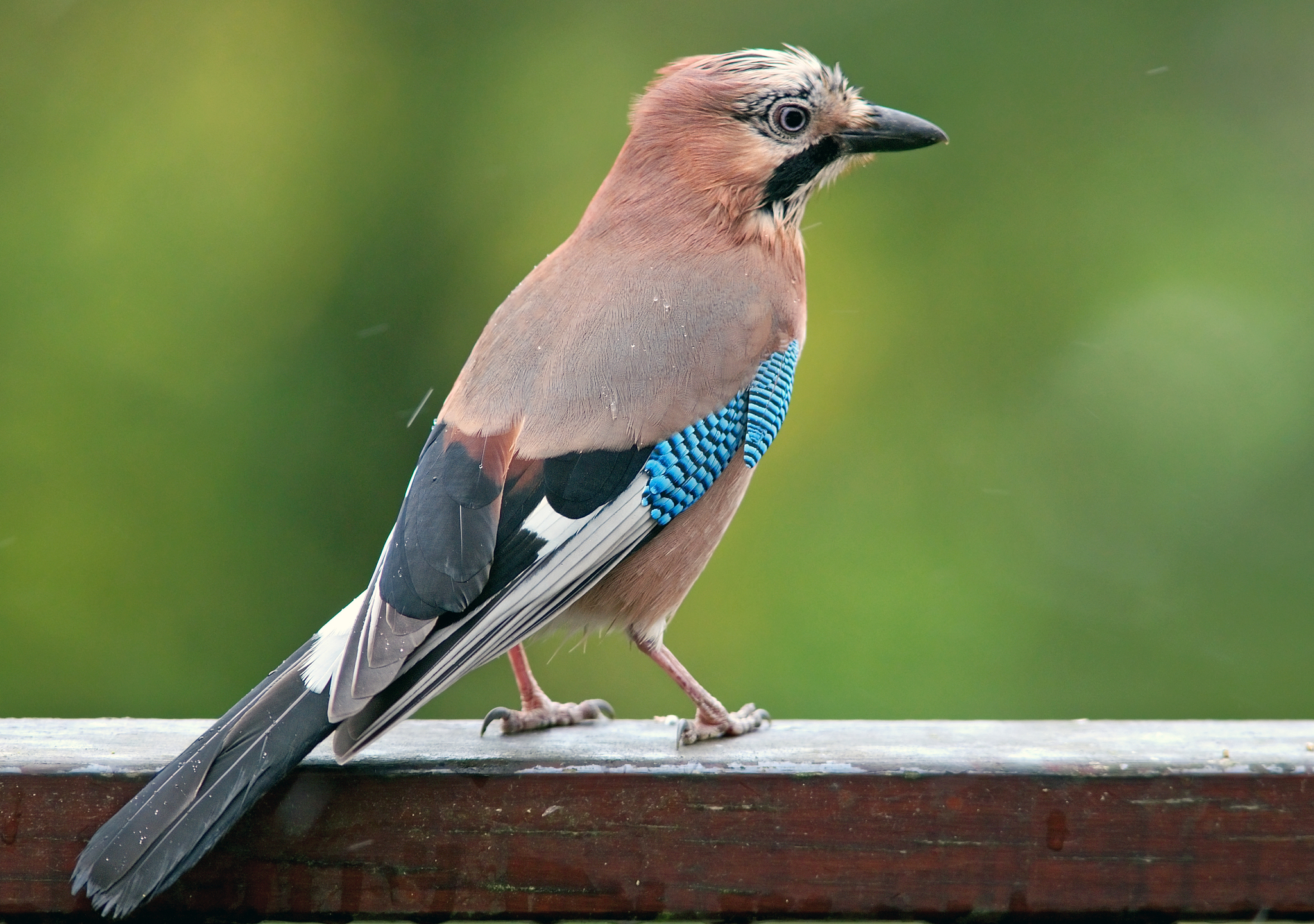
The Eurasian Jay is a colorful member of the crow family, known for its striking blue wing patches, pinkish-brown plumage, and distinctive harsh calls. It is a highly intelligent and adaptable bird, often found in woodlands, parks, and gardens across its extensive range. Jays are particularly noted for their habit of caching acorns and other nuts, playing a significant role in forest regeneration.
Size & lifespan
- Length
- 32-35 cm (12.6-13.8 in)
- Wingspan
- 52-58 cm (20.5-22.8 in)
- Weight
- 130-190 g (4.6-6.7 oz)
- Lifespan
- Up to 16 years in the wild, typically 5-7 years.
- Diet
- Omnivore
Physical characteristics
- Plumage
- The body plumage is predominantly pinkish-brown to vinous-pink. The crown is streaked black and white, often appearing blackish. The most distinctive feature is the bright blue, black-barred patch on the primary coverts, visible even when perched. The rump is white, contrasting with a black tail. The primaries are black, and the secondaries are black with white bases. A prominent black moustachial stripe extends from the base of the bill.
- Beak shape
- Strong, conical, and pointed bill, dark grey to blackish.
- Eye color
- Pale blue to whitish-blue iris, contrasting with the dark pupil.
- Leg color
- Pale brown to reddish-brown.
- Distinguishing features
- Bright blue, black-barred wing patches; white rump; black moustachial stripe; streaked crown; pinkish-brown body plumage.
- Juvenile appearance
- Juveniles resemble adults but have a slightly duller plumage, less distinct streaking on the crown, and often a browner iris. The blue wing patch may be slightly less vibrant.
- Seasonal changes
- No significant seasonal plumage changes. Plumage may appear slightly worn or faded towards the end of the breeding season before molting.
- Sexual dimorphism
- Males and females are monomorphic, meaning they look identical in plumage and size.
How to identify
- 1
Plumage Coloration
Look for the overall pinkish-brown body plumage. This is a key distinguishing feature among European Corvids.
- 2
Blue Wing Patches
The iridescent blue, black-barred patch on the wing is unmistakable and often the first thing noticed, especially in flight or when the bird is agitated.
- 3
White Rump
Observe the bright white rump, which is very conspicuous in flight and contrasts sharply with the black tail and darker back.
- 4
Black Moustachial Stripe
A distinct black stripe extending from the base of the bill downwards and backwards is a good field mark.
- 5
Streaked Crown
The crown is typically whitish with fine black streaking, giving it a somewhat 'capped' appearance.
- 6
Vocalizations
Listen for its characteristic harsh 'skaaak' call. Its mimicry can also be a clue, though it requires familiarity with other bird calls.
- 7
Behavior
Watch for its secretive nature, often moving through dense cover, but also its habit of caching acorns, which can be observed in autumn.
Habitat & range
- Biomes
- Temperate and boreal forests, mixed woodlands, deciduous forests, coniferous forests, parks, large gardens, orchards, and cultivated areas with scattered trees.
- Geographic range
- Widespread across Eurasia, from Western Europe and Northwest Africa through to East Asia, including Japan and parts of Southeast Asia. Its range extends from the British Isles in the west to the Pacific coast in the east.
- Elevation range
- Sea level up to 2,000 meters (6,500 feet), occasionally higher in some mountainous regions.
- Preferred environments
- Prefers mature broadleaf woodlands, especially those with oak trees due to their reliance on acorns. Also adapts well to suburban and urban green spaces where suitable tree cover and food sources are available.
Behavior
- Activity time
- Diurnal.
- Feeding habits
- Highly omnivorous. Diet includes a wide variety of insects (especially caterpillars, beetles), acorns, beech mast, chestnuts, other nuts and seeds, fruits, berries, small mammals (mice, voles), small birds, eggs, nestlings, and carrion. Famous for caching thousands of acorns and other nuts for winter consumption, often burying them individually, which aids in tree dispersal.
- Social behavior
- Typically seen singly or in pairs during the breeding season. Outside of breeding, they may form small family groups or loose flocks, especially when foraging for acorns. Can be quite secretive and shy, but also bold and inquisitive.
- Flight pattern
- Undulating, rather heavy flight with relatively shallow wing beats. Often flies with its white rump conspicuous. Can be quite agile when maneuvering through trees.
- Migration pattern
- Mostly resident throughout its range. Northern and eastern populations may undertake irruptive movements or short-distance migrations in years of poor acorn crops, moving south or west. Juveniles may disperse more widely.
- Territoriality
- Territorial during the breeding season, defending their nesting area. Outside of breeding, they are less territorial, especially when foraging in communal areas.
Song & calls
- Song
- The Eurasian Jay does not have a true song. Its vocalizations are primarily calls.
- Call
- Most characteristic call is a harsh, grating 'skaaak-skaaak' or 'kraaak-kraaak', often repeated. Also produces a variety of other calls, including softer 'kew' notes, chattering, and remarkable mimicry of other bird species (e.g., buzzards, owls, domestic fowl) and even human sounds. Alarm calls are typically louder and more insistent versions of the 'skaaak'.
- When they vocalize
- Vocalizes throughout the day, particularly active and noisy during the breeding season and when disturbed or alarmed. Mimicry is often heard during courtship or when relaxed.
Breeding & reproduction
- Breeding season
- April to June, with peak activity in May.
- Nesting habits
- Nests are typically built in trees or large shrubs, often well-hidden in a fork or against the trunk, 2-10 meters (6-33 feet) above the ground. The nest is a bulky cup made of twigs, roots, moss, and lined with finer materials like hair, grass, and feathers. Both sexes participate in nest building.
- Clutch size
- 4-6 eggs, occasionally 3-7.
- Egg description
- Typically 4-6 eggs, pale greenish-blue or buffish, finely speckled with olive-brown or grey, sometimes forming a cap at the broad end. Eggs are approximately 31 x 23 mm.
- Incubation period
- 16-19 days, primarily by the female, though the male may assist.
- Fledging period
- 19-23 days after hatching. Young remain dependent on parents for several weeks after fledging.
- Parental care
- Both parents feed and care for the young. The male often feeds the female during incubation.
Where to find
Oak Woodlands
Prime habitat, especially during autumn when they are actively collecting and caching acorns.
Mixed Forests
Any forest with a good mix of deciduous and coniferous trees, providing diverse food sources and nesting sites.
Parks and Large Gardens
Often found in suburban and urban green spaces with mature trees, especially if oaks are present.
Orchards and Cultivated Areas
Areas with scattered trees and fruit-bearing plants can attract them, particularly outside the breeding season.
Field tips
- Listen for Calls. Jays are often heard before they are seen. Their loud, harsh 'skaaak' call is a good indicator of their presence. They are also excellent mimics, so listen for unusual calls that might be a jay imitating another bird.
- Look for Movement in Trees. They are often secretive and prefer to stay within the cover of trees. Scan tree branches and dense foliage for movement, especially near oak trees.
- Observe Acorn Caching. In autumn, watch for jays carrying acorns in their bills and burying them in the ground or under leaf litter. This behavior is a strong indicator of their presence.
- Be Patient and Quiet. Jays can be shy. Moving slowly and quietly will increase your chances of observing them without causing them to flee.
- Check Bird Feeders (occasionally). While not typical feeder birds, they may occasionally visit feeders, especially those offering peanuts or other large seeds, particularly in winter.
Similar species
Siberian Jay
Perisoreus infaustus
The Siberian Jay is smaller, lacks the prominent blue wing patch, and has a more rufous-brown plumage with a grey head and black tail. Its range is restricted to northern coniferous forests.
Spotted Nutcracker
Nucifraga caryocatactes
The Spotted Nutcracker is larger, dark brown with white spots, and has a longer, more pointed bill. It lacks the blue wing patch and white rump of the Eurasian Jay. Its primary food source is pine nuts.
Other Corvids (e.g., Magpie, Jackdaw)
Pica pica, Corvus monedula
While also Corvids, Magpies are distinctly black and white with a very long tail, and Jackdaws are smaller, all grey-black with pale eyes. Neither shares the Eurasian Jay's unique combination of pinkish-brown, blue wing patches, and white rump.
Quick facts
- Key Feature:
- Bright blue, black-barred wing patches
- Dietary Niche:
- Omnivorous, with a strong preference for acorns
- Ecological Role:
- Significant disperser of oak trees through acorn caching
- Vocalization:
- Harsh 'skaaak' call and remarkable mimicry
- Social Structure:
- Pairs in breeding season, small groups outside
Fun facts
- A single Eurasian Jay can cache thousands of acorns in a season, remembering the location of many of them. Those they don't retrieve often sprout, making them vital 'forest gardeners'.
- Their ability to mimic other birds' calls is so advanced that they can fool other species, sometimes using these imitations to warn of predators or even to attract mates.
- The blue color in their wing patches is structural, not pigmentary. It's created by the way light interacts with the microscopic structure of the feathers, similar to how a peacock's feathers get their color.
- Eurasian Jays are known to 'ant' – rubbing ants on their feathers. This behavior is thought to help remove parasites, as the ants' formic acid acts as an insecticide.
Scientific classification
- Kingdom
- Animalia
- Phylum
- Chordata
- Class
- Aves
- Order
- Passeriformes
- Family
- Corvidae
- Genus
- Garrulus
- Species
- Garrulus glandarius
Explore the Eurasian Jay
Identify birds anywhere
Free on iOS, Android, and Web. Photo & sound identification, full species database, and your personal life list.