
Spotted a bird? Identify it instantly with the Birdby app
Open the appAbout
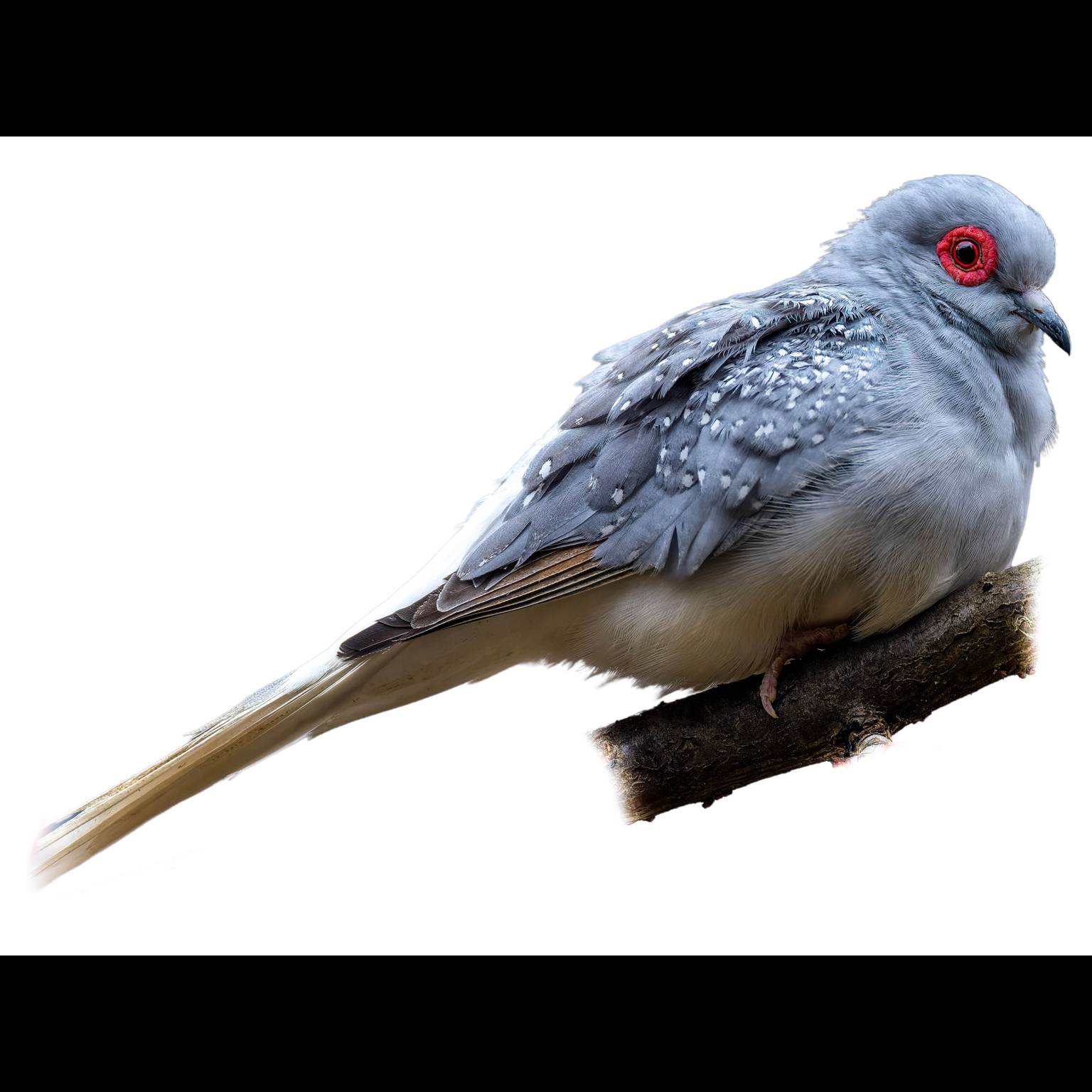
The Diamond Dove is a small, slender pigeon native to Australia, known for its distinctive white spots on its wings, resembling diamonds. It is a ground-feeding species, often found in arid and semi-arid regions.
Size & lifespan
- Length
- 19-21 cm
- Wingspan
- 26-30 cm
- Weight
- 23-32 g
- Lifespan
- Up to 10-12 years in captivity, likely shorter in the wild (3-5 years)
- Diet
- Granivore (primarily seeds)
Physical characteristics
- Plumage
- Adults have a grey body, with a white belly. The wings are brownish-grey with prominent white spots (diamonds) edged in black. The primary flight feathers are dark brown. The tail is long and graduated, with white outer tail feathers visible in flight. The rump is grey.
- Beak shape
- Small, slender, dark grey to black beak.
- Eye color
- Red iris, surrounded by a distinctive bright orange-red orbital ring (bare skin around the eye).
- Leg color
- Pinkish-red.
- Distinguishing features
- The most distinctive feature is the bright orange-red orbital ring and the white 'diamond' spots on the wings. Its small size and long tail are also key identifiers.
- Juvenile appearance
- Juveniles are duller overall, with a brownish-grey plumage and less distinct white spots on the wings. The orbital ring is greyish or dull orange, not yet the vibrant red of adults. The beak is darker, and the legs are duller pink.
- Seasonal changes
- No significant seasonal plumage changes. The intensity of the orbital ring may vary slightly with breeding condition, becoming more vibrant during courtship.
- Sexual dimorphism
- Males typically have a more intense and vibrant orange-red orbital ring, and their grey plumage may appear slightly darker or more bluish than females. Females generally have a duller orbital ring and slightly paler grey plumage. These differences can be subtle and are not always reliable for sexing without direct comparison.
How to identify
- 1
Size and Shape
Look for a very small, slender dove with a relatively long, pointed tail.
- 2
Wing Pattern
Observe the wings for distinctive small, round white spots ('diamonds') on a brownish-grey background. This is a key field mark.
- 3
Head and Eye
Note the bright orange-red bare skin around the eye (orbital ring). This is a very striking and reliable identification feature in adults.
- 4
Plumage Color
Overall grey body with a white belly. The grey can appear slightly bluish in males.
- 5
Behavior
Watch for its ground-feeding habits, often pecking at small seeds. Its swift, direct flight with rapid wing beats is also characteristic.
- 6
Vocalization
Listen for its soft, mournful, cooing 'coo-coo-coo' call, which is quite distinctive.
Habitat & range
- Biomes
- Arid and semi-arid grasslands, shrublands, open woodlands, and spinifex country.
- Geographic range
- Widespread across most of mainland Australia, avoiding the densest forests of the east coast and the extreme south-west.
- Elevation range
- Typically found from sea level up to approximately 1000 meters.
- Preferred environments
- Prefers areas with sparse vegetation, often near water sources such as rivers, creeks, and waterholes. They are also found in disturbed areas, farmlands, and suburban gardens, especially where food and water are available.
Behavior
- Activity time
- Diurnal, most active during the cooler parts of the day, morning and late afternoon.
- Feeding habits
- Primarily ground feeders, foraging for small seeds of grasses and herbs. They will also consume small insects, especially during breeding season. They drink frequently, often congregating at waterholes in the early morning and late afternoon.
- Social behavior
- Usually seen in pairs or small flocks, especially around water sources. During non-breeding periods, larger flocks can form. They are generally tame and approachable.
- Flight pattern
- Flight is swift and direct, with rapid wing beats. They often fly low to the ground over short distances. When flushed, they rise quickly with a whirring sound.
- Migration pattern
- Mostly sedentary, but may undertake local nomadic movements in response to rainfall and food availability, particularly in arid regions.
- Territoriality
- Pairs establish small breeding territories, which they defend with calls and displays. Outside the breeding season, they are less territorial.
Song & calls
- Song
- The primary song is a soft, mournful, cooing 'coo-coo-coo' or 'coo-coo-coo-coo-coo', often repeated. It starts with a lower note and rises slightly in pitch. It can be quite rapid.
- Call
- A soft, low 'coo' or 'croo' call, often given as an alarm or contact call. When flushed, they may emit a sharp 'whirr' from their wings.
- When they vocalize
- Most vocal during the breeding season, but calls can be heard year-round, especially in the morning and late afternoon.
Breeding & reproduction
- Breeding season
- Highly opportunistic, breeding can occur year-round, but is most common after good rainfall, typically from August to January in the south and March to June in the north.
- Nesting habits
- Nests are flimsy, shallow platforms of twigs, grass, and rootlets, typically built in low shrubs, small trees, or sometimes on the ground, usually less than 2 meters above the ground. Both parents participate in nest building.
- Clutch size
- Typically 2 eggs.
- Egg description
- Two small, pure white, elliptical eggs.
- Incubation period
- Approximately 13-14 days.
- Fledging period
- Chicks fledge around 12-14 days after hatching.
- Parental care
- Both parents share incubation duties and care for the young. They feed the chicks 'crop milk' initially, transitioning to regurgitated seeds.
Where to find
Waterholes and Riverbeds
Often found congregating at water sources, especially in arid regions, during early morning and late afternoon.
Open Woodlands and Shrublands
Look in areas with sparse undergrowth, spinifex, and scattered trees.
Gardens and Parks
In some suburban and rural areas, they can be found in gardens, particularly those with native plants and accessible water.
Farmlands
They may frequent agricultural areas, especially those with stubble or spilled grain.
Field tips
- Look on the ground. Diamond Doves are primarily ground feeders, so scan the ground beneath shrubs and trees, especially near water.
- Visit water sources. Check waterholes, creeks, and bird baths, particularly during dry periods and in the early morning or late afternoon.
- Listen for calls. Their soft cooing call can often lead you to their location, especially when they are hidden in vegetation.
- Be patient and quiet. They are generally tame but can be easily spooked. Approach slowly and quietly.
- Use binoculars. Their small size and subtle features (like the orbital ring and wing spots) are best observed with binoculars.
Similar species
Peaceful Dove
Geopelia placida
The Peaceful Dove is slightly larger and lacks the prominent white 'diamond' spots on the wings. It has fine black barring on the neck and breast, which the Diamond Dove lacks. The orbital ring of the Peaceful Dove is greyish-blue, not bright orange-red.
Bar-shouldered Dove
Geopelia humeralis
The Bar-shouldered Dove is significantly larger and has a distinctive rufous-brown bar across its shoulders and a barred neck. It also lacks the white 'diamond' spots and the bright red orbital ring of the Diamond Dove.
Zebra Dove
Geopelia striata
The Zebra Dove is found in Southeast Asia and is an introduced species in some parts of Australia. It is similar in size but has fine black barring on the neck, breast, and flanks, and lacks the white 'diamond' spots and the prominent red orbital ring.
Quick facts
- Size:
- Smallest Australian dove
- Diet:
- Almost exclusively seeds
- Habitat:
- Arid and semi-arid open country
- Distinguishing Mark:
- Bright red orbital ring and white wing spots
- Sociality:
- Pairs or small flocks
Fun facts
- Diamond Doves are popular cage birds worldwide due to their small size, attractive appearance, and relatively quiet nature.
- They are highly adapted to arid environments, capable of surviving on minimal water and often found far from permanent water sources.
- Their 'diamond' spots are actually white tips on the coverts, creating a striking pattern against the darker feathers.
- Like other doves and pigeons, they drink by sucking water, rather than scooping and tilting their heads back like most other birds.
Scientific classification
- Kingdom
- Animalia
- Phylum
- Chordata
- Class
- Aves
- Order
- Columbiformes
- Family
- Columbidae
- Genus
- Geopelia
- Species
- Geopelia cuneata
Explore the Diamond Dove
Identify birds anywhere
Free on iOS, Android, and Web. Photo & sound identification, full species database, and your personal life list.