
Spotted a bird? Identify it instantly with the Birdby app
Open the appAbout
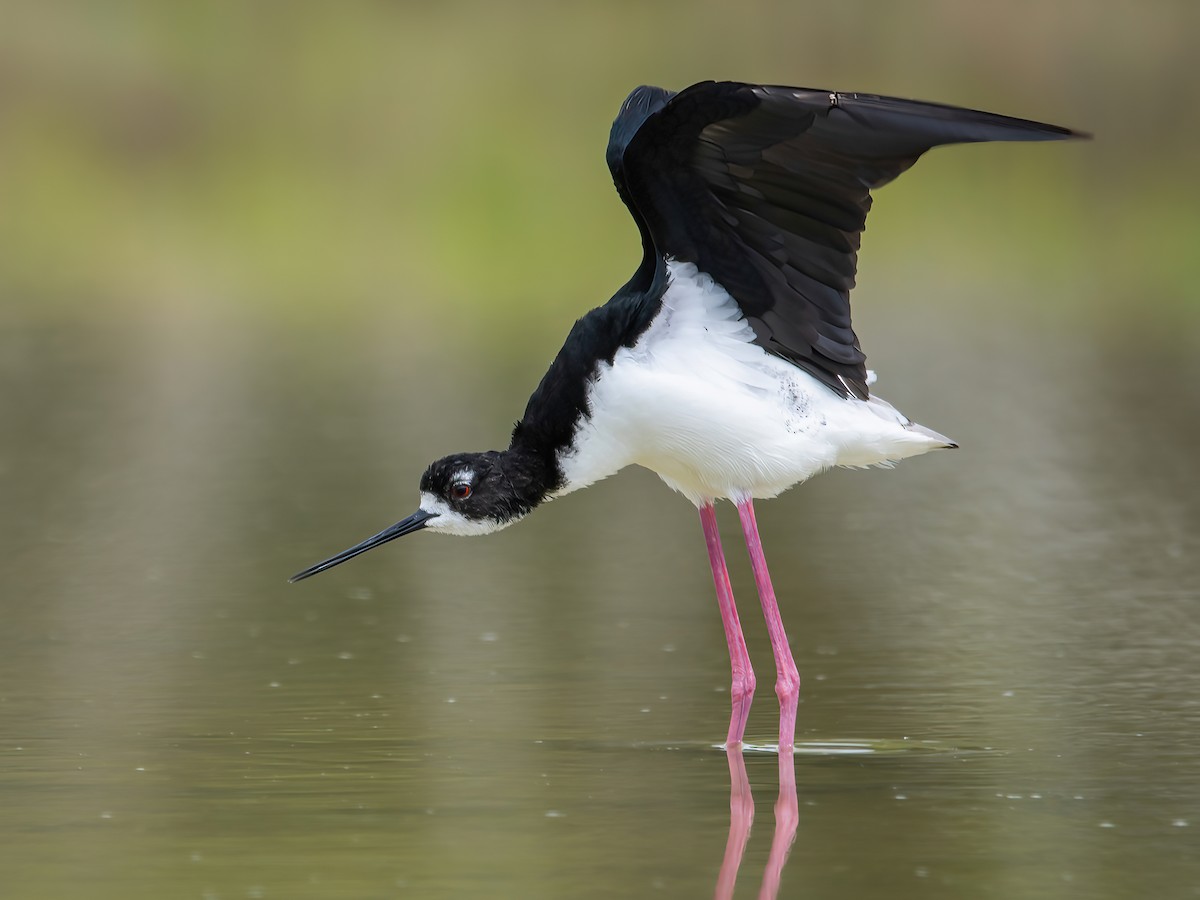
The Black-winged Stilt is a striking, long-legged wading bird known for its contrasting black and white plumage and exceptionally long, slender pink legs. It is found in wetlands across much of the world, feeding on small invertebrates.
Size & lifespan
- Length
- 33-36 cm (13-14 in)
- Wingspan
- 67-83 cm (26-33 in)
- Weight
- 136-205 g (4.8-7.2 oz)
- Lifespan
- Up to 12 years in the wild
- Diet
- Carnivore (primarily aquatic invertebrates)
Physical characteristics
- Plumage
- Adults have pure white underparts, head, and neck, contrasting sharply with glossy black wings and a black back. Some individuals, particularly males, may have a black cap or a black streak behind the eye, extending to the nape. The amount of black on the head and neck varies geographically and individually.
- Beak shape
- Long, very thin, needle-like, and straight, entirely black.
- Eye color
- Dark brown with a small, dark pupil.
- Leg color
- Extremely long, slender, bright pink to reddish-pink.
- Distinguishing features
- Unmistakable due to its extremely long pink legs (proportionally the longest of any bird relative to body size), slender black bill, and stark black-and-white plumage. Its elegant, upright posture is also characteristic.
- Juvenile appearance
- Juveniles resemble females but have a duller, brownish-black back and wings, often with pale feather fringes giving a scaly appearance. Their legs are duller pink, sometimes grayish-pink, and their heads are typically pure white or with very faint dusky markings.
- Seasonal changes
- No significant seasonal plumage changes, though breeding adults may show slightly more intense black coloration. The primary variations are age and sex-related.
- Sexual dimorphism
- Males typically have a more extensive black cap and nape, often extending further down the hindneck, and a more intense black on the back. Females tend to have a browner or duller black back, and less black on the head, often appearing pure white-headed or with only a small dark patch behind the eye. These differences can be subtle and vary geographically.
How to identify
- 1
Legs
Look for exceptionally long, slender, bright pink legs that trail far behind the tail in flight. This is the most distinctive feature.
- 2
Plumage Contrast
Observe the stark contrast between the pure white body (underparts, most of head and neck) and the glossy black wings and back. Note the variation in black on the head/nape for sex and age identification.
Habitat & range
- Biomes
- Wetlands, marshes, shallow lakes, lagoons, estuaries, salt pans, flooded fields, and sewage farms.
- Geographic range
- Widespread across much of the world, including southern Europe, Africa, Madagascar, southern and southeastern Asia, Australia, and New Zealand. Different subspecies occupy different regions.
- Elevation range
- Primarily found in lowland areas, typically below 500 meters, but can occur at higher altitudes in suitable wetland habitats.
- Preferred environments
- Shallow, open water bodies with muddy or sandy margins, often with sparse emergent vegetation. They prefer areas where they can wade easily to forage.
Behavior
- Activity time
- Diurnal, actively foraging during daylight hours.
- Feeding habits
- Forages by wading in shallow water, often up to its belly, using its long legs to reach deeper areas. It probes the mud or water with its sensitive bill, sweeping it from side to side or picking prey from the surface. Diet consists mainly of aquatic insects (larvae and adults), small crustaceans, mollusks, and occasionally small fish or tadpoles.
- Social behavior
- Highly social, especially during the breeding season, forming loose colonies. Outside of breeding, they can be found in small groups or large flocks, particularly during migration or at favored feeding sites.
- Flight pattern
- Graceful and direct, with steady, shallow wingbeats. The long pink legs trail conspicuously behind the tail, extending well beyond it. Often flies in small flocks.
- Migration pattern
- Many populations are migratory, moving from temperate breeding grounds to warmer wintering areas. Northern European and Asian populations migrate south to Africa and Southeast Asia. Southern populations may be resident or undertake shorter, local movements in response to water availability.
- Territoriality
- During the breeding season, pairs defend a small territory around their nest site, often aggressively chasing away intruders, including other stilts or larger birds.
Song & calls
- Song
- Does not have a complex song. Vocalizations are primarily calls.
- Call
- A distinctive, sharp, high-pitched 'kip-kip-kip' or 'kek-kek-kek' call, often repeated rapidly, especially when alarmed or in flight. Can also produce a more drawn-out 'kree-ee' sound.
- When they vocalize
- Most vocal when alarmed, during territorial disputes, or in flight. Calls are particularly frequent around nesting colonies.
Breeding & reproduction
- Breeding season
- Varies geographically, typically spring and summer (e.g., April-July in Europe, August-December in Australia).
- Nesting habits
- Nests are typically shallow scrapes on the ground, often lined with a few pebbles, grass, or shell fragments. They are usually located on small islands, raised hummocks, or bare ground near shallow water, often in loose colonies.
- Clutch size
- 3-4 eggs, occasionally 2 or 5.
- Egg description
- Typically 3-4 eggs, olive-buff to pale brown, heavily marked with black or dark brown spots and blotches, providing excellent camouflage.
- Incubation period
- 22-26 days, shared by both parents.
- Fledging period
- Chicks are precocial and leave the nest shortly after hatching (within hours). They can feed themselves but are guarded by parents. They become fully independent and capable of flight at around 28-32 days.
- Parental care
- Both parents share incubation duties and care for the young. They are highly protective of their chicks, often performing distraction displays (e.g., feigning injury) to lure predators away from the nest or young.
Where to find
Shallow Wetlands
Look in shallow freshwater or brackish wetlands, including marshes, lagoons, and the edges of lakes and ponds.
Estuaries and Salt Pans
Coastal estuaries, mudflats, and salt evaporation ponds are also prime habitats, especially during migration or in wintering grounds.
Flooded Agricultural Fields
Often found foraging in recently flooded rice paddies or other agricultural fields.
Field tips
- Scan open water edges. They prefer open, shallow water where they can wade and probe for food. Look for them at the water's edge or wading further out.
- Listen for calls. Their sharp 'kip-kip-kip' call is distinctive and often given when disturbed or in flight, helping to locate them.
- Observe feeding behavior. Watch for their characteristic head-down, bill-sweeping foraging method in shallow water.
Similar species
Pied Stilt
Himantopus leucocephalus
Often considered a subspecies of Black-winged Stilt or a distinct species. The main difference is the extent of black on the head and neck. Pied Stilt typically has a more extensive black cap and nape, often extending to the eye and sometimes forming a full black hood, whereas many Black-winged Stilts (especially females) have a pure white head and neck. The taxonomy is complex and debated.
Black Stilt
Himantopus novaezelandiae
Endemic to New Zealand. Adults are entirely glossy black, including the head, body, and wings, with bright red legs. This is a clear distinction from the black-and-white plumage of the Black-winged Stilt.
American Avocet
Recurvirostra americana
While also a long-legged wader, the American Avocet has an upturned bill and a rusty-orange head and neck during breeding season (gray in non-breeding). Its plumage pattern is also different, with more extensive white on the back and distinct black stripes on the wings. Legs are bluish-gray, not pink.
Quick facts
- Leg Length:
- Proportionally the longest legs of any bird.
- Diet:
- Mainly aquatic invertebrates.
- Nesting:
- Colonial ground nesters.
- Flight:
- Legs trail well beyond tail.
Fun facts
- The Black-winged Stilt's scientific name, Himantopus, comes from Greek words meaning 'strap-foot' or 'thong-foot', referring to its extremely long, slender legs.
- Despite their long legs, they are surprisingly agile in flight and can cover long distances during migration.
- Their long legs allow them to forage in deeper water than many other waders, reducing competition for food.
- When threatened at the nest, parents may perform elaborate distraction displays, such as feigning a broken wing, to draw predators away from their eggs or chicks.
Scientific classification
- Kingdom
- Animalia
- Phylum
- Chordata
- Class
- Aves
- Order
- Charadriiformes
- Family
- Recurvirostridae
- Genus
- Himantopus
- Species
- Himantopus himantopus
Explore the Black-winged Stilt
Identify birds anywhere
Free on iOS, Android, and Web. Photo & sound identification, full species database, and your personal life list.