
Spotted a bird? Identify it instantly with the Birdby app
Open the appAbout
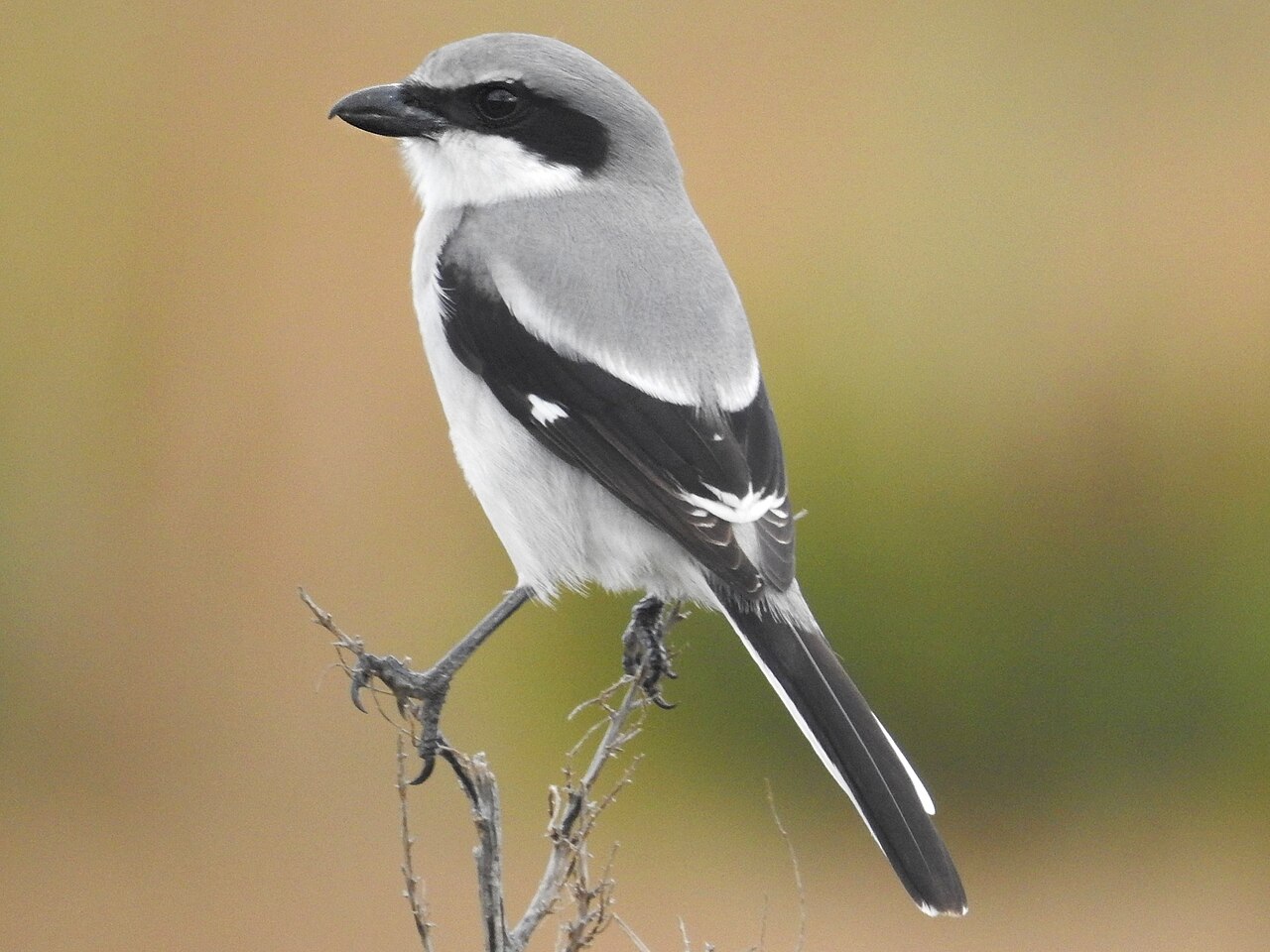
The Loggerhead Shrike is a medium-sized passerine bird known for its predatory behavior, often impaling prey on thorns or barbed wire fences, earning it the nickname "butcher bird." It is characterized by its gray, white, and black plumage, a distinctive black mask, and a hooked bill.
Size & lifespan
- Length
- 20-23 cm (7.9-9.1 in)
- Wingspan
- 30-33 cm (12-13 in)
- Weight
- 35-50 g (1.2-1.8 oz)
- Lifespan
- Up to 8 years in the wild
- Diet
- Carnivore (primarily insects, small mammals, birds, and reptiles)
Physical characteristics
- Plumage
- Adults have a gray head and back, white underparts, and black wings with a prominent white patch (visible in flight). The tail is black with white outer feathers. A distinct black mask extends from the bill through the eye to the ear coverts. The bill is dark gray, hooked at the tip. Juveniles are duller, with faint barring on the breast and flanks, and a less defined mask.
- Beak shape
- Strong, dark gray, sharply hooked upper mandible with a tomial tooth (a notch on the cutting edge of the upper bill) for dismembering prey.
- Eye color
- Dark brown
- Leg color
- Dark gray to black
- Distinguishing features
- Black mask, hooked bill, gray back, white underparts, black wings with white patch, and a relatively long tail with white outer feathers.
- Juvenile appearance
- Juveniles have a brownish-gray back, faint wavy barring on the breast and flanks, and a less distinct, often brownish-gray mask. Their plumage is generally duller and more mottled than adults.
- Seasonal changes
- No significant seasonal plumage changes. Plumage remains consistent year-round, though wear and tear can make feathers appear duller before molting.
- Sexual dimorphism
- Males and females are generally similar in plumage, though females may be slightly duller with a less extensive black mask. Measurements are also very similar.
How to identify
- 1
Size and Shape
Medium-sized songbird, about the size of an American Robin, with a relatively large head, short neck, and a long tail. Appears somewhat stout-bodied.
- 2
Plumage
Look for the distinctive gray back, white underparts, and black wings with a white patch. The black mask through the eye is a key identifier.
- 3
Bill
Observe the strong, dark, hooked bill, characteristic of a predatory bird, even though it's a passerine.
- 4
Perching Behavior
Often seen perched conspicuously on exposed branches, utility wires, or fence posts, scanning for prey.
- 5
Hunting Behavior
Watch for its characteristic swooping flight to catch prey on the ground, and if lucky, observe its impaling behavior on thorns or barbed wire.
- 6
Vocalizations
Listen for its varied song, which can be musical but also includes harsh, scratchy notes, and its distinctive 'shack-shack' call.
Habitat & range
- Biomes
- Grasslands, shrublands, open woodlands, agricultural fields, pastures, deserts, and savannas.
- Geographic range
- Breeds across much of North America, from southern Canada through the United States, and into Mexico. Winters in the southern parts of its breeding range and further south into Mexico and Central America.
- Elevation range
- Typically found from sea level up to approximately 2,000 meters (6,500 feet), though occasionally higher in some regions.
- Preferred environments
- Prefers open country with scattered shrubs, small trees, or fences that provide perches for hunting and impaling prey. Requires areas with short grass or bare ground for foraging and dense thorny vegetation for nesting and caching.
Behavior
- Activity time
- Diurnal
- Feeding habits
- A predatory songbird. It hunts from elevated perches, swooping down to catch prey. Known for its unique habit of impaling prey (large insects, small rodents, birds, lizards, snakes) on thorns, barbed wire, or wedging them into tight crevices for later consumption or to aid in dismemberment, as its feet are not strong enough to hold prey like a raptor. This behavior is called 'lardering' or 'butchering'.
- Social behavior
- Primarily solitary or found in pairs during the breeding season. Highly territorial.
- Flight pattern
- Direct and undulating flight, often low to the ground, with rapid wing beats. Can hover briefly while hunting.
- Migration pattern
- Northern populations are migratory, moving south for the winter. Southern populations are largely resident. Migrants typically move short to medium distances, arriving on breeding grounds in early spring and departing in late summer or early fall.
- Territoriality
- Highly territorial, especially during the breeding season. Both sexes defend the nesting territory, often aggressively chasing away intruders.
Song & calls
- Song
- A varied and complex song, often described as a series of musical whistles, trills, and harsh notes, sometimes mimicking other birds. It can be quite melodious but also includes harsh, scratchy phrases. Often sung from an exposed perch.
- Call
- Common calls include a harsh, grating 'shack-shack' or 'tcheck-tcheck', a high-pitched 'kweee', and various chattering or scolding notes when agitated or defending territory.
- When they vocalize
- Most vocal during the breeding season, from early spring through summer. Calls can be heard year-round, especially when disturbed.
Breeding & reproduction
- Breeding season
- Typically March to July, varying by latitude. May raise one or two broods per year.
- Nesting habits
- Nests are usually built in dense, thorny shrubs or small trees, often 1-3 meters (3-10 feet) above the ground. The nest is a bulky, cup-shaped structure made of twigs, grass, weeds, and bark strips, lined with softer materials like rootlets, feathers, and animal hair.
- Clutch size
- 3-7 eggs
- Egg description
- 3-7 eggs (typically 4-6), oval to elliptical, whitish or pale greenish-white, heavily spotted and blotched with brown, gray, or lavender, especially at the larger end.
- Incubation period
- 15-17 days, primarily by the female.
- Fledging period
- 17-20 days after hatching. Young are fed by both parents.
- Parental care
- Both parents participate in feeding the nestlings and fledglings. The male often brings food to the incubating female. Young remain dependent on parents for several weeks after fledging.
Where to find
Open Grasslands and Pastures
Look in areas with short grass and scattered shrubs or trees, often near agricultural fields.
Shrub-steppe Habitats
Arid and semi-arid regions with sagebrush and other low, dense shrubs provide ideal habitat.
Roadsides and Fencelines
Often perch on utility wires, fence posts, or roadside vegetation, making them relatively easy to spot from a vehicle.
Orchards and Hedgerows
These provide both hunting perches and dense nesting sites.
Field tips
- Scan Perches. Loggerhead Shrikes are often conspicuous, perching on the highest available point to survey their territory. Use binoculars to scan fence posts, power lines, and prominent shrub tops.
- Look for Impaled Prey. In suitable habitat, look for their 'larders' – insects or small vertebrates impaled on thorns or barbed wire. This is a definitive sign of shrike presence.
- Listen for Calls. Familiarize yourself with their calls and songs. Their harsh alarm calls can alert you to their presence, even if they are hidden.
- Observe Hunting Behavior. Watch for their characteristic hunting style: a quick dive from a perch to the ground to capture prey.
- Visit Appropriate Habitats. Focus your search in open, semi-arid areas with scattered shrubs and short vegetation, avoiding dense forests.
Similar species
Northern Shrike
Lanius borealis
The Northern Shrike is larger and has a less extensive black mask that typically does not extend past the eye. Adults have fine barring on the breast and flanks (Loggerhead Shrike adults are plain white below). Northern Shrikes are primarily winter visitors to the US, breeding further north.
Mockingbirds (e.g., Northern Mockingbird)
Mimus polyglottos
Mockingbirds are generally slimmer, lack the hooked bill and black mask of the shrike, and have more prominent white wing patches (especially in flight). While they share some gray and white plumage, their overall shape and behavior (especially hunting) are distinct.
American Kestrel
Falco sparverius
Kestrels are raptors with a more upright posture, different head markings (two black vertical stripes on the face), and a more robust, pointed bill. They are also larger and have different flight patterns (more hovering). While both hunt small prey, their taxonomic groups and specific hunting methods differ significantly.
Quick facts
- Nickname:
- Butcher Bird
- Hunting Method:
- Impales prey on thorns or barbed wire
- Diet:
- Insects, small mammals, birds, reptiles
- Conservation Concern:
- Declining populations across much of its range
- Distinguishing Mark:
- Black mask and hooked bill
Fun facts
- Despite being a songbird (Passeriformes), the Loggerhead Shrike is a formidable predator, often referred to as a 'raptorial passerine'.
- Its unique habit of impaling prey is crucial because its feet are not strong enough to hold prey while tearing it apart, unlike true raptors.
- The Loggerhead Shrike's scientific name, 'Lanius ludovicianus', means 'butcher from Louisiana', reflecting its predatory nature and early descriptions from that region.
- Some shrikes have been observed using their impaling sites as a 'pantry', storing multiple prey items for later consumption.
- Population declines are attributed to habitat loss and degradation, pesticide use affecting insect prey, and collisions with vehicles.
Scientific classification
- Kingdom
- Animalia
- Phylum
- Chordata
- Class
- Aves
- Order
- Passeriformes
- Family
- Laniidae
- Genus
- Lanius
- Species
- Lanius ludovicianus
Explore the Loggerhead Shrike
Identify birds anywhere
Free on iOS, Android, and Web. Photo & sound identification, full species database, and your personal life list.