
Spotted a bird? Identify it instantly with the Birdby app
Open the appAbout
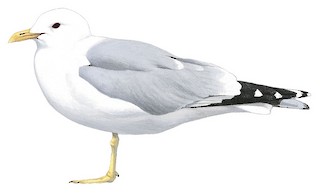
The Mew Gull, also known as Common Gull in Europe, is a medium-sized gull characterized by its relatively small, delicate bill, rounded head, and gentle expression. It is a widespread species found across the Northern Hemisphere, typically inhabiting coastal areas, estuaries, and inland waters, particularly during migration and winter.
Size & lifespan
- Length
- 40-46 cm (16-18 in)
- Wingspan
- 110-125 cm (43-49 in)
- Weight
- 290-550 g (10-19 oz)
- Lifespan
- Up to 20 years in the wild, typically 10-15 years.
- Diet
- Omnivore, primarily opportunistic feeders consuming fish, marine invertebrates, insects, worms, small rodents, berries, carrion, and refuse.
Physical characteristics
- Plumage
- Adult breeding plumage features a white head, body, and tail, with a pale grey mantle and upperwings. The wingtips are black with prominent white 'mirrors' (spots). Non-breeding adults have fine streaking on the head and nape. Juveniles and first-winter birds are mottled brown and grey, gradually acquiring adult plumage over two to three years.
- Beak shape
- Relatively small, slender, and delicate bill, typically yellowish-green in adults, often with a dusky or blackish subterminal band in non-breeding plumage. Juveniles have a pinkish bill with a dark tip.
- Eye color
- Dark brown, giving a 'gentle' expression.
- Leg color
- Yellowish-green in adults, pinkish-grey in juveniles.
- Distinguishing features
- Small, delicate bill, rounded head, dark eye, and yellowish-green legs are key adult features. The extent of black on the wingtips with distinct white mirrors is also diagnostic. In flight, the relatively narrow wings and buoyant flight are noticeable.
- Juvenile appearance
- First-winter birds are heavily mottled brown and grey on the head, neck, and upperparts, with a dark bar on the inner primaries and a dark tail band. The bill is pinkish with a dark tip, and legs are pinkish-grey. They gradually lighten and acquire more grey in their second winter.
- Seasonal changes
- Breeding adults have a pure white head and neck. Non-breeding adults develop fine, dusky streaking on the head and nape, particularly around the eye and hindneck. The bill may also show a dusky subterminal band.
- Sexual dimorphism
- Males and females are generally similar in plumage and size, though males may be slightly larger.
How to identify
- 1
Size and Build
Medium-sized gull, smaller and more delicate than Herring Gulls, but larger than Bonaparte's Gulls. Appears elegant with a rounded head and slender body.
- 2
Bill
Adults have a relatively small, slender, yellowish-green bill, often with a dusky subterminal band in non-breeding plumage. This is a key differentiator from the Ring-billed Gull's thicker, ringed bill.
- 3
Legs
Adults have yellowish-green legs, contrasting with the pink legs of Herring Gulls and the brighter yellow legs of Ring-billed Gulls.
- 4
Eye
Dark eye, giving a 'gentle' or 'kind' expression, unlike the often fierce-looking yellow eyes of larger gulls.
- 5
Wingtips (Adult)
Black wingtips with prominent white 'mirrors' (spots) on the outer primaries. The black is less extensive than on Ring-billed Gulls.
- 6
Plumage (Non-breeding Adult)
Fine dusky streaking on the head and nape, especially around the eye, which distinguishes it from the pure white head of breeding adults.
- 7
Juvenile Plumage
Mottled brown and grey overall, with a dark tail band and a pinkish bill with a dark tip. Look for the relatively small size and delicate structure even in juvenile plumage.
- 8
Call
Listen for the characteristic 'mewing' call, a plaintive 'kyew' or 'kyaaa', which is softer than the calls of larger gulls.
Habitat & range
- Biomes
- Coastal areas, estuaries, large rivers, lakes, agricultural fields, urban parks, and refuse dumps.
- Geographic range
- Holarctic. Breeds across northern Europe, Asia, and northwestern North America (Alaska and western Canada). Winters south to the Mediterranean, Black Sea, Caspian Sea, East Asia, and the Pacific coast of North America.
- Elevation range
- Primarily lowlands, from sea level up to several hundred meters, especially near water bodies.
- Preferred environments
- Coastal beaches, rocky shores, mudflats, estuaries, agricultural land, freshwater lakes, and rivers. Often found in urban and suburban areas, especially during winter, foraging in parks, playing fields, and parking lots.
Behavior
- Activity time
- Diurnal, active during daylight hours.
- Feeding habits
- Highly opportunistic. Forages by walking, wading, swimming, and occasionally diving. Eats fish, crustaceans, mollusks, insects (especially earthworms after rain), small mammals, berries, eggs and chicks of other birds, and human refuse. Often follows plows in agricultural fields to catch invertebrates.
- Social behavior
- Highly social, especially outside the breeding season. Forms large flocks for foraging, roosting, and migration. Breeds in colonies, sometimes mixed with other gull species.
- Flight pattern
- Graceful and buoyant flight with relatively shallow wing beats. Often glides on updrafts. Can be seen soaring high or hovering over water when foraging.
- Migration pattern
- Migratory across most of its range. Northern populations move south for the winter, often to coastal areas or large inland water bodies. Some populations in milder coastal regions may be resident or undertake shorter movements.
- Territoriality
- Territorial during the breeding season, defending a small area around the nest within the colony. Less territorial outside the breeding season.
Song & calls
- Song
- Does not have a complex song. Vocalizations are primarily calls.
- Call
- A characteristic 'mewing' call, often described as a plaintive 'kyew' or 'kyaaa'. Also gives a higher-pitched 'kee-a' or 'klee-oo' call, and a rapid 'gag-ag-ag' alarm call. Calls are generally softer and less raucous than larger gulls.
- When they vocalize
- Vocalizes year-round, but particularly vocal during the breeding season and when interacting in flocks.
Breeding & reproduction
- Breeding season
- Typically May to July.
- Nesting habits
- Nests colonially on the ground, often on small islands, coastal cliffs, dunes, or marshy areas. Nests are scrapes lined with grass, seaweed, moss, and feathers.
- Clutch size
- 2-4 eggs, most commonly 3.
- Egg description
- Usually 2-4 eggs, olive-brown to greenish-blue, heavily spotted and blotched with dark brown or black.
- Incubation period
- 23-28 days, incubated by both parents.
- Fledging period
- 30-35 days after hatching. Young are semi-precocial, leaving the nest shortly after hatching but remaining dependent on parents.
- Parental care
- Both parents participate in incubation, brooding, and feeding the chicks until they fledge and for a period thereafter.
Where to find
Coastal Areas
Beaches, estuaries, mudflats, and harbors, especially during migration and winter.
Inland Waters
Large lakes, rivers, and reservoirs, particularly in winter and during migration.
Agricultural Fields
Often seen following plows or foraging in recently tilled fields for invertebrates.
Urban/Suburban Areas
Parks, playing fields, parking lots, and refuse dumps, especially in winter.
Field tips
- Observe Bill and Leg Color. These are crucial for distinguishing Mew Gulls from similar species like Ring-billed Gulls. Look for the slender, yellowish-green bill and yellowish-green legs.
- Note Head Shape and Eye. The rounded head and dark eye give it a 'gentle' expression, a good field mark.
- Check Wingtip Pattern. In adults, the black wingtips with distinct white mirrors are diagnostic. Compare the extent of black to other gulls.
- Listen for Calls. The 'mewing' call is distinctive and can help confirm identification, especially when visual cues are challenging.
- Consider Geographic Location. While widespread, their distribution can help narrow down possibilities, especially in North America where they are primarily a Pacific coast species (known as Short-billed Gull) or a winter visitor inland.
- Observe Behavior. Their more delicate foraging style and less aggressive demeanor compared to larger gulls can be an indicator.
Similar species
Ring-billed Gull
Larus delawarensis
The Ring-billed Gull is slightly larger and stouter than the Mew Gull. Adults have a thicker, brighter yellow bill with a distinct black ring, and paler yellow legs. Its wingtips have more extensive black, and the white mirrors are less prominent or absent. The head shape is often flatter on top.
Herring Gull
Larus argentatus
Herring Gulls are significantly larger and more robust than Mew Gulls. Adults have a heavier yellow bill with a red spot on the lower mandible, and pink legs. Their wingtips have more extensive black, and the grey mantle is often darker. Juveniles are much browner and take longer to acquire adult plumage.
Glaucous-winged Gull
Larus glaucescens
Found on the Pacific coast, the Glaucous-winged Gull is much larger and has a pale grey mantle that extends to the wingtips, lacking any black. Its bill is heavier and yellow with a red spot, and legs are pink. Juveniles are uniformly pale brown/grey.
Quick facts
- Common Name:
- Mew Gull (Common Gull in Europe)
- Scientific Name:
- Larus canus
- Family:
- Laridae
- Size:
- Medium (40-46 cm)
- Bill Color (Adult):
- Yellowish-green, often with dusky band
- Leg Color (Adult):
- Yellowish-green
- Eye Color:
- Dark
- Key Feature:
- Small, delicate bill; dark eye; yellowish-green legs; black wingtips with white mirrors
- Diet:
- Omnivore
- Conservation Status:
- Least Concern
Fun facts
- The name 'Mew Gull' comes from its distinctive 'mewing' call, which sounds similar to a cat's meow.
- In North America, the subspecies 'brachyrhynchus' is often treated as a separate species, the Short-billed Gull (Larus brachyrhynchus), due to genetic and morphological differences, though this split is not universally accepted by all taxonomic authorities.
- Mew Gulls are known to follow fishing boats and agricultural machinery, taking advantage of disturbed prey.
- Despite being a 'gull', their relatively gentle nature and smaller size often lead them to be overlooked or misidentified among larger, more boisterous gull species.
Scientific classification
- Kingdom
- Animalia
- Phylum
- Chordata
- Class
- Aves
- Order
- Charadriiformes
- Family
- Laridae
- Genus
- Larus
- Species
- Larus canus
Explore the Mew Gull
Identify birds anywhere
Free on iOS, Android, and Web. Photo & sound identification, full species database, and your personal life list.