
Where does the Mew Gull live?
Larus canus
Spotted a bird? Identify it instantly with the Birdby app
Open the appThe Mew Gull lives in specific habitats and regions. Knowing where, and when, to look improves your chances of a successful sighting.
Biomes
Coastal areas, estuaries, large rivers, lakes, agricultural fields, urban parks, and refuse dumps.
Geographic range
Holarctic. Breeds across northern Europe, Asia, and northwestern North America (Alaska and western Canada). Winters south to the Mediterranean, Black Sea, Caspian Sea, East Asia, and the Pacific coast of North America.
Preferred environments
Coastal beaches, rocky shores, mudflats, estuaries, agricultural land, freshwater lakes, and rivers. Often found in urban and suburban areas, especially during winter, foraging in parks, playing fields, and parking lots.
Elevation range
Primarily lowlands, from sea level up to several hundred meters, especially near water bodies.
Where to look
Coastal Areas
Beaches, estuaries, mudflats, and harbors, especially during migration and winter.
Inland Waters
Large lakes, rivers, and reservoirs, particularly in winter and during migration.
Agricultural Fields
Often seen following plows or foraging in recently tilled fields for invertebrates.
Urban/Suburban Areas
Parks, playing fields, parking lots, and refuse dumps, especially in winter.
Field tips
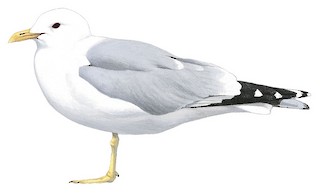
- Observe Bill and Leg Color. These are crucial for distinguishing Mew Gulls from similar species like Ring-billed Gulls. Look for the slender, yellowish-green bill and yellowish-green legs.
- Note Head Shape and Eye. The rounded head and dark eye give it a 'gentle' expression, a good field mark.
- Check Wingtip Pattern. In adults, the black wingtips with distinct white mirrors are diagnostic. Compare the extent of black to other gulls.
- Listen for Calls. The 'mewing' call is distinctive and can help confirm identification, especially when visual cues are challenging.
- Consider Geographic Location. While widespread, their distribution can help narrow down possibilities, especially in North America where they are primarily a Pacific coast species (known as Short-billed Gull) or a winter visitor inland.
- Observe Behavior. Their more delicate foraging style and less aggressive demeanor compared to larger gulls can be an indicator.
Migration
Migratory across most of its range. Northern populations move south for the winter, often to coastal areas or large inland water bodies. Some populations in milder coastal regions may be resident or undertake shorter movements.
Explore the Mew Gull
Identify birds anywhere
Free on iOS, Android, and Web. Photo & sound identification, full species database, and your personal life list.